



History and Culture
History of mathematics and cultural connections
Worth reading: Belhoste's biography of Cauchy | Tangente
Writing a biography of a man like Cauchy is a tour de force.
Secrets from mathematical archives | Tangente
For its YouTube channel, the Académie des sciences produced a series entitled "Treasures from the archives." Each episode, lasting around five minutes, features a member of the Academy presenting a document from its archives.

Markov recommends Avenue Henri-Martin
The well-known board game Monopoly is a fine example of a stochastic process—a situation whose evolution is governed by the laws of probability. So, to find out whether you should buy Gare Saint-Lazare or Rue de Vaugirard, follow the guide…
A (good) Babylonian approximation
The Babylonians have always been renowned as brilliant mathematicians, and the clay tablets that have survived sometimes bear dazzling witness to their skill.
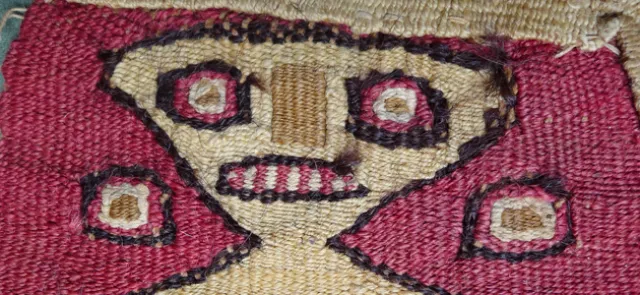
Geometry of Andean textiles | Tangente
In the Andes, weavers from periods sometimes lost in the distant past produced an immense variety of patterns that nevertheless bear a clear family resemblance. Mathematics can help us understand part of the visual language these textiles share.

Combinatorics on words and music | Tangente
Combinatorics on words is an area of mathematics that has proved particularly fruitful for studying certain musical phenomena, especially the rhythmic features of African and Malagasy music—so much so that a computer can even recreate them!
Marcia Ascher, pioneer | Tangente
Behind a wealth of research in ethnomathematics, mathematician Maria Ascher is regarded as one of the founders of this new discipline
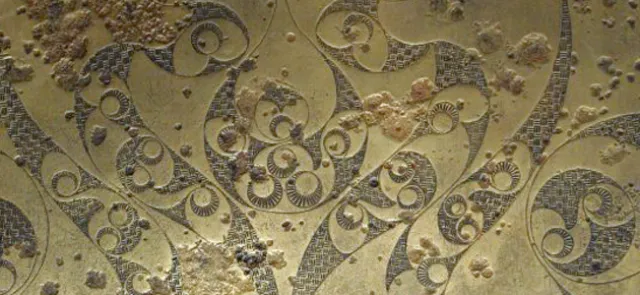
Geometry in Celtic art | Tangente
Celtic art is constructed according to mathematical and geometric principles. Ethnomathematics helps us identify and analyze the geometry that underpins this symbolic art.
Laurent Schwartz, politically engaged mathematician | Tangente
The publication of the graphic novel Laurent Schwartz, les engagements d'un médaillé Fields offers an opportunity to revisit the life and struggles of this surprising mathematician.

Fermat Museum: Heritage and mathematics | Tangente
In July 2024, the Fermat Museum opened in Pierre de Fermat's birthplace in Beaumont-de-Lomagne, Tarn-et-Garonne.

The new Fourier has arrived! | Tangente
The mathematician Joseph Fourier is buried in Père-Lachaise Cemetery (Division 18, near the Casimir-Perrier roundabout) in Paris. His tomb, decorated with Egyptian motifs, was restored in 2023 by the City of Paris at the request of the Society of Friends of Joseph Fourier.

Beyond Gauss in finance | Tangente
Gaussian curves are unsuitable for modelling risky financial assets such as stocks. To overcome this problem, Benoît Mandelbrot introduced the concept of a multifractal measure and generalized Brownian motion.
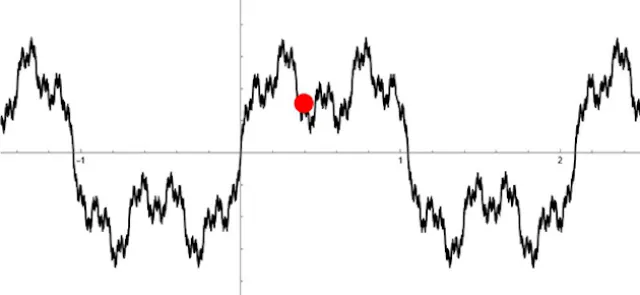
Fractal dimension
The construction of fractal objects called for new definitions of distance.
The man of fractures
For millennia, straight lines, circles, parabolas, and other smooth surfaces had reigned supreme and unchallenged over geometry. Then Mandelbrot unleashed the "mathematical monsters" of the early 20th century, transforming our picture of the world forever.
The Mandelbrot–Zipf–Estoup law
The polymath Benoît Mandelbrot took an interest in many subjects before becoming famous for his research on fractals.

Mandelbrot, a free spirit | Tangente
In the centenary year of his birth, we look back at the life of Benoît Mandelbrot, the "father of fractals": those strange geometric entities with which he adorned mathematics and which he managed to uncover even in nature.

Penney's paradox explained | Tangente
Does tossing a coin strike you as simplistic and dull? Be careful, though: it has some baffling surprises in store!
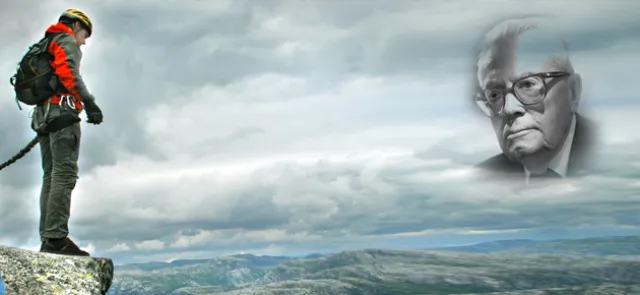
Allais and the limits of utilitarianism | Tangente
The paradox formulated by the French economist Maurice Allais exposes a contradiction in an earlier theory of decision-making. But the paradox is only apparent and, above all, illustrates a major limitation of rational choice theory.

The two-envelope paradox | Tangente
A paradox can sometimes resemble an urban legend. First, its precise origins may be difficult to pin down; second, over time it may become distorted, change form, and proliferate. Such is the case with the two-envelope paradox.
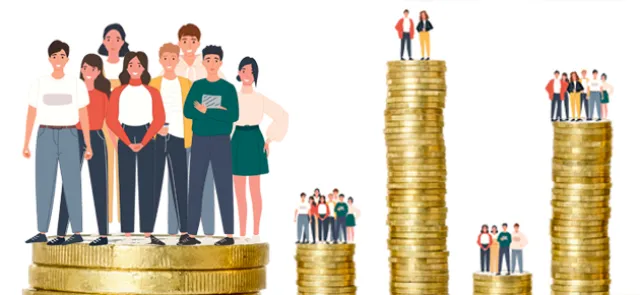
Simpson's paradox and appearances | Tangente
Could something that is true in every subgroup of a population become false when the population is considered as a whole? How is that possible? This is exactly what Simpson's paradox—the best-known paradox in statistics—shows.