



History and Culture
History of mathematics and cultural connections

They found it
Here are a few amateur mathematicians whose names are associated with recent results.

Recognized amateurs
What is an amateur mathematician? Defining one is no easy task, especially since the concept has undoubtedly evolved over time. Nevertheless, we will look at a few examples, both past and present.

Clairaut's pedagogical Éléments d'algèbre | Tangente
Clairaut's Élemens d'algèbre (Elements of Algebra) was long a standard reference for teaching algebra.

Clairaut.com: a complete online biography | Tangente
As its name suggests, clairaut.com is devoted entirely to Alexis Clairaut. It provides a comprehensive inventory of his works, with links to them, along with his correspondence, academic reports, and the principal tributes and portraits devoted to him by his contemporaries.

Clairaut: a mathematical child prodigy | Tangente
The engraving by Delafosse below was made from a portrait drawn by L. C. de Carmontelle in 1763.
The geometry of curves
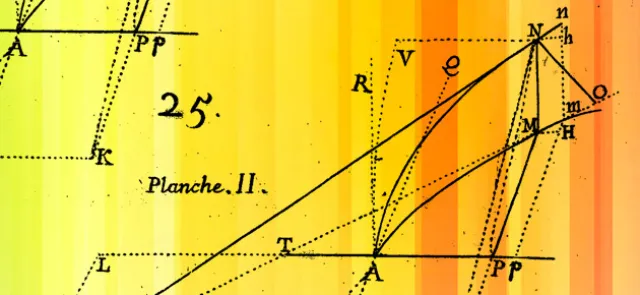
Alexis Claude Clairaut first came to the attention of learned circles through his book on curves of double curvature, presented to the Académie in 1729. He was only 16 at the time. The book was published in 1731, earning him election to the Académie des sciences at the age of 18.
In Clairaut’s footsteps
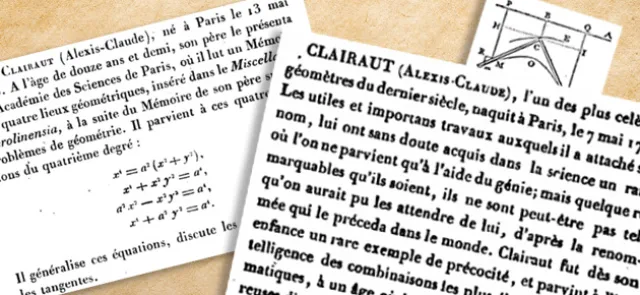
Alexis Clairaut is probably little known today. Yet his writings inspired many scientists. A compilation of 19th-century publications reveals a fame that has since faded.
Alexis Clairaut: A forgotten light of mathematics | Tangente
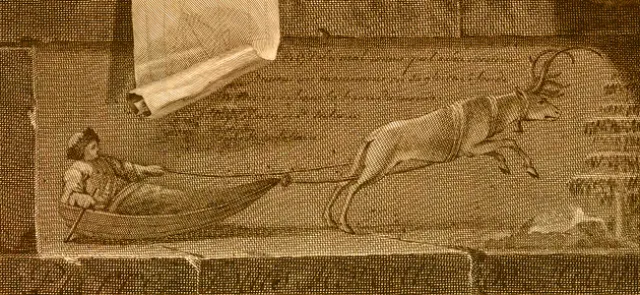
Alongside Leonhard Euler and Jean Le Rond d’Alembert, Alexis Clairaut was one of the greatest mathematicians of the Enlightenment. Though little known today, he played a fundamental role in validating Newton's theory of universal gravitation.

Sylvie Méléard wins the Irène-Joliot-Curie Prize | Tangente
A specialist in probability theory, particularly stochastic processes, Sylvie Méléard has spent the past twenty years applying mathematical models to living systems: changes in population size over time (such as bacterial growth), the proportion of an allele in a population, and genetic evolution (such as antibiotic resistance).

Jacques Roubaud: tribute to a poet-mathematician | Tangente
Following Oulipo's time-honored formula, Jacques Roubaud is now excused from its meetings on account of his death, which occurred this past December 5, his 92nd birthday.

Kepler, or the defeat of the circle
Kepler's first law states that planets follow elliptical orbits around the Sun. How can this be proved with the bare minimum of theory? To answer this question, physicist Richard Feynman produced a little gem of classical geometry applied to celestial mechanics.
A question of circumference
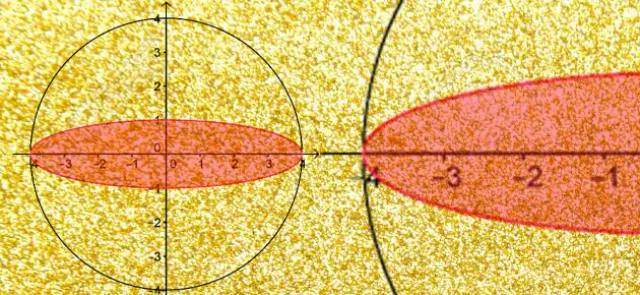
You might expect calculating the perimeter of an ellipse—a fairly ordinary shape—to be straightforward. Yet it is a problem on which mathematicians have displayed extraordinary ingenuity. And in the formula contest, Ramanujan wins!

Condorcet’s Enlightenment fight against slavery | Tangente
In his Réflexions sur l’esclavage des nègres (Reflections on Black Slavery), published in 1781 under the pseudonym Pastor Joachim Schwartz ("black" in German), Condorcet opposed slavery, which he regarded as a fundamental violation of human rights, and denounced the contradictions and injustices bound up with the enslavement of Black people.

Condorcet, champion of women's suffrage | Tangente
A few years before the Revolution began, Condorcet was the first French writer to make the case for women's voting rights in his Lettres d’un bourgeois de New-Haven (1787).

Condorcet's paradox explained | Tangente
From Lewis Carroll to Kenneth Arrow, the famous Condorcet paradox has generated a great deal of discussion.
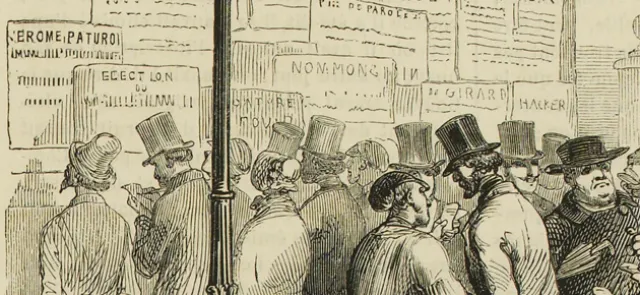
Condorcet, theorist of electoral procedures | Tangente
Condorcet is recognized as one of the pioneers in the theory of electoral systems, alongside his contemporary, the Chevalier de Borda. Both thinkers brought a fundamental idea to light: the method used to elect a candidate has a decisive influence on the outcome.

From political arithmetic to social mathematics | Tangente
Condorcet is not the first to seek to apply mathematics to public life. Yet he sets himself radically apart from his predecessors—and lays claim to that distinction—by coining the phrase "social mathematics."
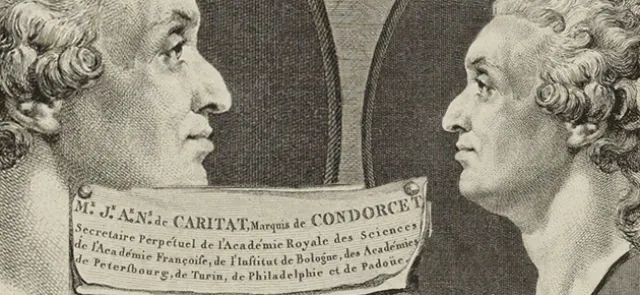
Condorcet judged by his peers | Tangente
Condorcet always took an interest in analysis, but accounts and assessments of his mathematical work varied widely. Although he bounced back after the Académie’s unfavorable judgment of his first paper, the 19th century proved much harsher.

Condorcet’s project for a numeral system | Tangente
During the French Revolution, the National Constituent Assembly decided to standardize weights and measures and entrusted several scientists, including Condorcet, with determining the length of what would become the metre. In the same spirit of rationalization and simplification, Condorcet turned his attention to the education of young children.

Condorcet: mathematics for citizenship | Tangente
Condorcet embraced the ideals of the French Revolution and played an active part in the educational reforms set in motion by the Revolution.