



History and Culture
History of mathematics and cultural connections
Before black holes: Laplace's hidden stars | Tangente
In astronomy, a "black hole" is neither a hole nor black. The existence of these celestial objects was predicted by Einstein's theory of general relativity in the early twentieth century. It was demonstrated several decades later through the detection of gravitational waves produced by the coalescence of objects that came to be called black holes. What exactly are they?

Laplace is in the house: stations, high schools and memory | Tangente
The scientist's legacy lives on today in the various places and institutions… that bear his name!
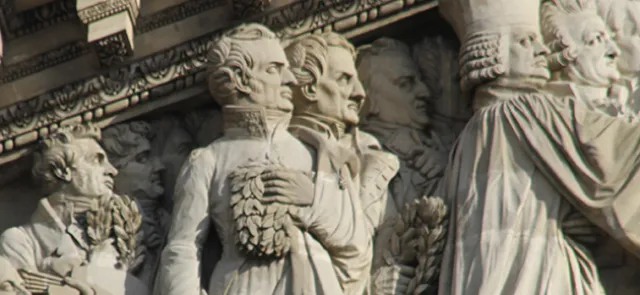
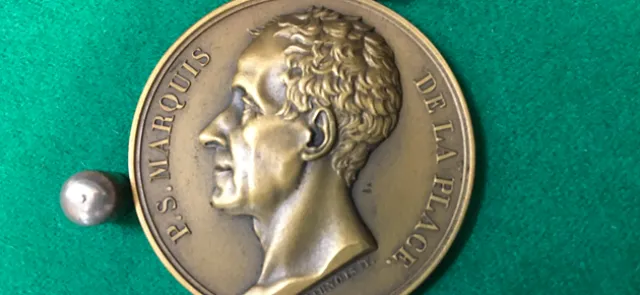
Pierre-Simon Laplace: a giant for the ages | Tangente
Laplace's scientific output is colossal. A tireless researcher, the "French Newton" also devoted himself to making the latest discoveries widely known and to providing scientific training for new generations.
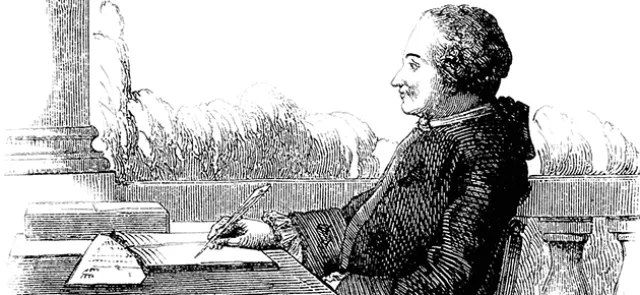
A pedagogical interest in transmitting knowledge
An exceptional scientist, Laplace was also a driving force behind the development of education at the highest level, helping to devise curricula and concerned that mathematics teaching should not be detached from philosophical reflection.

From Laplace's equation to the Laplacian
The Laplacian operator is used to describe most diffusion phenomena in physics. It is central to analysis, geometry and probability theory, among other fields. Its origins lie in an equation discovered by Laplace that governs the gravitational interaction between bodies separated by empty space.
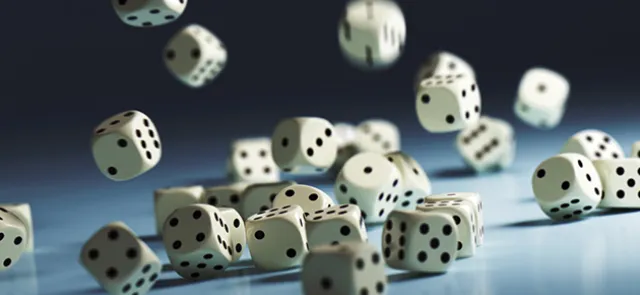
Laplace: philosopher of chance and determinism | Tangente
The chief architect of determinism, Laplace marked a crucial milestone in the transformation of probability theory into a fully fledged branch of mathematics. Is that a paradox, or a coherent intellectual approach? Let's return to his writings to find out!
Census-taking and the normal distribution
To calculate France's population, Laplace proposes a sampling method based on births and introduces the normal distribution to estimate the error. It would take until the 21st century for Insee to draw inspiration from his method.
The beginnings of linear algebra
Linear algebra took off in the mid-19th century, notably through the work of Arthur Cayley (1821–1895) and Hermann Günther Grassmann (1809–1877), and was formalized fifty years later with the emergence of algebraic structures.
Three laws of error
Observations of celestial bodies are invariably subject to error. How can we choose the "most relevant" value from several measurements? Laplace, along with Legendre and Gauss, developed theories that ultimately led to the celebrated normal distribution.
Laplace's many mathematical functions | Tangente
In his scientific work, Laplace introduced and used numerous mathematical functions. Alongside the Laplacian and the Laplace transform, we find generating functions and the potential function.

Laplace on probability and metaphysics | Tangente
When Laplace took up a seat in the Senate, he thought his active involvement in science was effectively over. Yet he went on to state a fundamental law of probability theory, before exploring the philosophical implications of his findings in this emerging new science.
Laplace's brilliant insight into black holes | Tangente
The finite speed of light and its particle nature led Laplace, through a bold line of reasoning, to contemplate the existence of black holes—before changing his mind. Although he could not have conceived of light's dual nature at the time, he was right!

Laplace's role in Napoleon's deposition | Tangente
Laplace the scientist, but also Laplace the politician: on March 31, 1814, Paris surrendered as coalition forces reached its gates. Raised to the highest honors by the emperor, Laplace hesitated over signing Napoleon's deposition. Let's follow his inner struggle.
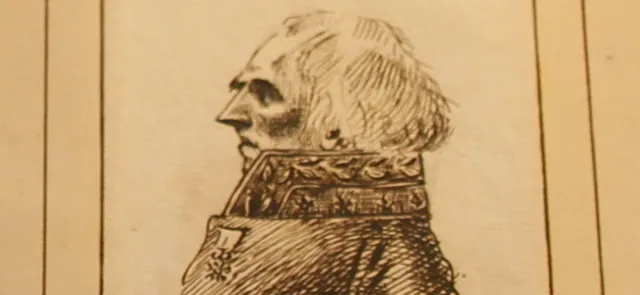
Laplace, unloved by historians: an ambiguous portrait | Tangente
Although Laplace's scientific work is recognized worldwide, his political role remains controversial and is sometimes disparaged. Historians often judge him harshly—when they do not ignore the scientist altogether. Does this reflect a French difficulty in finding a place for science in the shared cultural imagination?
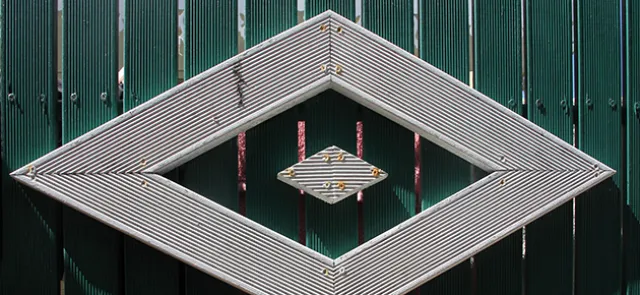
From rhomb to rhombus
For many people, the rhombus—originally called a "rhomb" (see In Brief, "The origin of the rhombus"; the associated adjective is still "rhombic")—is characterized by its acute angles pointing upward and downward. Yet, as Euclid already observed, this quadrilateral is defined by the equal lengths of its sides. Its ability to form tilings accounts for its use in architecture and decoration.
On the road – Mathematical brief | Tangente
Both unusual—since it does not usually rest on its "base"—and harmonious, as it is a quadrilateral with four equal sides, the rhombus appeals to graphic artists, advertisers and other designers: it appears in puzzles, games, road signs, logos…
Rhombi filling space – Article | Tangente
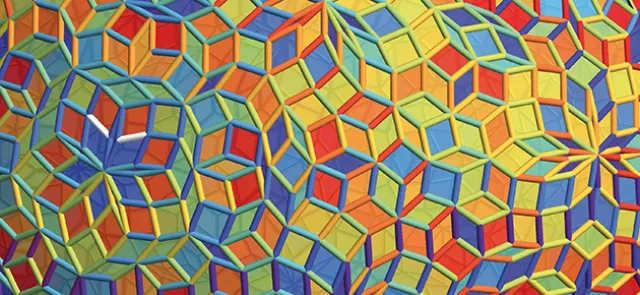
Are there polyhedra whose faces are all rhombi? Various mathematicians have studied this problem in solid geometry since the 17th century, each contributing to what is now a complete classification of the convex polyhedra.

La Maison des mathématiques de l’Ouest - Article | Tangente
Activities that bring artists and mathematicians together to share mathematics with the public are flourishing across Pays de la Loire and Brittany. A Maison des mathématiques de l’Ouest was established to bring them together.
Reading ancient and medieval mathematicians | Tangente
In 2018, the British publisher Routledge launched a series entitled "Scientific Writings from the Ancient and Medieval World" with a Babylonian astronomical handbook.
The hidden riches of the multiplication table
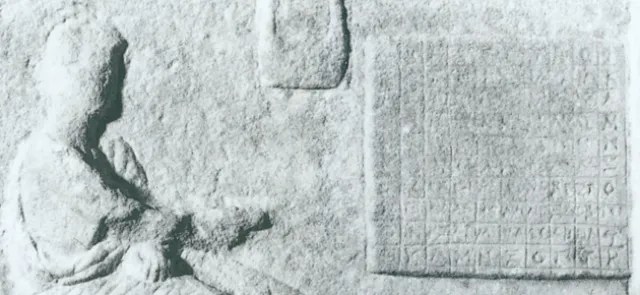
Think you know your multiplication tables? Think again! A surprising property emerges when a regular polygon is drawn on the multiplication table: the mean of the values at its vertices is the value at the polygon's center!