



History and Culture
History of mathematics and cultural connections

D'Arcy Thompson and the geometry of nature
Can the forms we see in nature be explained mathematically? Physics has had its principle of least action since Maupertuis in the 18th century, but biology had to wait until the early 20th century for anyone to attempt a synthesis.

Matrimonial mathematics
Sets of points can give rise to some delightful optimization problems.

Word histories: maximum, minimum and Latin | Tangente
"Optimum," "maximum," "minimum," "extremum": Latin vocabulary has certainly been plundered for terms denoting the extreme values of a function.

Brachistochrone:
Is the shortest path always the fastest? Mathematicians have known since the 17th century that it is not. Skateboarders, too, have learned this through experience, ever since the profiles of their half-pipes began to follow the shape of a "brachistochrone" curve.

The art of avoiding crossings
Artists using mathematics: nothing new there. But artists posing optimization problems that mathematicians still cannot solve: now that is surprising! One seemingly innocuous conjecture about drawing graphs has resisted all attempts at proof for fifty years.

Kurt Hensel, father of p-adic numbers | Tangente
Kurt Hensel is best known for his work on p-adic numbers.

Patrick Dehornoy: a tribute to the mathematician | Tangente
The specialist in ordered braids also made numerous videos popularizing mathematics.

Christian Mauduit, number theorist, has died | Tangente
The number theorist was an expert on representing integers in different bases.

Jean-Claude Gardin: a free-thinking archaeologist | Tangente
Few works offer as critical an overview of the state of a discipline as Archéologie théorique, written by Jean-Claude Gardin and published by Hachette in 1979.

Jean-Paul Benzécri, father of correspondence analysis | Tangente
Jean-Paul Benzécri (born in 1932) began as a mathematician before turning to multivariate statistics.
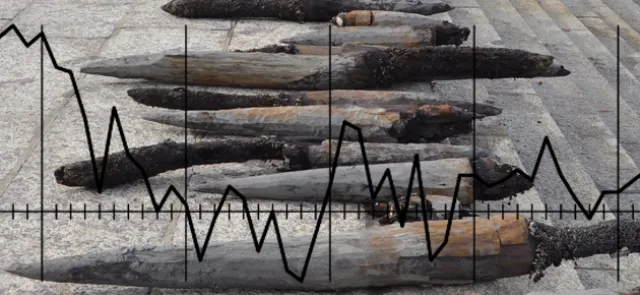
Dendrochronology: dating by tree rings | Tangente
How was a harbour built in Roman times? When was this violin made? When was a mine's infrastructure built? Dendrochronologists seek to answer all these questions by precisely dating objects, structures or remains containing wood.
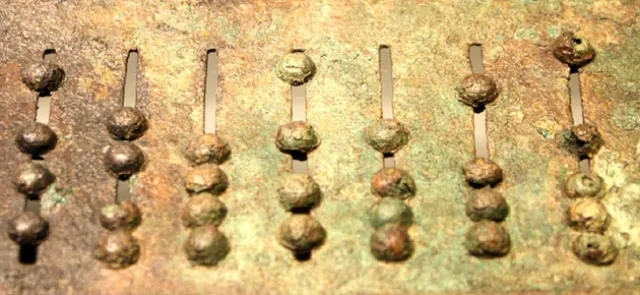
Beneath the paving stones… mathematics – Ancient mathematical instruments | Tangente
Counting, measuring and building: these were the mathematical aims of the Ancients. To achieve them, they created instruments that archaeologists have since unearthed.
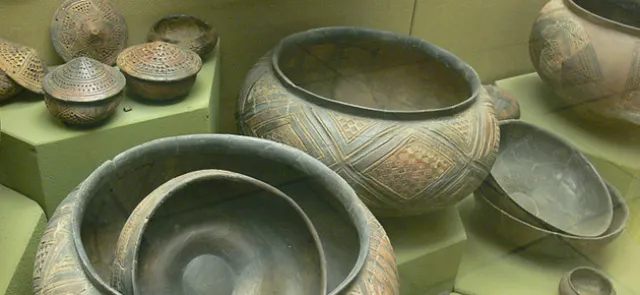
Archaeological chronology: statistical methods | Tangente
To establish a chronology, archaeologists draw on a variety of statistical models, including correspondence analysis. Monte Carlo numerical methods are also brought into play. Mathematics is becoming indispensable to archaeology!
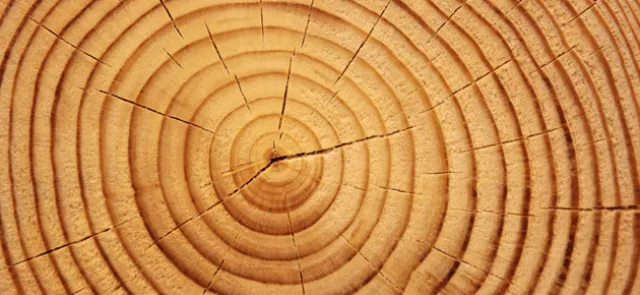
Bayesian statistics applied to dating
When we think of the tools archaeologists use to date objects or events, radiocarbon dating and dendrochronology immediately spring to mind. Mathematical techniques based on probability are also used.

Settlement waves: A mathematical model | Tangente
Mathematical models developed by mathematician Albert Ammerman and geneticist Luca Cavalli-Sforza, combining human genetics and archaeology, have challenged prevailing accounts of population expansion and the myth of large-scale invasions.
Alexandre Grothendieck: mathematician of extremes | Tangente
Barely opened to the public, Alexandre Grothendieck's archives offer a glimpse into the career and extraordinary discoveries of one of mathematics' last great geniuses. An enormous task awaits specialists in algebraic geometry and historians of mathematics!

Tangente Best Article Award | Tangente
Why not showcase your talent for bringing mathematical culture to a wider audience? That is exactly what the Tangente Best Article Award is for. Read this page and you will have everything you need to submit, by September 30, a miniature masterpiece that might even be published in Tangente.

Tangente Prize 2019: vote (and get others voting)!
As they do every year, our readers are invited to read books about mathematics published for a general readership over the past eighteen months and vote for their favorite. The five books receiving the most votes will become the "nominees," from which the jury will select the 2019 winner of the Tangente Book Prize.

Two theorems for the price of one
The idea of pairing two mathematical objects according to a set of rules allows us to extend certain results without reinventing everything: that is the whole point of duality. Or, mathematically speaking, how to kill two birds with one stone.

A math problem taken to court
Should the solution to a mathematical puzzle have to be approved by a judge? If the case reported here is anything to go by, the answer is not so simple.