



History and Culture
History of mathematics and cultural connections
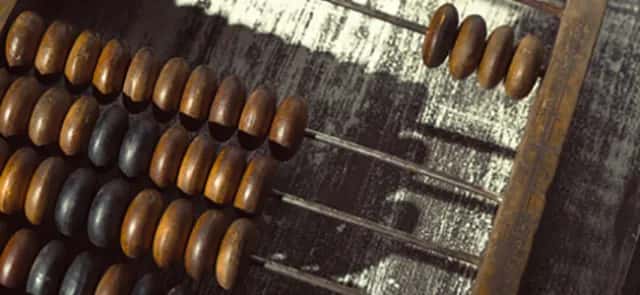
Objects that embody knowledge
A mathematical object is a concept arising from... mathematics. The objects featured in this saga are physical ones, of interest not only mathematically but also historically, educationally and aesthetically. They illustrate concepts and make them easier to understand.
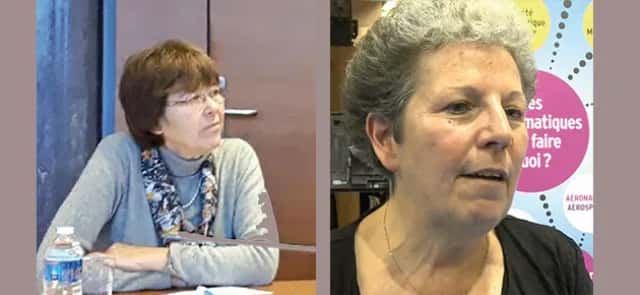
Taking action against gender stereotypes
We met Véronique Slovacek-Chauveau and Annick Boisseau, the vice-president and secretary, respectively, of Femmes et mathématiques, who kindly agreed to answer our questions.
Gender balance in mathematics: an urgent priority
Although progress has been made in recent years, women remain underrepresented among those who use mathematics, from high school through to highly skilled scientific jobs. What lies behind this imbalance?
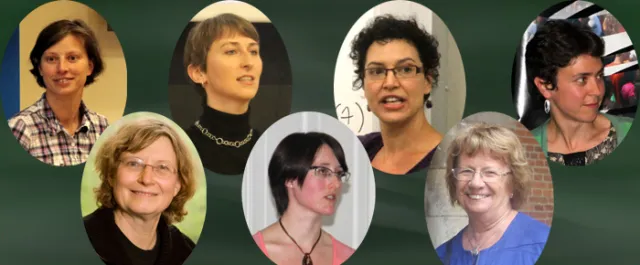
The women shattering the glass ceiling
Women are underrepresented in scientific careers and leadership positions. Yet some are at the helm of organizations across the mathematical world. We shine a spotlight on the women leading associations, learned societies, businesses and more.
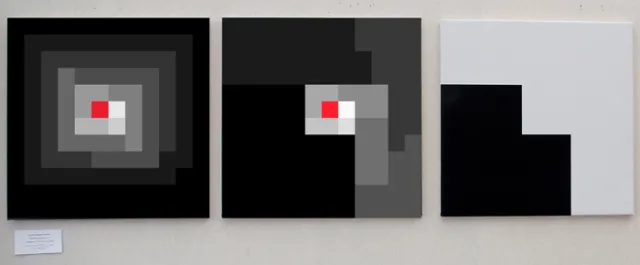
Fibonacci in concrete art: mathematics and aesthetics
The famous Fibonacci sequence begins 1, 1, 2… and each term is the sum of the previous two. It abounds in surprising properties. Has it finally yielded all its secrets? That remains a mystery, as some artists are now working with it and exploring it from every angle.
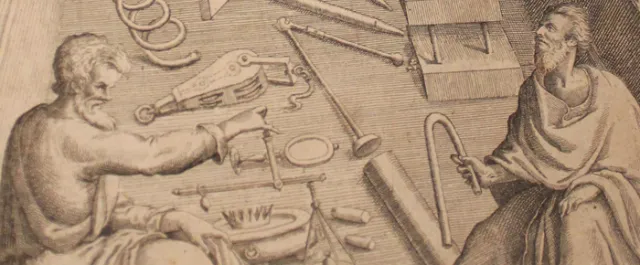
Heron in space
Heron's formula extends to quadrilaterals and tetrahedra, as well as to all polyhedra, yielding many applications that remain relevant today.
Cédric Villani at his best: lectures
Despite an extremely busy schedule, our most mathematically minded MP still pursues a few mathematics outreach activities...
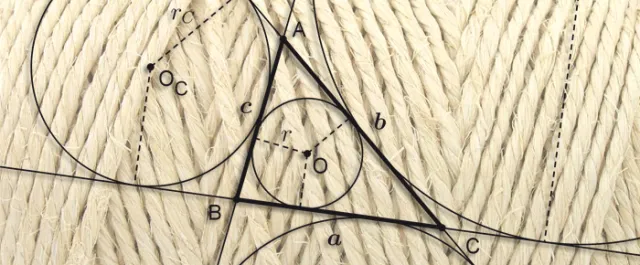
A nest of theorems
Heron's formula is strikingly simple. All the more remarkably, it provides a highly effective way to prove other, equally elegant results. It even leads to more fascinating problems in geometry!
A high-flying formula
Most of us learned how to use a compass to construct a triangle from the lengths of its three sides. Those three numbers are enough to determine a triangle. But how can we find its area from those data alone? That is precisely what Heron's formula does.
Maths as an accessory: briefs and curiosities
The latest trendy creations for mathematical fashion lovers

Buffon and chance in geometry
In a 1733 paper, the Comte de Buffon introduced what is now known as "Buffon's needle problem." This experiment illustrates a field of mathematics that is flourishing today: stochastic geometry, with its many applications ranging from telecommunications to medical imaging.

Rational behavior under risk: probability
Faced with a lottery offering two different prizes, people adopt different strategies. Why do some participants prefer a potential prize that is not the largest? Their choices depend on how each person conceives of probability—whether as a one-off event or one that will be repeated.
Steganography, cryptography's inseparable companion
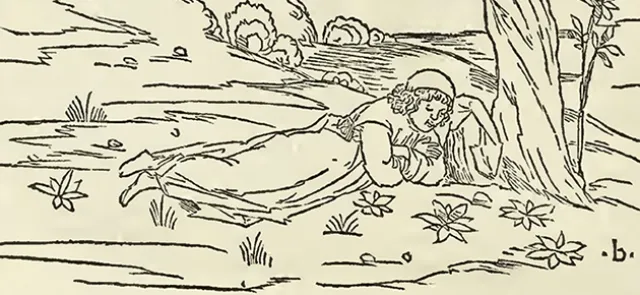
While cryptography seeks to make information unintelligible, steganography aims to conceal the very existence of that information. The idea is to hide it within a drawing, image, text or sound.
Intelligence agencies: the world's largest employers of mathematicians
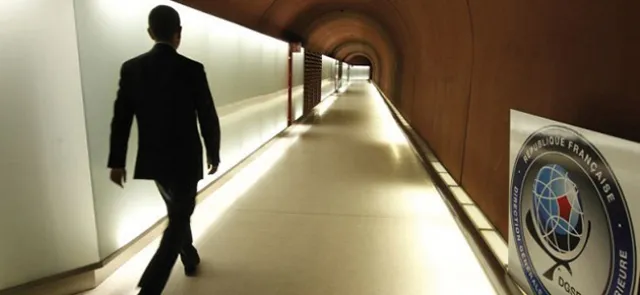
In the popular imagination, intelligence agencies are staffed by muscle-bound spooks, not exactly refined intellectuals—and certainly not computer scientists sitting behind screens or fully trained mathematicians with degrees. In reality, precisely the opposite is true!

Codebreaking in intelligence: history and methods
Throughout history, decrypting coded messages has played a major—though often overlooked—role. From the first battle won through cryptography alone to the breaking of Enigma, examples abound, but they have often been kept hidden. That remains true today.
Linear equations and linear recurrences are one and the same!
One of a mathematician's skills is recognizing the same structures in different guises. A similarity in the calculations used in two ostensibly separate areas is often an early sign of this… Let's look at certain differential equations and sequences.
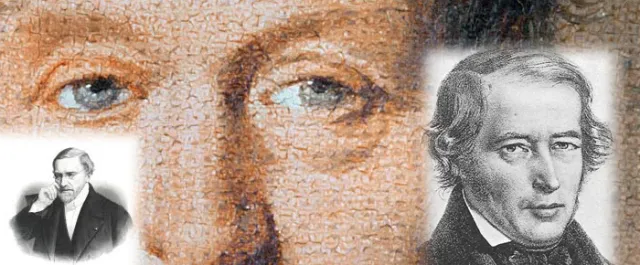
Geometry without figures
Michel Chasles dreamed of it; the theory of vector spaces now makes it possible: we can do geometry without drawing a single figure. Geometric and algebraic viewpoints thus coexist, and everyone can choose whichever feels most comfortable!
“The” dimension: not such an obvious idea!
The notion of dimension can be glimpsed in Euclid, then takes clearer shape with Descartes before branching out according to the subject at hand: analytic geometry, vector spaces or topology. There is a whole host of “dimensions”! Here, the focus is on the dimension of vector spaces, due to Georg Hamel.
Cross product and scalar triple product
Defined on three-dimensional Euclidean space, these two products grew out of Hamilton's quaternions. They have become useful tools in geometry and mechanics.
The slow emergence of Euclidean spaces
The axiomatic definition of the dot product provided a rigorous and fruitful framework for studying metric properties—those involving distance, angle, and orthogonality. This concept did not emerge clearly until the 1920s.