



History and Culture
History of mathematics and cultural connections

On the trail of a forgotten book: 19th-century textbooks | Tangente
The Éléments de trigonométrie rectiligne (Elements of Rectilinear Trigonometry), written by a mysterious F.J., were found in the trash of a religious institution in Damascus in the early 1990s.

From Euclid to Bourbaki: perpetual reform
Mathematics has undergone waves of reform in the past, is undergoing them now, and will continue to do so. This applies to schools of mathematical thought and major research movements, but also to elementary mathematics—the mathematics taught in secondary schools in most countries around the world.

Division algorithms
From the abacus to the counting frame, what a long way we have come to reach our present-day algorithm, so well known to schoolchildren.

Mathematician and pianist: a winning composition | Tangente
The final of the 27th international competition for great amateur pianists, bringing together 92 candidates from 27 different countries, took place on April 10 at the grand amphitheater of Assas in Paris.
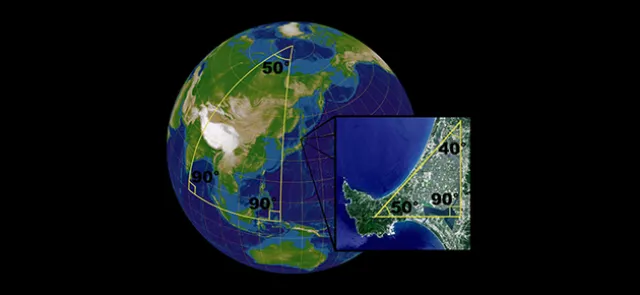
The projective line: a fruitful new perspective
The line is the simplest geometric figure imaginable. The variety of situations encountered in geometry may seem more complicated, and yet… might there be a special perspective from which the plane could be understood as a line? That is precisely what projective geometry is about!
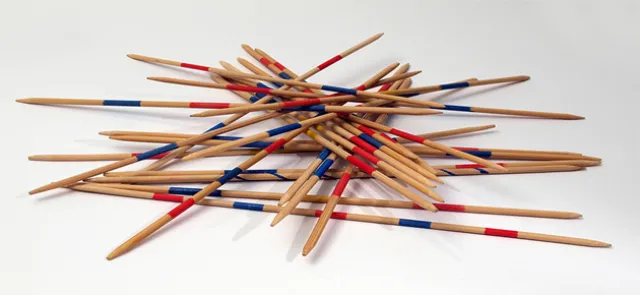
Harmonic pencils of lines
How can we express simply that several lines are concurrent? Despite appearances, pure geometry is not the best tool for the job! Introducing a coordinate system and a few equations may prove more useful.

Lines that have a name (2)
Some lines have a name, and some mathematicians have their own line.
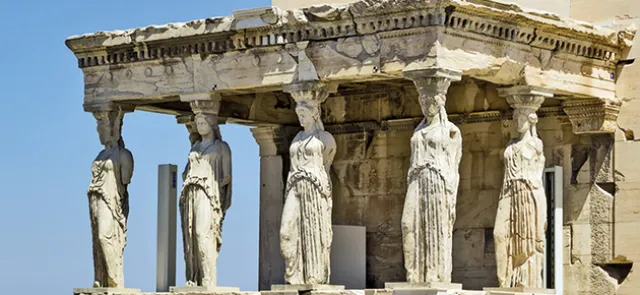
Euclid: an introduction to the straight line
Written more than two thousand years ago, Euclid's Elements is a foundational text of classical geometry. The concept of the straight line is central to it. Let's meet this scholar of ancient Greece and take a closer look at his view of the straight line.

These lines that bear a name (1)
Some lines carry a mathematician's name. They are generally lines associated with the triangle, linked to certain notable points.

Equations of a line
What defines a line, and in what geometric setting? Each possible answer leads to a representation from which the corresponding equations follow.

Descartes and Cartesian coordinates | Tangente
To locate points in a plane, Cartesian coordinates are generally used. Descartes is credited with inventing this method, so much so that it bears his name. Wrongly?

Without straightedge, without compass: Mascheroni | Tangente
Every straightedge-and-compass construction can be carried out with compass alone. This rather extraordinary result comes as a surprise.
The number line: definitions versus intuition
In the 19th century, mathematicians sought rigorous definitions of the quantities that make up the continuum of the line. How did they rigorously characterize the real continuum?
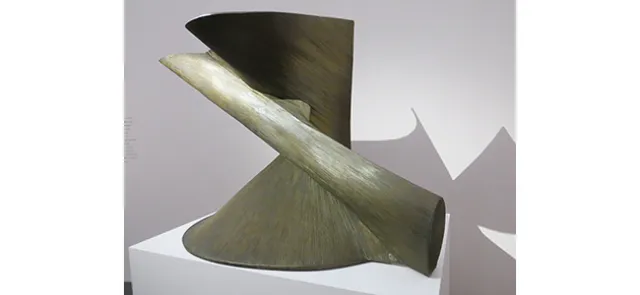
Antoine Pevsner: homage to the straight line
In 1956, the sculptor Antoine Pevsner declared: "The most important feature of my work today […], the principle on which all my sculpture is now built, is the exclusive use of straight lines."

The definition of the straight line through the ages
You thought you knew what a straight line is? Read on, and you may well start to doubt it…

Astrological calculations: how consistent are they?
The notion of houses, which originated with the Babylonians, who mainly observed the movements of the stars in the sky as seen from Earth, is an early form of astrology.
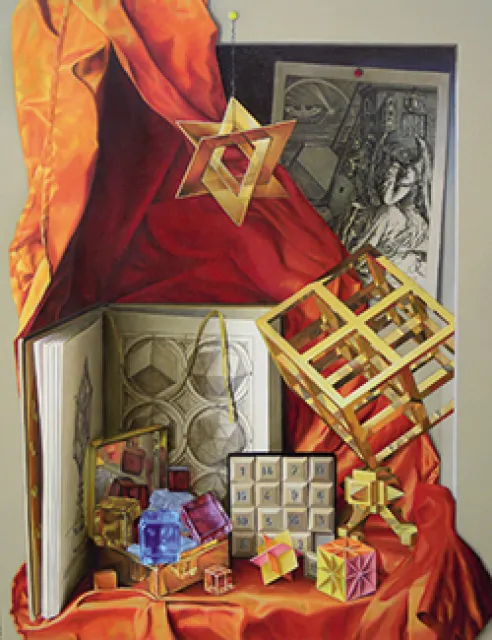
Sylvie Donmoyer, an artist fascinated by mathematics
An artist, not a mathematician, Sylvie Donmoyer is fascinated by geometric forms. In one engraving after another, inspired by Dürer and above all by Escher, she weaves connections between the two worlds of art and mathematics.
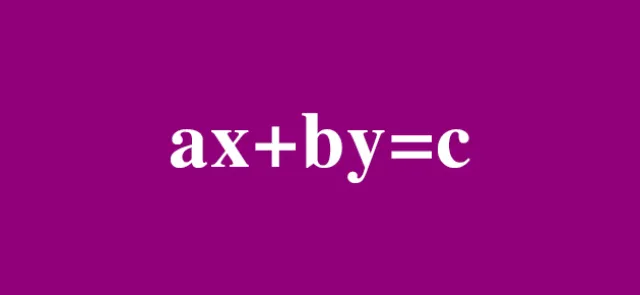
Bachet and Bézout: a winning mathematical duo
From Gauss's lemma to the Chinese remainder theorem, by way of numerous Diophantine equations, no problem seems able to resist the Bachet–Bézout theorem. Games, recreational puzzles, arithmetical tricks… Let's dive into mathematics!

What is a pseudo-science? Astrology | Tangente
Despite terms borrowed from astronomy, the inconsistencies that emerge when the scientific method is applied to astrology strip it of all credibility. It is what is known as a pseudo-science.

The beginnings of astrology
Astrology as we know it today is actually quite recent. It owes more to the Greeks of the Hellenistic and Roman periods than to the remote reaches of antiquity. Let us trace the history of practices often intended to determine the right moment for political decisions.