



Knowledge
In-depth articles on mathematical knowledge and theories
 Podcast
Do you think in words when solving an equation?
Neuroscience reveals that the brain processes mathematics through networks distinct from those of natural language, calling into question our understanding of mathematical cognition.
 Podcast
Ackermann-Péter function: recursion without bounds
With a surprisingly simple definition, the Ackermann–Péter function generates numbers of a staggering size. This mathematical construction, born out of research into computability, shows how quickly a recursive procedure can exceed all the usual bounds.
 Podcast
Mersenne primes: discover perfect numbers
The search for Mersenne primes very quickly leads us to examine gigantic numbers.
 Podcast
Regular polygons with integer-coordinate vertices: one proof for all n
Discrete geometry is a recent field of research concerned with "discrete objects," such as graphs and tilings. But it also offers a fresh perspective on problems that are difficult to solve in a continuous setting, including the existence of regular polygons with integer-coordinate vertices.
 Podcast
Integer points on a line: methods of solution
Many problems in discrete geometry are simply stated and can be used in teaching to make certain concepts easier to understand. Searching for points with integer coordinates on a line naturally leads to applications of theorems from number theory.
 Podcast
Moving on the discrete plane: generating sets and minimality
Exploring how one can move around a grid leads to the concepts of generating sets and minimality. This example shows the power of discrete geometry as a tool for better visualizing and exploring complex ideas from classical geometry or algebra.
 Podcast
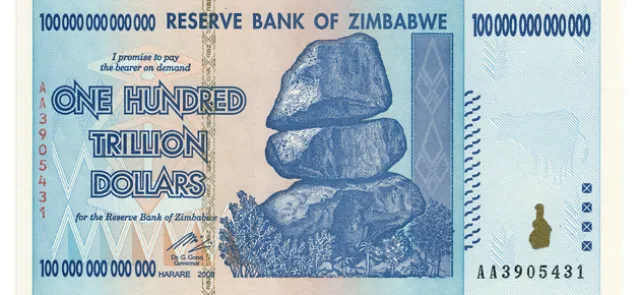
Long and short scales: billion, trillion, milliard—how to name large numbers
From colossal fortunes to the limits of mathematical language, words struggle to keep pace as numbers explode. From long and short scales, through international conventions, to mathematicians' bold inventions, the way we name extremely large quantities tells a story in which language, science and imagination meet.
 Podcast
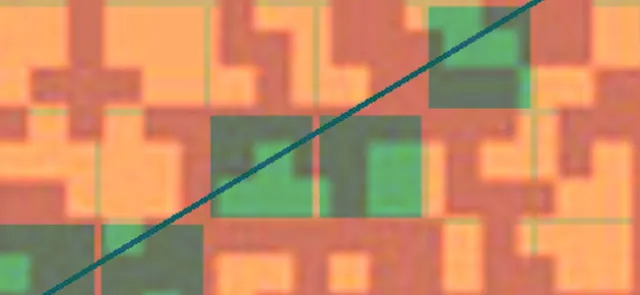
Discrete lines: the birth of a new geometry
Problems involving representation on a pixelated screen belong to discrete geometry. But beyond mere aesthetic considerations, are these new subjects of study—including discrete lines—tools for exploring Euclidean geometry more deeply, or objects of a new geometry?
 Podcast
Euler–Cramer paradox: Are 9 points enough to define a cubic?
The Euler–Cramer paradox: If nine points seem sufficient to determine a cubic curve, how can two distinct cubics also pass through those same nine points?
 Podcast
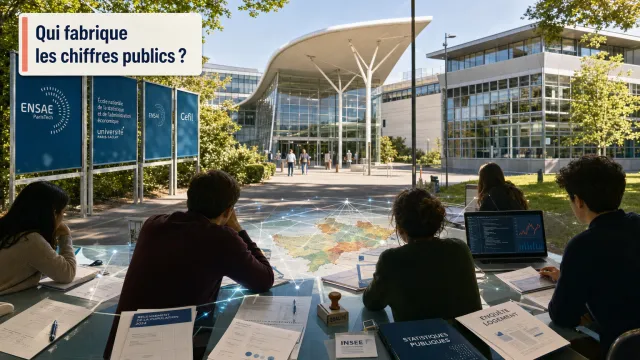
Training Insee staff: ENSAE, ENSAI and Cefil
Insee trains its staff at three schools with admission by competitive examination: ENSAE, ENSAI and Cefil. Their multidisciplinary programs in statistics, economics and computer science prepare students for data careers.
 Podcast
Econometrics: measuring to understand | Insee
Econometrics uses mathematics and statistics to uncover causal relationships in economic phenomena and inform public policy.
 Podcast
How are statistical data collected in France?
Official statistics are governed by strict rules for surveys. Discover the institutions involved, multimode data collection and the biases inherent in each method.
 Podcast
Mathematical properties of 2026 | Tangente
Let's not break with our start-of-year tradition and explore together a few charming quirks of the new vintage!
 Podcast
Multiplicative persistence of numbers | Tangente
Adding or multiplying together the digits of an integer is an activity a curious child might feel like doing. But they probably have no idea that it is the source of problems still unsolved in 2025!
 Podcast
Prime numbers and changing digits | Tangente
Unlike some composite numbers, it is hard to tell whether a number is prime just by looking at it. So what happens to a prime number if we make a change to its digits — for example, by permuting them or removing some of them? Can it stay prime? Or, on the contrary, does it stop being prime?
 Podcast
Palindromic numbers: numerical symmetry | Tangente
These numbers, which can be read equally well from left to right or from right to left, raise questions. At first glance they seem highly unusual, and therefore rare. Yet when an elementary arithmetic process is repeated on any whole number whatsoever, we almost always end up with just such a number. Bizarre, how bizarre!
 Podcast
It doesn't take much to be happy
We know that mathematics can be a source of joy, but have you heard of happy numbers? Simple to define, they hold plenty of surprises and show just how much playing with integers remains an inexhaustible source of research at every level.
 Podcast
The magic wand theorem | Tangente
Maryam Mirzakhani is also known for having obtained, with Alex Eskin and Amir Mohammadi, the magic wand theorem, so named because it made it possible to solve at a stroke many previously inaccessible problems. To explain it, let's first delve into translation surfaces. The illumination problem is one of its many applications.
 Podcast
Mirzakhani's geodesics
Maryam Mirzakhani first became known for the work she carried out for her thesis, in which she counts closed geodesics on hyperbolic surfaces. To explain her results, we will take a short tour through the world of hyperbolic geometry.
 Podcast
Mirzakhani: thinking in pictures | Tangente
Even before her research career began, Maryam Mirzakhani started filling small notebooks with drawings of imaginary surfaces resembling fantastical worlds. Some of these sketches, which she found "simply beautiful," inspired several of her works in topology.