



Knowledge
In-depth articles on mathematical knowledge and theories

Dust in the corners
The beauty of fractal curves fascinates amateurs and seasoned mathematicians alike. The latter, however, know that these objects also give rise to subtle problems in measure theory. Here we illustrate an apparently paradoxical situation and a delicate theorem.
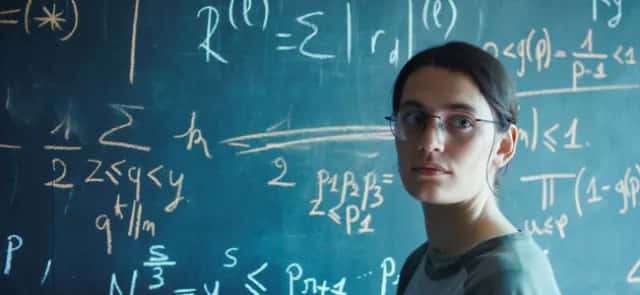
Marguerite's Theorem – Article | Tangente
Anna Novion's film Marguerite's Theorem had already won numerous prizes and awards before it even reached cinemas. Anna Novion, the director, and Ariane Mézard, the mathematician who advised her, agreed to answer Tangente's questions.

This is not a square
A square is a special kind of rhombus. Anyone can easily calculate the area of a square, but what about the area of a rhombus? Similarly, a square has both a circumcircle and an incircle. What happens in the case of a rhombus?
Square matrices and transformations of the plane
The notion of a square root can be extended to very general sets. One may then obtain more than two square roots—even infinitely many! Matrices provide one example. Orientation-preserving similarities, viewed through the lens of complex numbers, lead us back to less startling results.
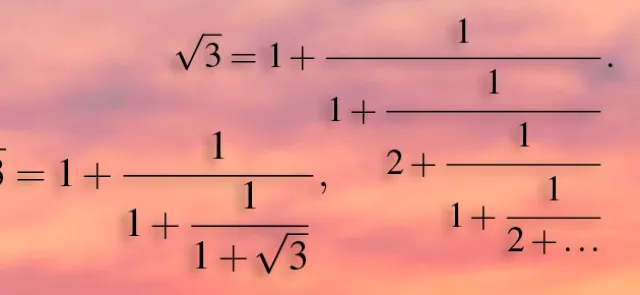
Roots and continued fractions
There are other ways to represent real numbers besides our decimal notation! One of the best known is to write a number as a continued fraction. The resulting representations, even when truncated, very quickly provide "good" approximations of the original number.
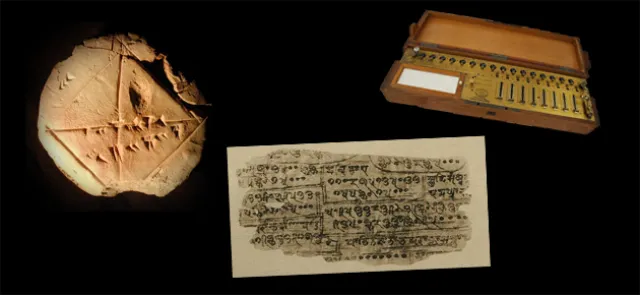
Extracting square roots: the main algorithms
Calculating square roots "with a quill," as people said in the 18th century, is a challenging art with many facets. Let's explore some famous methods and see why they work.

An adventure in fifteen videos | Tangente
Directors Cassia Sakarovitch and Gwenael Mulsant have set themselves a challenge: to make short videos about mathematical concepts from the specialist mathematics curriculum in the final two years of French high school.

Marguerite at the ENS | Tangente
Le Théorème de Marguerite, screened last June at the La Baule Festival, received a standing ovation!

Counting squirrels and other wild animals
By definition, wild animals cannot be counted systematically and exhaustively: it is difficult to warn them that a census taker will be calling at their home next Monday! This is where statistics—and estimation theory in particular—comes to the rescue.

Carmichael numbers | Tangente
Does Fermat's little theorem characterize prime numbers? Far from it! Yet few composite numbers satisfy the theorem's conclusion, making them all the more intriguing to number-theory enthusiasts and specialists alike.

Great names for great numbers
Many mathematicians have lent their names to numbers in common use. "Very large" numbers have names too: a way had to be found to represent them as well, since they come up in several fields, from combinatorics to mathematical logic!

Adrien-Marie Legendre, in search of integer solutions
The search for integer or rational solutions to algebraic equations has left its mark on the history of mathematics. The law of quadratic reciprocity, stated by Legendre, which determines whether a number is a square "modulo a given integer," advanced this field.

Sophie Germain primes | Tangente
From Fermat's Last Theorem to cryptography, Sophie Germain primes have played a part in many scientific adventures over the past two centuries. These prime numbers have earned their place in the pantheon of arithmetic, yet we still do not know whether infinitely many exist.

Making counting easier | Tangente
Counting the elements of certain sets is not always straightforward. In the last century, William Burnside, a mathematician specializing in group theory, established a result that simplifies the calculation of the number of objects in certain finite sets.

Counting to exist: the political uses of... | Tangente
Counting seems straightforward enough: you count what is there. Nothing could be more childlike... or so it seems. Yet counting entails highly significant political choices and can serve extremely important economic, social and even identity-related purposes.

A showcase of mathematical inequalities | Tangente
Mathematics abounds in inequalities, often drawing on differential or integral calculus. Many problems can be solved with their help. So let's explore them!

And order was established
The notion of order is part of our daily lives, whether we are putting objects away, comparing quantities or deciding what order to tackle a series of tasks in. Yet it took a very long time for these natural activities to be conceptualized mathematically.
Bienaymé–Chebyshev inequality in probability | Tangente
Summarizing a set of observations with a few key numbers is essential. But how much do these numbers tell us about the frequencies within particular intervals? The Bienaymé–Chebyshev inequality provides a first quantitative answer.

Order amid disorder: rearrangement | Tangente
Take a random sequence of numbers. It is unlikely that they will all be in increasing or decreasing order from the outset. Can we nevertheless hope to extract perfectly ordered subsequences? Yes—but they may not be as long as we would like!

Five variants of the Cauchy–Schwarz inequality | Tangente
The Cauchy–Schwarz inequality appears in several branches of mathematics: analysis, arithmetic, geometry, probability... It is so important that many widely differing proofs have been devised!