



Knowledge
In-depth articles on mathematical knowledge and theories

Tchebychev's inequalities for sequences | Tangente
Elementary results can sometimes prove astonishingly fertile, opening the way to a host of developments and applications. Chebyshev's inequality is a case in point.

Ptolemy's little-known inequality explained | Tangente
The Greek mathematician, geographer and astronomer Claudius Ptolemy discovered a theorem about quadrilaterals inscribed in a circle in the second century CE. His result is certainly far less famous than that of his compatriot Pythagoras, but it is every bit as beautiful.

Dido's problem and isoperimetry | Tangente
For a given perimeter, the disk is the figure with the greatest area. This result, popularized by a trick attributed to Dido, the founder and first queen of Carthage, is the "isoperimetric theorem." It gave rise to many more general inequalities.
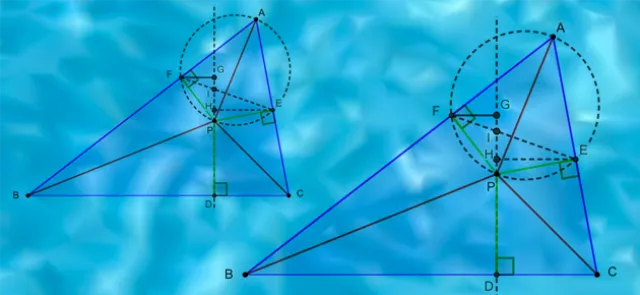
The riches of the triangle inequality | Tangente
The word "inequalities" often brings arithmetic or algebra to mind. But inequalities also have their place in geometry! The most famous of them, the celebrated triangle inequality, still has more than one trick up its sleeve.
Charlotte Angas Scott, a pioneer | Tangente
A pioneer of algebraic geometry and a specialist in curves and surfaces, British mathematician Charlotte Angas Scott was forced to move to the United States to find an academic post. Her chief claim to fame is an elegant proof she devised for a difficult theorem by Max Noether.
Research
Singmaster's conjecture, the Polymath projects, the Green–Tao theorem…
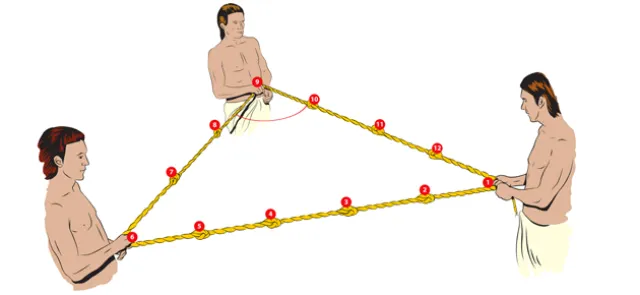
Generating the famous Pythagorean triples
Characterizing all right triangles in the plane with integer side lengths amounts to finding all Pythagorean triples. The geometric problem thus appears to become purely arithmetic! How did mathematicians go about completing this quest?
Pythagorean triangles
When the side lengths of a triangle form a Pythagorean triple, the triangle is called a Pythagorean triangle. Discover its properties...

The Pythagorean theorem before Pythagoras | Tangente
Pythagoras would never have accepted this result being named after him: he knew perfectly well that he had learned it on his journeys of study. As we shall see, it already existed in Babylon and India!
Some results
Terence Tao has successfully tackled many mathematical conjectures. Here are a few examples.

From an Erdős conjecture to Tao’s theorem
The prolific Hungarian mathematician Paul Erdős (1913–1996), along with many number theorists and combinatorialists who followed him, studied the "discrepancy problem." In 1932, Erdős formulated a deep conjecture. In 2015, Tao proved it.
Omics data: genomics, statistics and Big Data | Tangente
Technological advances in high-throughput sequencing make it possible to produce large volumes of biological data at lower cost and at different scales of living systems. The resulting massive datasets are both high-dimensional and heterogeneous.

ChatGPT and the mathematics of intelligence | Tangente
Who hasn't heard of ChatGPT? The feats of this artificial intelligence have sparked impassioned debate, along with fears and hopes for the future. To understand what it is all about, let's begin by exploring how this gigantic neural network works!

Individual-level data protection | Tangente
How can millions of individual records be processed and made available to researchers while protecting privacy and commercial confidentiality? This is a challenge the official statistical service faces every day—and one it meets rather convincingly.

Statistics: what is it for?
You like mathematics, but it seems too far removed from "real life." Why not take a look at statistics? This discipline has countless direct applications, with many more undoubtedly still to be imagined or discovered!
Statistical mixture models explained | Tangente
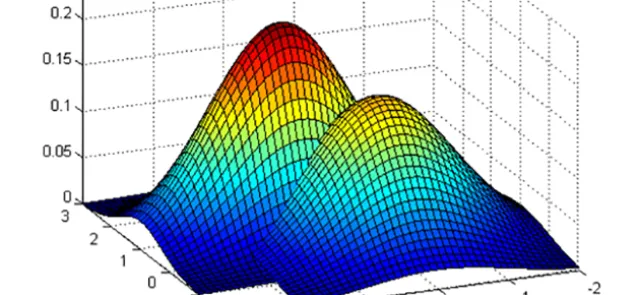
How can we estimate a model's parameters from a sample whose members come from several different subpopulations that have been mixed together, when information about which one each belongs to has been lost? Several methods are available, depending on the requirements and assumptions, including the famous EM algorithm.

Automated classification: K-means | Tangente
Your data collection has been highly effective: you now have a scatter plot revealing an impressive point cloud. How can these points be grouped into classes? How many classes will emerge? Today’s methods are advanced enough to automate the process.

Optimal control and Zermelo problems | Tangente
A particularly important class of optimal control problems consists of Zermelo-type problems: their applications have proved rich and fruitful in mathematics… and beyond. They are studied using a combination of geometric and numerical methods.

The sphere effect
The sphere came to be seen as a model of the world because of its perfection. Greek mathematicians soon sought to measure its properties, laying the groundwork for calculation techniques that would not bear fruit until centuries later.

Mapping and the geometry of the Earth | Tangente
Understanding the shape of the planet we live on, and then depicting it, has been an adventure since the earliest days of antiquity. At every stage, the model has been refined and improved, drawing ever closer to the one we use today: the geoid.