



Math for everyone
Mathematical content accessible to everyone
 Podcast
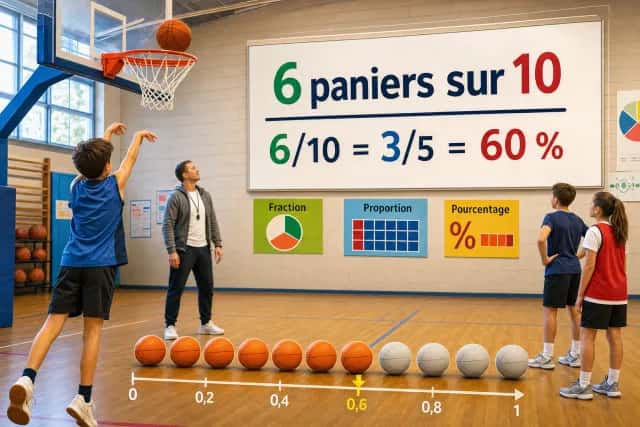
Can you learn fractions by shooting a basketball?
A Norwegian study demonstrates that basketball exercises help students aged 11 to 13 improve by 15% in fractions, thanks to learning through the body.
 Podcast
Pascal's Wager: probability and faith in mathematical analysis
An explanation of Blaise Pascal's famous argument about the wager of faith, applying probability theory to the question of God's existence.
 Podcast
Year 2038 bug: the 32-bit timestamp problem explained
A massive bug related to the way computers represent large numbers looms on January 19, 2038, at 3:14:08 a.m.
 Podcast
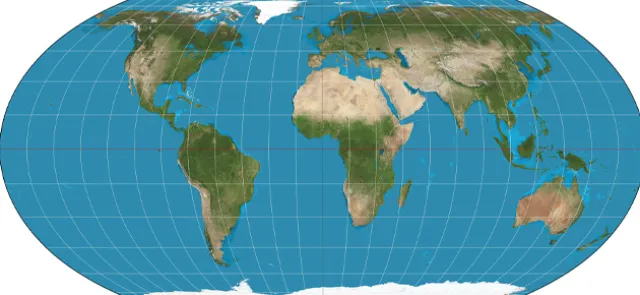
Mercator projection: anatomy of a geopolitical map
We tend to think of mathematics as a perfectly neutral science. Yet, like any human construct, its uses can prove more political than they appear. That is how an age-old geometry problem found its way into diplomatic debates in recent months.

CNRS public consultation: how French people relate to mathematics
33,000 citizens took part in the CNRS's major nationwide consultation on mathematics. Discover what this landmark survey reveals about access to maths.
 Podcast
Cédric Aubouy, math clown and author of “Je ne sais pas”
Cédric Aubouy, a mathematical clown and founder of the L’île logique company, agreed to meet us to mark the publication of his first novel, Je ne sais pas ou la disparition des mathématiciens.
 Podcast
Insee surveys: methods and the challenges of official statistics
Discover how Insee rigorously conducts its statistical surveys, from sampling to estimating unemployment.
 Podcast
666: When the devil shows up in math | Tangente
From the biblical 666 to the Belphegor number, certain numbers send a shiver down the spine… and bring a smile to mathematicians' faces. Behind these "cursed" objects, the creativity and ingenuity of recreational mathematics run wild, ranging from number games to diabolical curiosities.
 Podcast
Mathematical properties of 2026 | Tangente
Let's not break with our start-of-year tradition and explore together a few charming quirks of the new vintage!

Blaise Pascal’s Pascaline | Tangente
This past November 19, a Pascaline dating from 1642, valued at between two and three million euros, was due to go under the hammer at Christie’s in Paris.
 Podcast
Vampire numbers and their fangs | Tangente
Yes, vampire numbers really do exist! And they have fangs!
 Podcast
Parasitic numbers and permutations | Tangente
How do you multiply 105,263,157,894,736,842 by 2? Simple: just move the final digit, 2, to the front of the number, giving 210,526,315,789,473,684. And there you have it!
 Podcast
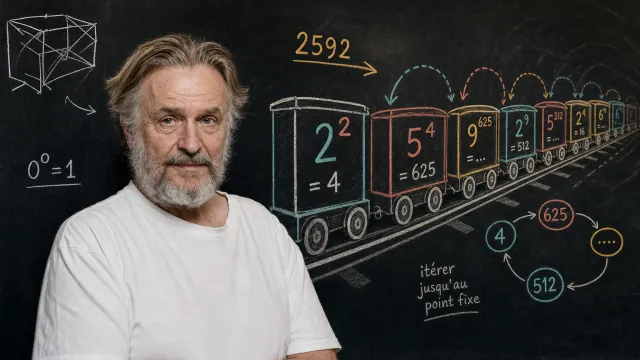
Conway's power trains | Tangente
Power trains are iterated functions introduced by Conway.
 Podcast
Multiplicative persistence of numbers | Tangente
Adding or multiplying together the digits of an integer is an activity a curious child might feel like doing. But they probably have no idea that it is the source of problems still unsolved in 2025!
 Podcast
Prime numbers and changing digits | Tangente
Unlike some composite numbers, it is hard to tell whether a number is prime just by looking at it. So what happens to a prime number if we make a change to its digits — for example, by permuting them or removing some of them? Can it stay prime? Or, on the contrary, does it stop being prime?
Narcissistic numbers and their secrets | Tangente
In the 1960s, while teaching at the University of Rochester in New York State, Mike Armstrong became particularly interested in k-digit numbers equal to the sum of the kth powers of their digits.
 Podcast
Palindromic numbers: numerical symmetry | Tangente
These numbers, which can be read equally well from left to right or from right to left, raise questions. At first glance they seem highly unusual, and therefore rare. Yet when an elementary arithmetic process is repeated on any whole number whatsoever, we almost always end up with just such a number. Bizarre, how bizarre!
 Podcast
It doesn't take much to be happy
We know that mathematics can be a source of joy, but have you heard of happy numbers? Simple to define, they hold plenty of surprises and show just how much playing with integers remains an inexhaustible source of research at every level.
 Podcast
The magic wand theorem | Tangente
Maryam Mirzakhani is also known for having obtained, with Alex Eskin and Amir Mohammadi, the magic wand theorem, so named because it made it possible to solve at a stroke many previously inaccessible problems. To explain it, let's first delve into translation surfaces. The illumination problem is one of its many applications.
 Podcast
Mirzakhani's geodesics
Maryam Mirzakhani first became known for the work she carried out for her thesis, in which she counts closed geodesics on hyperbolic surfaces. To explain her results, we will take a short tour through the world of hyperbolic geometry.