



Math for everyone
Mathematical content accessible to everyone
And order was established
The notion of order is part of our daily lives, whether we are putting objects away, comparing quantities or deciding what order to tackle a series of tasks in. Yet it took a very long time for these natural activities to be conceptualized mathematically.

A little order…: order relations in mathematics | Tangente
Dictionary words, like points in the plane, can be put in order. Each choice of method—alphabetical order, lexicographic order, and so on—corresponds to an ordering: it is up to each of us to choose the order relation that suits our needs!

Bienaymé–Chebyshev inequality in probability | Tangente
Summarizing a set of observations with a few key numbers is essential. But how much do these numbers tell us about the frequencies within particular intervals? The Bienaymé–Chebyshev inequality provides a first quantitative answer.

More means: harmonic and arithmetic | Tangente
The arithmetic, quadratic, geometric and harmonic means (among many others) are all examples of a general family: the power means. They satisfy a well-known chain of inequalities.

Cauchy–Schwarz in graph theory | Tangente
Take ten points and join some of them with line segments, but never form a triangle (that is, a triangle whose vertices are among the original ten points). What is the maximum number of segments you can draw?

Order amid disorder: rearrangement | Tangente
Take a random sequence of numbers. It is unlikely that they will all be in increasing or decreasing order from the outset. Can we nevertheless hope to extract perfectly ordered subsequences? Yes—but they may not be as long as we would like!

The birth of thermodynamics and Clausius | Tangente
The study of heat transformed our view of the world by prompting us to consider whether a physical "arrow of time" exists. It all comes down to one remarkably simple relation: the Clausius inequality.

Social inequality: the Gini coefficient | Tangente
Statisticians often publish averages, reducing a snapshot of a country's socioeconomic situation to a single figure. But these averages often (always?) conceal stark disparities. One way to bring them into sharper focus is to quantify inequality as well.
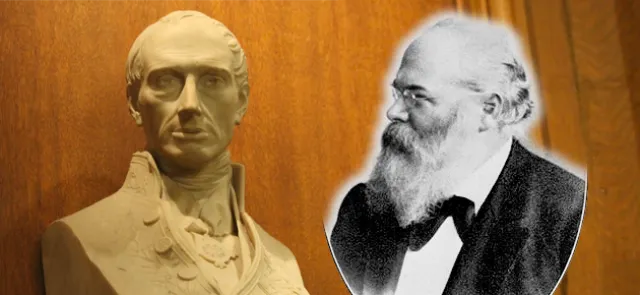
Cauchy–Schwarz inequality: proofs | Tangente
The Cauchy–Schwarz inequality takes many forms: arithmetic, integral and geometric; it even appears in probability theory. Let us trace its development, from Cauchy's numerical formulation around 1820 to its general form a century later.

Five variants of the Cauchy–Schwarz inequality | Tangente
The Cauchy–Schwarz inequality appears in several branches of mathematics: analysis, arithmetic, geometry, probability... It is so important that many widely differing proofs have been devised!

Tchebychev's inequalities for sequences | Tangente
Elementary results can sometimes prove astonishingly fertile, opening the way to a host of developments and applications. Chebyshev's inequality is a case in point.

A history of ordered means: AM, GM, HM | Tangente
“The” mean of two numbers is defined “naturally” according to the context. It is not always the familiar arithmetic mean! Several different notions coexist and are closely interconnected, as Liouville, Cauchy and Jensen clearly understood.

Solving inequalities: methods and examples | Tangente
Some of our readers no doubt have unpleasant memories of inequalities.

The usual inequality on real numbers | Tangente
Once their values are known, any two numbers can be compared—whether they are integers, fractions, or real numbers—and we can say which is smaller.

Ptolemy's little-known inequality explained | Tangente
The Greek mathematician, geographer and astronomer Claudius Ptolemy discovered a theorem about quadrilaterals inscribed in a circle in the second century CE. His result is certainly far less famous than that of his compatriot Pythagoras, but it is every bit as beautiful.

Dido's problem and isoperimetry | Tangente
For a given perimeter, the disk is the figure with the greatest area. This result, popularized by a trick attributed to Dido, the founder and first queen of Carthage, is the "isoperimetric theorem." It gave rise to many more general inequalities.
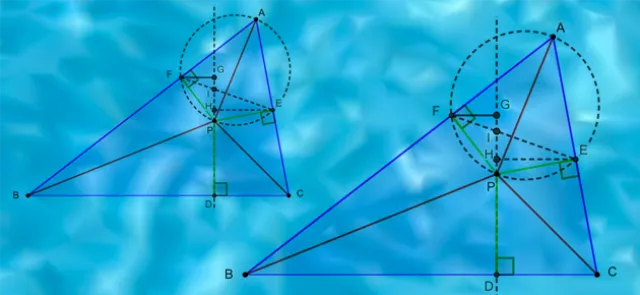
The riches of the triangle inequality | Tangente
The word "inequalities" often brings arithmetic or algebra to mind. But inequalities also have their place in geometry! The most famous of them, the celebrated triangle inequality, still has more than one trick up its sleeve.
Charlotte Angas Scott, a pioneer | Tangente
A pioneer of algebraic geometry and a specialist in curves and surfaces, British mathematician Charlotte Angas Scott was forced to move to the United States to find an academic post. Her chief claim to fame is an elegant proof she devised for a difficult theorem by Max Noether.

Fermat's infinite descent explained | Tangente
Pierre de Fermat wrote that he had succeeded in proving that the area of a right triangle can never be an integer that is a perfect square. To do so, he introduced a method of reasoning that would go down in history: infinite descent.

Terence Tao: the rise of a prodigy | Tangente
Given his life story and exceptional intellectual abilities, mathematician Terence Tao—born in Australia in 1975 and now a professor at the University of California, Los Angeles (UCLA), in the United States—has been dubbed the "Mozart of mathematics" by many.