



Math for everyone
Mathematical content accessible to everyone
Extracting square roots: the main algorithms
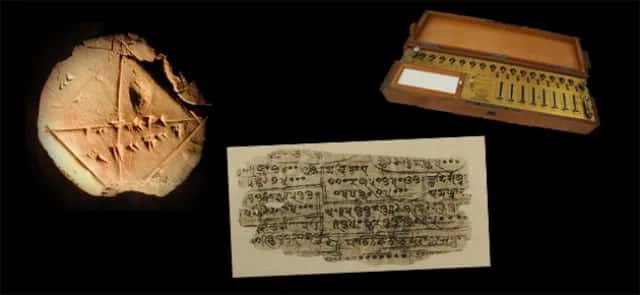
Calculating square roots "with a quill," as people said in the 18th century, is a challenging art with many facets. Let's explore some famous methods and see why they work.

How many stars are there in our galaxy? | Tangente
The first map of the Milky Way was drawn by William Herschel (1738–1822) in 1785. Unable to count every star, he used a statistical method.

Marie Crous's two books digitized | Tangente
And soon Marie Crous, a pioneer of decimal arithmetic in France, will no longer be forgotten!

An adventure in fifteen videos | Tangente
Directors Cassia Sakarovitch and Gwenael Mulsant have set themselves a challenge: to make short videos about mathematical concepts from the specialist mathematics curriculum in the final two years of French high school.

Marguerite at the ENS | Tangente
Le Théorème de Marguerite, screened last June at the La Baule Festival, received a standing ovation!

Vauban… for the pigs | Tangente
Sébastien Le Prestre (1633–1707), Marquis de Vauban, better known simply as Vauban, was an eighteenth-century man of many talents: engineer, military architect, urban planner, encyclopedist… Louis XIV appointed him Marshal of France near the end of his life. He was responsible for numerous military fortresses throughout France.

Perrin's test for primes… almost! | Tangente
The Perrin numbers are named after Raoul Perrin, a French engineer (1841–1910) who served as president of the Société mathématique de France in 1908.

The many facets of counting | Tangente
The etymology of the French verb "dénombrer" is relatively transparent: as in the words "énumérer" and "numération", we can recognize the Latin root numerus, meaning number or quantity. To dénombrer is thus to seek an answer to the question "how many?"

Counting squirrels and other wild animals
By definition, wild animals cannot be counted systematically and exhaustively: it is difficult to warn them that a census taker will be calling at their home next Monday! This is where statistics—and estimation theory in particular—comes to the rescue.

Carmichael numbers | Tangente
Does Fermat's little theorem characterize prime numbers? Far from it! Yet few composite numbers satisfy the theorem's conclusion, making them all the more intriguing to number-theory enthusiasts and specialists alike.

Great names for great numbers
Many mathematicians have lent their names to numbers in common use. "Very large" numbers have names too: a way had to be found to represent them as well, since they come up in several fields, from combinatorics to mathematical logic!

Egon Balas | Tangente
Egon Balas's life story reads like an adventure novel. Discover the remarkable story of this mathematician from communist Romania, who managed to escape the turmoil brought upon him by his love of freedom and whose name is associated with numerous discoveries, particularly in operations research.

Adrien-Marie Legendre, in search of integer solutions
The search for integer or rational solutions to algebraic equations has left its mark on the history of mathematics. The law of quadratic reciprocity, stated by Legendre, which determines whether a number is a square "modulo a given integer," advanced this field.

Theatre and maths with Compagnie Terraquée | Tangente
François Perrin, an actor, director and mathematician, and Meriem Zoghlami, a creator of unconventional cultural formats, lead Compagnie Terraquée. Exactly ten years ago, they founded its Mathéâtre lab. In 2017, the company devised a major festival, "Maths en ville".

Sophie Germain primes | Tangente
From Fermat's Last Theorem to cryptography, Sophie Germain primes have played a part in many scientific adventures over the past two centuries. These prime numbers have earned their place in the pantheon of arithmetic, yet we still do not know whether infinitely many exist.

Making counting easier | Tangente
Counting the elements of certain sets is not always straightforward. In the last century, William Burnside, a mathematician specializing in group theory, established a result that simplifies the calculation of the number of objects in certain finite sets.

Counting to exist: the political uses of... | Tangente
Counting seems straightforward enough: you count what is there. Nothing could be more childlike... or so it seems. Yet counting entails highly significant political choices and can serve extremely important economic, social and even identity-related purposes.

Convexity in geometry and analysis | Tangente
Convex geometry took off during the 1960s, particularly because of its applications in probability theory and optimization
A showcase of mathematical inequalities | Tangente
Mathematics abounds in inequalities, often drawing on differential or integral calculus. Many problems can be solved with their help. So let's explore them!

Sorting algorithms: complexity and methods | Tangente
When a collection of data contains different values, one common task is to sort them—that is, to arrange them in a given order: the usual numerical order, lexicographic order as in a dictionary, or any other order defined by a total ordering relation.