



Math for everyone
Mathematical content accessible to everyone
Laplace's brilliant insight into black holes | Tangente
The finite speed of light and its particle nature led Laplace, through a bold line of reasoning, to contemplate the existence of black holes—before changing his mind. Although he could not have conceived of light's dual nature at the time, he was right!

A fresh perspective on differential equations
The method developed by Laplace and his successors replaces differentiation with multiplication, turning a given differential equation into a "simple" algebraic equation. Today, no one working with differential equations can do without this technique.
Numbers or not?
Irrational numbers had a troubled beginning. Introducing roots of integers that are not perfect powers raised many questions about the nature and essence of numbers. Is a radical incommensurable with unity and its subdivisions a number?

From rhomb to rhombus
For many people, the rhombus—originally called a "rhomb" (see In Brief, "The origin of the rhombus"; the associated adjective is still "rhombic")—is characterized by its acute angles pointing upward and downward. Yet, as Euclid already observed, this quadrilateral is defined by the equal lengths of its sides. Its ability to form tilings accounts for its use in architecture and decoration.

The origin of the rhombus – Maths brief | Tangente
Many mathematical terms have Greek or Latin roots. But the word "losange", the French for rhombus, is something of a puzzle: its origin is disputed.

On the road – Mathematical brief | Tangente
Both unusual—since it does not usually rest on its "base"—and harmonious, as it is a quadrilateral with four equal sides, the rhombus appeals to graphic artists, advertisers and other designers: it appears in puzzles, games, road signs, logos…

A magic rhombus – mathematics brief | Tangente
In August 2019, our reader Mustapha Rherrad created a magic rhombus using the integers from 1 to 32, arranged so that the sums along every "slanting row" and every "main diagonal" are equal.
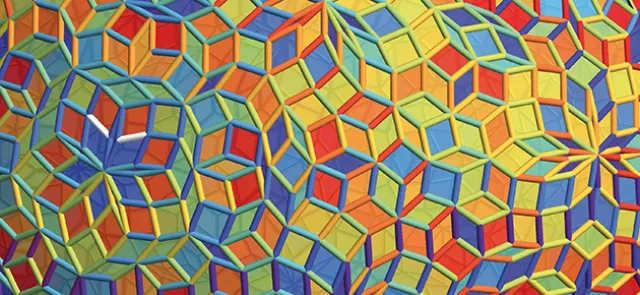
Rhombi filling space – Article | Tangente
Are there polyhedra whose faces are all rhombi? Various mathematicians have studied this problem in solid geometry since the 17th century, each contributing to what is now a complete classification of the convex polyhedra.

La Maison des mathématiques de l’Ouest - Article | Tangente
Activities that bring artists and mathematicians together to share mathematics with the public are flourishing across Pays de la Loire and Brittany. A Maison des mathématiques de l’Ouest was established to bring them together.

Reading ancient and medieval mathematicians | Tangente
In 2018, the British publisher Routledge launched a series entitled "Scientific Writings from the Ancient and Medieval World" with a Babylonian astronomical handbook.
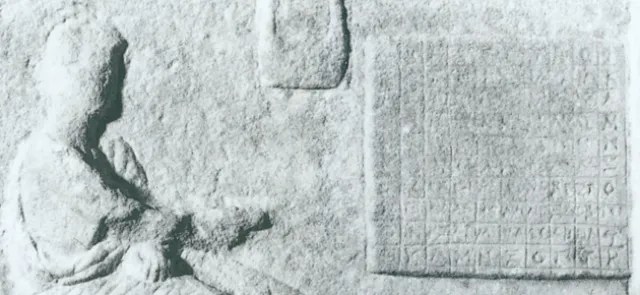
The hidden riches of the multiplication table
Think you know your multiplication tables? Think again! A surprising property emerges when a regular polygon is drawn on the multiplication table: the mean of the values at its vertices is the value at the polygon's center!

Dust in the corners
The beauty of fractal curves fascinates amateurs and seasoned mathematicians alike. The latter, however, know that these objects also give rise to subtle problems in measure theory. Here we illustrate an apparently paradoxical situation and a delicate theorem.
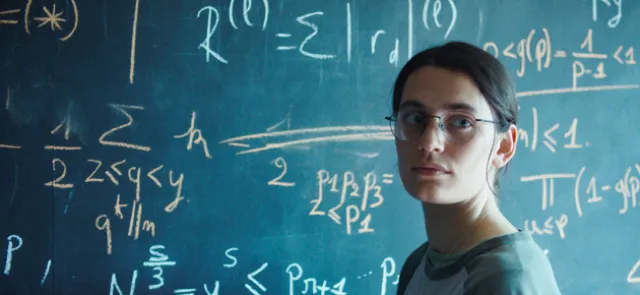
Marguerite's Theorem – Article | Tangente
Anna Novion's film Marguerite's Theorem had already won numerous prizes and awards before it even reached cinemas. Anna Novion, the director, and Ariane Mézard, the mathematician who advised her, agreed to answer Tangente's questions.

Tête-à-tête chercheuse(s): maths brief | Tangente
Nathalie Ayi, a researcher and associate professor at Sorbonne Université, also created and hosts the podcast Tête-à-tête chercheuse(s).

Rhombus Notes – A Mathematical Brief | Tangente
Did you know?
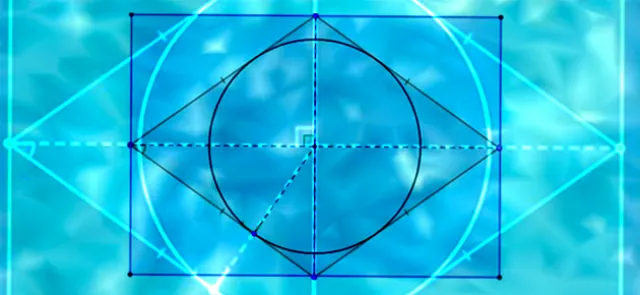
This is not a square
A square is a special kind of rhombus. Anyone can easily calculate the area of a square, but what about the area of a rhombus? Similarly, a square has both a circumcircle and an incircle. What happens in the case of a rhombus?
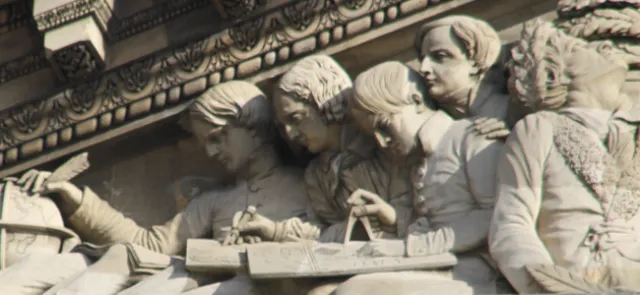
Square matrices and transformations of the plane
The notion of a square root can be extended to very general sets. One may then obtain more than two square roots—even infinitely many! Matrices provide one example. Orientation-preserving similarities, viewed through the lens of complex numbers, lead us back to less startling results.
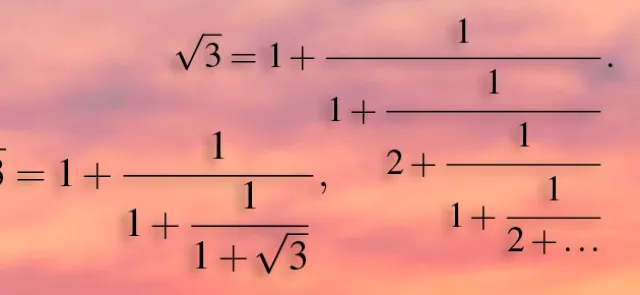
Roots and continued fractions
There are other ways to represent real numbers besides our decimal notation! One of the best known is to write a number as a continued fraction. The resulting representations, even when truncated, very quickly provide "good" approximations of the original number.

Newton's method
Do you know how your calculator—or your smartphone's calculator—computes the square root of a number a > 0?

Lightning calculators
How do lightning calculators use root-extraction algorithms so quickly?