



Math for everyone
Mathematical content accessible to everyone

The endless variety of glissettes | Tangente
Roulettes do not exhaust the possibilities offered by plane-on-plane motion—or the geometric wonders hidden within it. Armed once again with drawing paper, tracing paper and pens, we continue our exploration with some somewhat overlooked curves: glissettes.

Generating CAD curves with Bézier | Tangente
Computer-aided design (CAD) emerged with the first computer graphics systems in the field of industrial design. Geometric design algorithms underpin 3D representation.

Elliptic curves
An elliptic curve is an algebraic curve of genus 1, defined by a polynomial equation in Cartesian coordinates with real coefficients.
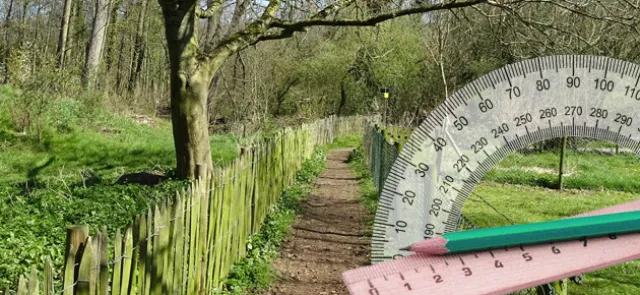
An algebraic stroll
Algebraic curves come in every degree and every variety. They can be represented in the real plane, the complex plane or even the projective plane. How can we find our way around? Learn to recognize them and navigate this rich geometric universe!
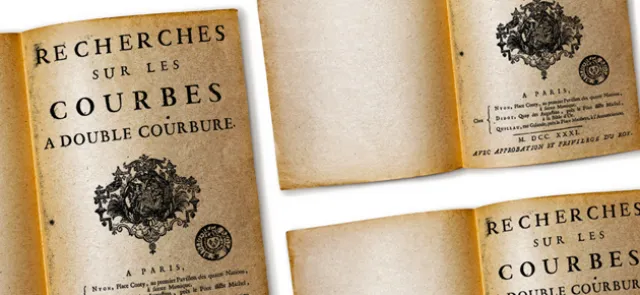
Curves that leave the plane
Not all curves in space are confined to a plane. To study these "space curves," several new concepts—curvature and torsion—are introduced using a carefully chosen frame of reference. Get to grips with them and learn how to use them!

Getting to grips with polar coordinates
Polar coordinates are particularly well suited to plotting and studying circles, rose curves, and other spirals.
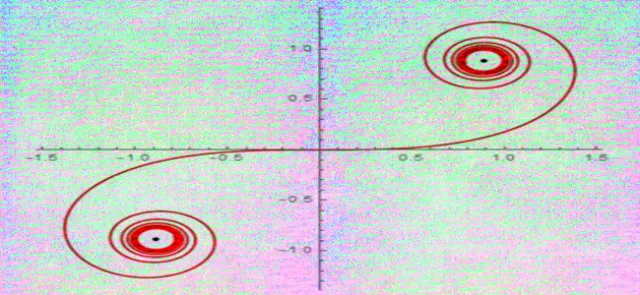
Equations for curves
There are essentially two ways to define a plane curve using equations: with a Cartesian (or implicit) equation, or with parametric equations.

The early history of the cycloid
It took decades to uncover the geometric properties of cycloids and trochoids. The scholars who studied them began with physical or practical questions before turning to these remarkable curves themselves.

Modelling trajectories
The links between mathematics and the physical sciences are both ancient and profound. They find their most striking expression in the curves, trajectories and other loci obtained through experiment. Conic sections are especially prevalent, at every scale from the microscopic to the macroscopic.
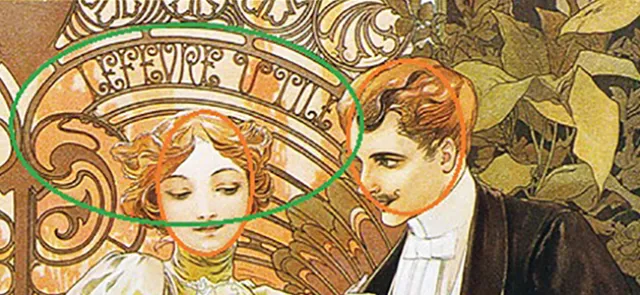
Art Nouveau: a movement of curves | Tangente
Art Nouveau was a total art movement that flourished across several European countries in the late 19th century. Never before had an artistic movement placed such emphasis on the beauty and variety of curves.

New women members of the Académie des sciences | Tangente
Of the eighteen newly elected members of the Académie des sciences, eight are women, including two in the mathematics section: Nalini Anantharaman and Mireille Bousquet-Mélou.

Jumps in number sequences | Tangente
By playing with letters, digits and numbers, we can build sequences whose "stop" and "restart" rules reveal surprising arithmetic phenomena. It would take a clever mind indeed to fathom the jumps between successive terms!

What if we replayed the match?
Predicting the result of a football match from statistics alone is impossible. Yet methods have been developed to refine such predictions. Goals often seem to come down to chance—but might analysing how the match unfolded provide a more reliable way to assess the teams?

The emergence of probability theory
In the second half of the 17th century, Blaise Pascal and Pierre de Fermat exchanged letters on the development of a mathematical theory of probability that went beyond the elementary observations one might make about rolling a die. Christian Huygens would take their ideas further.

In logic and combinatorics
In mathematical and logical puzzles, often inspired by observations of everyday life, polynomials can crop up in surprising ways. Geometry, binary logic and algorithms, peg games, combinatorics… no field is immune!

Polynomial stories
Anyone may come across a polynomial along the way. Here's the proof...

The foundations of signal processing
Harmonic analysis, born of functional analysis, studies how functions can be represented as superpositions of basis functions. In signal theory, these basis functions, often polynomials, lie at the heart of sound and image processing in our digital world.

Degree 45: François Viète rises to the challenge! | Tangente
Reconstructing a historic mathematical challenge.

Polynomials that make a difference | Tangente
A polynomial can be evaluated without any multiplication, using addition alone. Charles Babbage based his famous "Difference Engine" on this remarkable property.

Leonardo da Vinci and mathematics | Tangente
Everything you need to know about Leonardo da Vinci