



Amazing Math
Surprising or counterintuitive mathematical results and proofs

A little something missing
The term "ellipse" differs from the names of the other two conics, the parabola and the hyperbola. In fact, it means "something missing". Behind this surprising etymology lies a mathematical revolution: Apollonius of Perga's theory of conics.
Condorcet's paradox explained | Tangente
From Lewis Carroll to Kenneth Arrow, the famous Condorcet paradox has generated a great deal of discussion.
Polygonizing a number: histonumbers and Theodorus' spiral | Tangente
Several methods can be used to associate a polygon with a given number.

The one-cut theorem: any polygon in a single cut | Tangente
Can a polygon be cut from a sheet of paper with a single straight cut? Surprisingly, the answer is yes! More surprisingly still, this also applies to other objects.
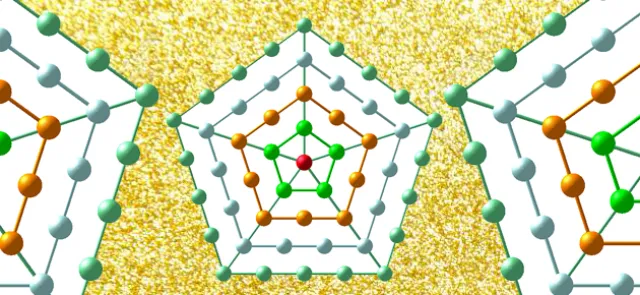
When polygons form numbers
All is number! The Pythagorean school established many properties of numbers from their geometric representations. First developed for triangles and squares, this way of arranging numbers was later extended to all kinds of polygons.

Heptadecagon: fact and fiction
Theory tells us that a regular seventeen-sided polygon—a heptadecagon—can be constructed using only a straightedge and compass. But it gives no details of the construction, which is far from straightforward.

The mathematicians of Père-Lachaise | Tangente
At this time of year, around All Saints’ Day, tradition calls for visits to cemeteries. So let's take the opportunity to visit the graves of mathematicians in the most iconic cemetery of all: Père-Lachaise.
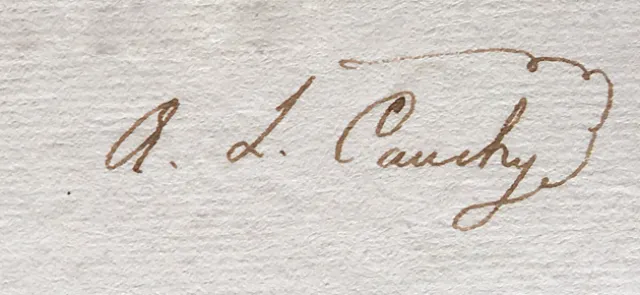
Origins of group theory: Cauchy and Galois | Tangente
Cauchy the analyst is well known; Cauchy the algebraist, much less so. Cauchy's contribution to group theory long went unrecognized, even though his research on algebraic structures was highly influential.

The battle over infinity: Cauchy and limits | Tangente
For more than two centuries, scholars and mathematicians debated infinitesimals: could they be handled safely, or were the paradoxes they generated insoluble? Amid this debate, Cauchy ushered analysis into the modern era while maintaining a nuanced position.
Geometry and philology: Cauchy's limits | Tangente
The mathematician Olry Terquem's review of Cauchy's paper on polyhedra ends in a most curious fashion.

Counting by substitution
At barely 25, Cauchy puts the finishing touches to a paper on symmetric functions that is eventually published as two articles. In it, he introduces new concepts, notation and methods, and creates the calculus of substitutions, which will play a central role in the development of group theory.

Combinatorics on words and music | Tangente
Combinatorics on words is an area of mathematics that has proved particularly fruitful for studying certain musical phenomena, especially the rhythmic features of African and Malagasy music—so much so that a computer can even recreate them!

The turtle algorithm in Vanuatu | Tangente
Mathematical modelling offers one way to make sense of Vanuatu's sand drawings. In particular, it will lead us to a surprising "turtle theorem".
Laurent Schwartz, politically engaged mathematician | Tangente
The publication of the graphic novel Laurent Schwartz, les engagements d'un médaillé Fields offers an opportunity to revisit the life and struggles of this surprising mathematician.
Penney's paradox explained | Tangente
Does tossing a coin strike you as simplistic and dull? Be careful, though: it has some baffling surprises in store!

The surprising aperitif problem | Tangente
Where should a platter of canapés be placed to satisfy the guests as well as possible? This seemingly innocuous problem has inspired brilliant developments over the centuries. It also illustrates how individual and collective optimization are often at odds—a seemingly paradoxical result.

Allais and the limits of utilitarianism | Tangente
The paradox formulated by the French economist Maurice Allais exposes a contradiction in an earlier theory of decision-making. But the paradox is only apparent and, above all, illustrates a major limitation of rational choice theory.

The two-envelope paradox | Tangente
A paradox can sometimes resemble an urban legend. First, its precise origins may be difficult to pin down; second, over time it may become distorted, change form, and proliferate. Such is the case with the two-envelope paradox.
Simpson's paradox and appearances | Tangente
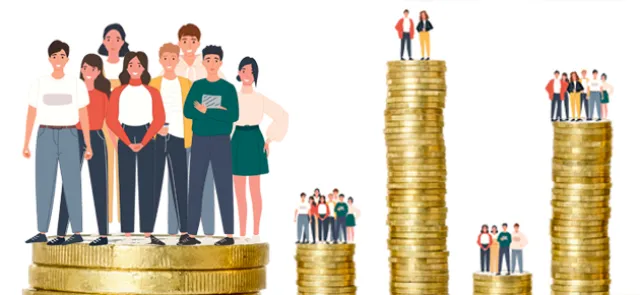
Could something that is true in every subgroup of a population become false when the population is considered as a whole? How is that possible? This is exactly what Simpson's paradox—the best-known paradox in statistics—shows.

The notion of paradox in mathematics | Tangente
The terms "paradox" and "paradoxical" are part of everyday language. In mathematics and logic, however, they have precise meanings that need to be clarified if we are to understand what we are talking about and what status to assign to so-called "paradoxical" results.