The story of an arithmetic game
------------------------------------
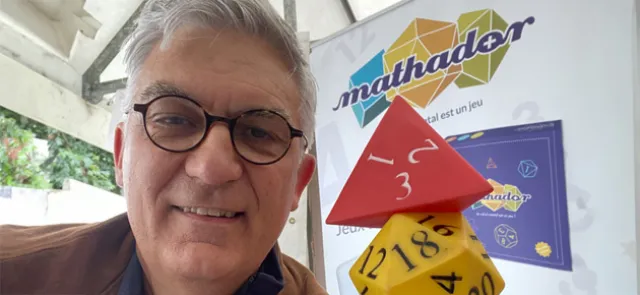
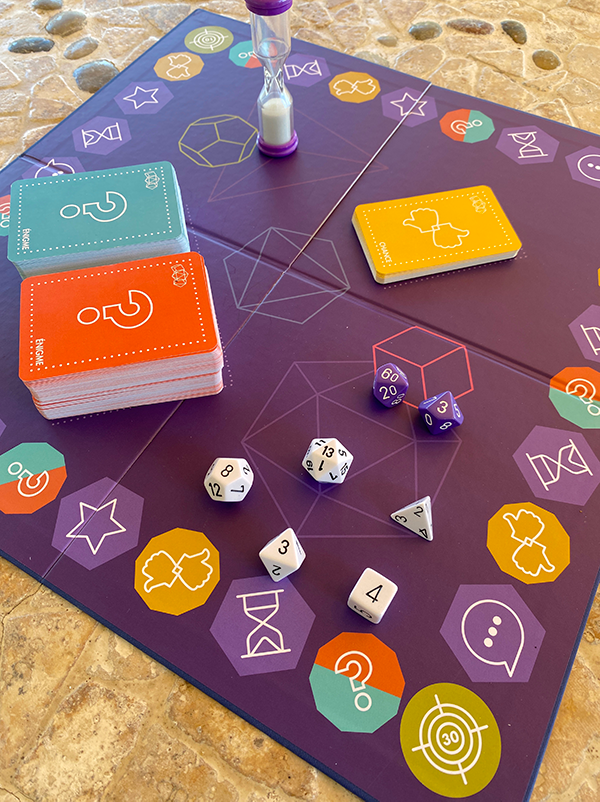
An article published in issue 71 of Tangente also announces the release of this board game, in which players (between two and four) must take turns solving, in under a minute, calculation puzzles linked to the square on which they have landed. This involves answering a small problem shown on a card or, when the square contains operation signs, reaching a “target number” determined by rolling two red dice whose ten faces bear digits (the target is therefore between 0 and 99), by combining numbers obtained by rolling five dice shaped like regular polyhedra. It was, moreover, the discovery of the five Platonic solids as dice during a game of Donjon et Dragon (Tactical Studies Rules, 1974) that gave Mathador’s creator the initial idea…
Since that first edition, there has been a succession of versions: in 2003, a Junior version (Réseau Canopé, L2D); in 2006, a Kid version (Réseau Canopé, L2D) with large dice; in 2010, the Mathador Flash version (a small metal box containing the dice with rules adapted to the classroom, Réseau Canopé); and in 2014 and 2015, the first digital versions, including Mathador Chrono and Mathador Solo (Réseau Canopé), still current, playable online on the **mathador.fr** website and as apps for tablets, smartphones and all devices.
Board game and digital: two complementary recent versions
----------------------------------------------------------
2019: for its 20th anniversary, Mathador decided to change its look. The new box marks a real turning point, with a small revolution in the game board, which introduces new squares allowing greater variety, with movement determined at random using another die. The fundamentals do not change, but the two hundred and twenty puzzles are new and the board offers different types of calculation challenges. Besides reaching the target number as quickly as possible, the challenge may also be to find the greatest number of different solutions for reaching the target or to earn the greatest possible number of points by making the target number. A nod to the Mathador Flash version, in which each operation earns points: addition 1, multiplication 1, subtraction 2 and division 3. You do not divide for pleasure, but for three points!
Alongside this new box, use of the digital version is exploding. In the time it takes to take out the dice, roll them, read the numbers, write them down and start looking, with the digital Mathador Chrono version, the player has already juggled four or five different rolls, thanks to a few mouse clicks. Another strength: the necessary and indispensable drill work becomes a game (it had fallen somewhat by the wayside for the latest generations). “Boring” and “repetitive” change their rhyme and become “attractive”! Combinatorics + Randomness = Joyful.
A teaching tool, too
--------------------
The use of games in mathematics in primary and secondary school is developing. Mathador is part of it. This pragmatic adventure has gradually become, with the Flash version, a teaching tool for mental arithmetic.
Réseau Canopé, which distributes the Mathador games, clearly measures this through contacts and feedback from classes. Year after year, the game gains ground. It is now not far from gaining recognition as a fully fledged teaching tool.
In the form of collective game workshops or individual challenges, primary school has gained an edge over secondary school. Indeed, for twenty years, the growing place of games at school has developed in parallel with that of mental arithmetic, both in curricula, since 2002, and in practices. The number of classes that use games such as Mathador as a daily ritual is constantly increasing. Moreover, this practice is almost certainly the best antidote to the anxiety still associated with learning mathematics. But for the culture of number games to become the equal of the culture of word games, there is still a long way to go!
*Éric Trouillot is the creator of the Mathador game.*