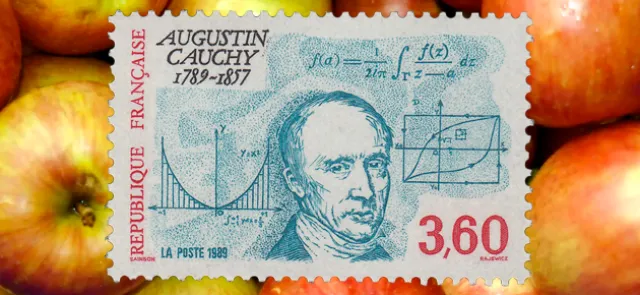




Les travaux de Cauchy qui fondent l’analyse complexe datent grosso modo de la période 1814-1831. En 1814, il présente son Mémoire sur les intégrales définies (qui fait près de 200 pages !), sujet qui l’anime jusqu’à ses deux Mémoires de Turin présentés en 1831.
Bien qu’il ait utilisé ces résultats dans des travaux ultérieurs, il n’apporte pas d’autres contributions substantielles à cette théorie avant 1849. Les premiers travaux de Cauchy sont particulièrement intéressants car ils s’insèrent dans une lignée de calculs et de questionnements sur la légitimité de ces calculs.
L’équation de Cauchy-Riemann avant l’heure
Dans un mémoire de 1740 sur l’intégration, Alexis Clairaut avait démontré que, P et Q étant des polynômes, la forme différentielle P(x, y) dx + Q(x, y) dy est exacte si la dérivée de P selon la variable x est égale à la dérivée de Q selon la variable y (un résultat obtenu au même moment par Euler sans que Clairaut n’en ait eu connaissance).
(Entre autres choses, une forme différentielle peut être un moyen d’associer un nombre à une courbe, à l’aide d’un procédé relevant de l’intégration. Une forme différentielle est dite exacte (on disait « complète » à l’époque de Clairaut) si, en un sens précis, le nombre associé à une courbe ne dépend que de ses points de départ et d’arrivée.)