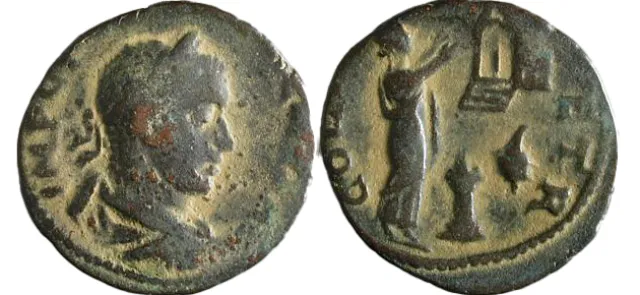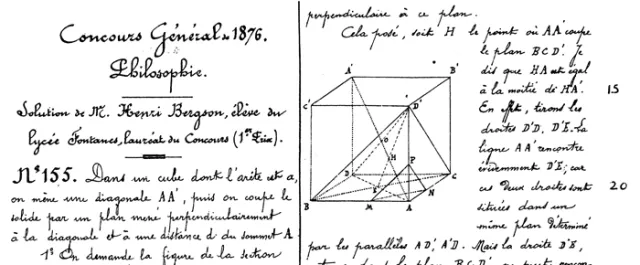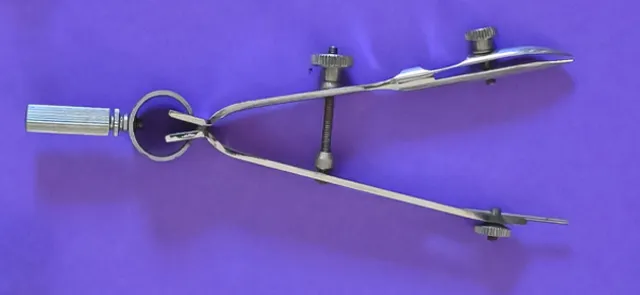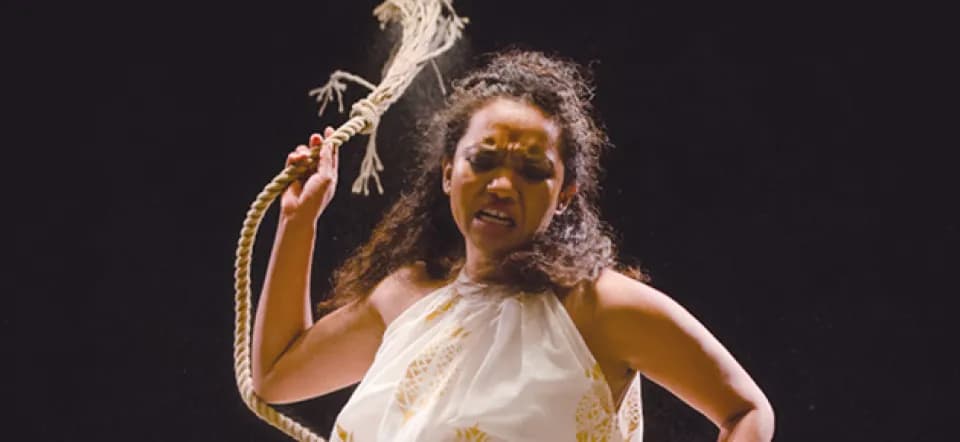
The finest mathematical hoax is attributed to Queen Dido in the 9th century BCE. According to legend, after landing on the shores of North Africa, she was granted, for herself and her people to settle on, an area of land "that could be covered by an oxhide"—a reasonable request in which no one could have suspected any trickery. But after cutting the hide into thin strips, she turned this into "the area of land that could be enclosed by the oxhide": this was the origin of the city of Carthage, in present-day Tunisia. Some see it as the birth of operations research and optimization; others, as another instance of age-old feminine cunning. Dido met a tragic end. Seduced by Aeneas, she killed herself when he left her to found Rome…
In the 3rd century BCE, King Hiero of Syracuse asked Archimedes to determine what a crown was made of: was it pure gold, as expected, or had the goldsmith mixed in some cheaper silver? The method devised by Archimedes and described by Vitruvius in the 1st century BCE is presented in the box. It is remarkable both for its ingenuity and for its ability to account for the considerable measurement uncertainties of the time.
Disillusionment ahead
-----------------------------
After such an auspicious beginning, the contribution of mathematics to combating fraud subsequently lost momentum. This was only to be expected: since Archimedes’ day, society has become far more standardized, and regulations of every kind now govern the composition of alloys and orange juice alike, as well as the usable floor area of apartments and the discharge of pollutants. Fraud-control authorities make do with checks carried out by inspectors and have no need for professional mathematicians. Every day brings more regulations, obligations and prohibitions of every kind, along with the corresponding fraud. None of this is truly scientific.
One field in which mathematics still plays a part is risk assessment, which is essential to insurance (see les Mathématiques des assurances, Bibliothèque Tangente 57). Anyone can offer insurance for the Paris–Nice flight and collect the premiums, but if the plane crashes, the claims must be paid—hence the need for what is known as "own funds," with the risks pooled with other insurers if necessary. The rarer the risk, the greater the profit will be (reinsurance is more lucrative than insurance!). European regulation recently purported to strengthen insurance companies’ own funds through the Solvency II Directive, but the white paper produced by the Société de calcul mathématique (see reference) shows that the mathematical tools introduced for risk assessment are in fact wholly unsound.
More generally, mathematics is involved in assessing natural hazards such as floods and earthquakes: designing buildings and equipment to withstand them, and managing crises. This work is new because the necessary databases are only just beginning to be established. Previously, the approach was empirical and relied on generous safety factors (Roman bridges are still standing!).
Mathematics and finance
----------------