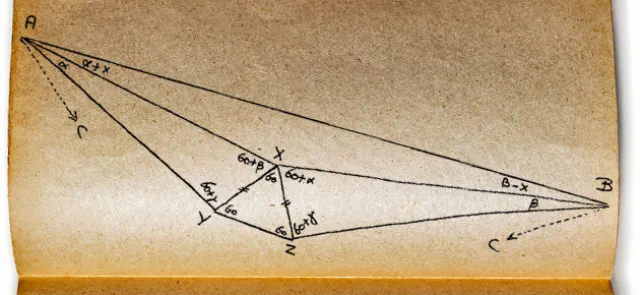
Three non-collinear points—in other words, a triangle—give rise to an impressive number of properties. One of the best known is that the angles thus formed add up to 180° (or π radians).
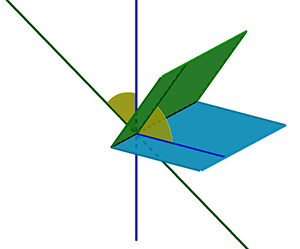
What happens in three dimensions? Let us take four non-coplanar points—in other words, a tetrahedron. Here, the notion of an "angle" is more ambiguous (see les Angles, Bibliothèque Tangente 53, 2015). We may consider the twelve plane angles formed by pairs of edges. We may also consider the six dihedral angles formed by pairs of faces. Or we can focus on the angles known as solid angles, or trihedral angles, formed at the tetrahedron's four vertices.
We are interested here in dihedral angles. That means studying angles formed by lines (or vectors), using normals to the planes.