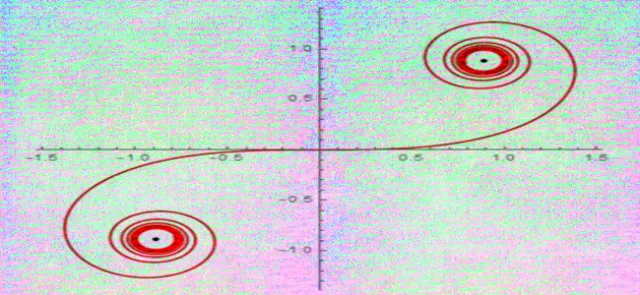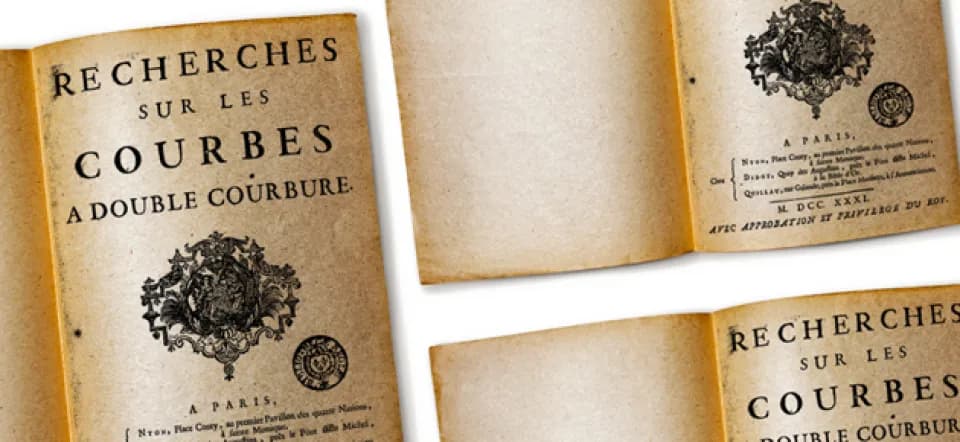
Some curves refuse to lie in a plane. The first person bold enough to study these audacious geometric objects was Alexis Claude Clairaut (1713–1765), who, at just 19, wrote a 137-page paper entitled Recherches sur les courbes à double courbure, published in 1731. By the age of 13, he had already mastered conic sections and infinitesimal analysis, presenting a paper on fourth-degree algebraic curves to the Académie royale des sciences! As he acknowledged in his preface, his method was inspired by Descartes: "What he [Descartes] says about them simply teaches us that, to examine them, perpendiculars must be dropped from every point of the curves onto two mutually perpendicular planes, and each point on the curves must be matched with the corresponding point on the curves thereby formed in those two planes." By studying two plane curves, Clairaut obtained two "curvatures." Modern terminology distinguishes the curvature and torsion of a space curve, that is, a curve not contained in a plane.
From Clairaut to Darboux
---------------------
The study of space curves was continued by Gaspard Monge (1746–1818) in his Mémoire sur les développées, les rayons de courbure, et les différens genres d’inflexions des courbes à double courbure, presented to the Académie in 1771 and published fourteen years later. Other important papers followed, in which Monge introduced the concepts of radius of curvature, polar, principal normal, the developable ruled surface generated by the tangents to a space curve, and the edge of regression.
Monge wrote in an elegant style, moving in turn between geometric, analytic and differential approaches. He anticipated the concept of torsion, viewed as a "departure from planarity," just as curvature measures a "departure from straightness."
In 1826, two years before Gauss, Cauchy placed these concepts on an analytic footing, using the terminology introduced by École polytechnique graduate Louis-Léger Vallée (1784–1864) in his Traité de géométrie descriptive. Finally, the French mathematicians Jean-Frédéric Frénet (1816–1900) and Joseph-Alfred Serret (1819–1885), followed by Gaston Darboux (1842–1917), definitively established an effective framework for studying space curves.