Some authors believe that "losange" may come from the Gaulish lausa and share its origin with "lauze" (a flat stone). This explanation is semantically convincing, but geographically less so, since the Gaulish forms in which it occurs are concentrated in the Provençal and Franco-Provençal areas. The term might derive from louange, alluding to the rhombic framing of coats of arms, or from the Spanish losa ("floor tile"). Another possible etymology is loxangle, from the Greek loxos ("oblique") and the Latin angulus ("angle"). Other hypotheses have also been proposed, including an Arabic origin. The word was feminine until the 18th century, after which the masculine form gradually prevailed.
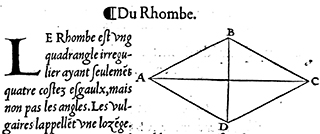
In his Livre singulier et utile, touchant l’art et practique de geometrie (A Singular and Useful Book Concerning the Art and Practice of Geometry, 1542), the mathematician Charles de Bovelles (1479–c. 1566) writes: "The rhombus is an irregular quadrilateral with four equal sides […]. Ordinary people call it a lozenge."
There is a synonym of Greek origin: rhombe, from the Greek rhombos ("spinning wheel", "spinning top", "turbot"). The term has become somewhat obsolete in French, but has returned through the English word rhombus, the English name for the shape. In Italian and Spanish, it is called rombo. In French, it gave rise to the adjective "rhombic". A rhombic polyhedron is a polyhedron whose faces are rhombuses (see the article "Des losanges plein l'espace", Rhombuses Everywhere). The best-known examples are the rhombic dodecahedron and the rhombic triacontahedron. A rhombohedron is a polyhedron made up of six rhombuses; the term was coined in 1818 by the crystallographer André Brochant de Villiers (1772–1840) to replace "rhomboid", the term used by his colleague René Just Haüy (1743–1822).
In heraldry
-------------