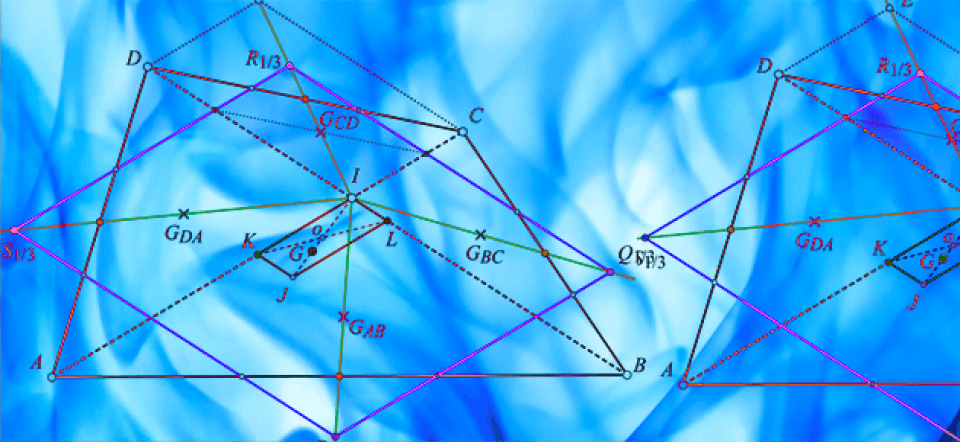
A simple quadrilateral ABCD is a closed polygonal chain joining the vertices A, B, C, D and A, in that order, and thus defining an interior and an exterior. It is said to be convex if every line segment joining any two of its points lies entirely within its interior. Equivalently, the quadrilateral lies entirely on one side of every line through two consecutive vertices. Parallelograms and trapezoids are therefore always examples of convex quadrilaterals.
Pierre's quadrilateral
----------------------
General theorems about polygons, chiefly triangles and quadrilaterals, have been established since antiquity. One of the most famous is undoubtedly Ptolemy's theorem, which characterizes cyclic quadrilaterals (see box).
A more elementary result was obtained by Pierre Varignon (1654–1722), along with various variants and generalizations. Let P, Q, R and S be the midpoints of the sides of quadrilateral ABCD.
####