



Math for everyone
Mathematical content accessible to everyone

Squaring polygons
Archimedes' Stomachion, the world's oldest puzzle, can produce thousands of shapes from fourteen polygonal tiles. But what about the inverse problem? Under what conditions do two given polygons have a common polygonal dissection, and how can one be found?

Maulnes Castle: Renaissance architecture on a pentagonal plan | Tangente
Few people know that less than 200 km from Paris stands a Renaissance castle built to a pentagonal design. Only a handful of such buildings can be found anywhere in the world...
When polygons form numbers
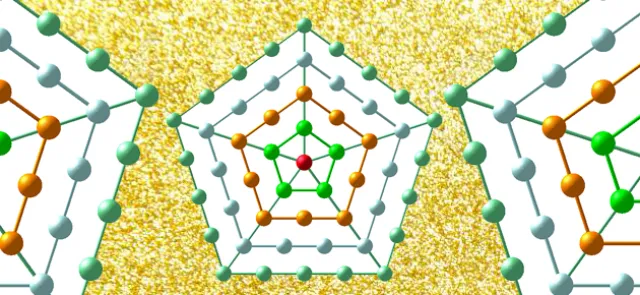
All is number! The Pythagorean school established many properties of numbers from their geometric representations. First developed for triangles and squares, this way of arranging numbers was later extended to all kinds of polygons.
Pentacles and pentagrams: symbols and mathematics | Tangente
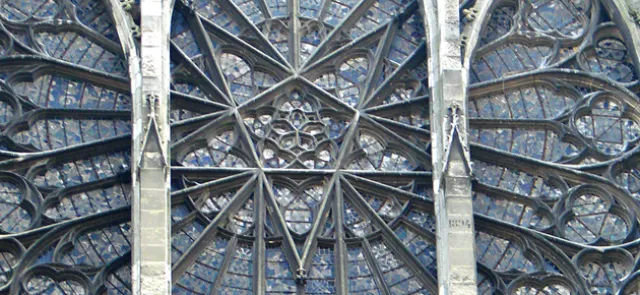
The pentagram, also known as the star pentagon, is a non-convex pentagon formed by joining every other vertex of a regular pentagon. It has journeyed through the ages and across civilizations, always shrouded in mystery.

Largest small polygon: max area at fixed diameter | Tangente
Let us consider polygons of diameter at most one—that is, polygons in which the distance between any two points is no greater than one—and determine which has the greatest area.

A little gem from Gauss
Triangles and quadrilaterals have inspired a wealth of mathematical literature. Yet few people seem to have taken a close interest in pentagons before a certain Carl Friedrich Gauss, who gave us a little gem for calculating their areas.
Robbins pentagons
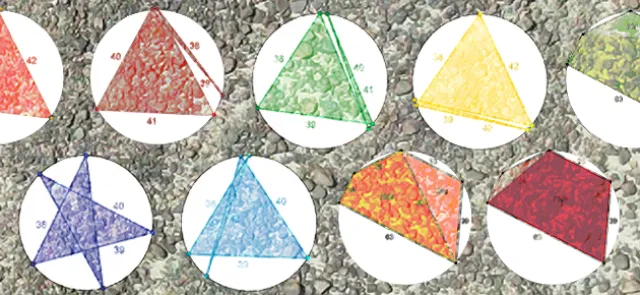
While the geometry of triangles and quadrilaterals has been studied in detail for many centuries, the geometry of pentagons has only recently begun to be explored. Let's follow in the footsteps of Heron, Brahmagupta and Robbins.

Pythagoras and Heron
Heron's formula emerges when we seek to express the area of a triangle in terms of its side lengths. A variation of the argument recovers the Pythagorean theorem.

Heptadecagon: fact and fiction
Theory tells us that a regular seventeen-sided polygon—a heptadecagon—can be constructed using only a straightedge and compass. But it gives no details of the construction, which is far from straightforward.

Tangential quadrilaterals
Engineer Henri Pitot (1695–1771) is remembered for the tube that bears his name, which he proposed in 1732 to "measure the speed of flowing water and the wake of ships" and which is still widely used in aerodynamics. But geometry was this self-taught scholar's first love.

Polygon taxonomy: triangles and quadrilaterals | Tangente
Just as a taxonomist inventories and classifies living species, whether animal or plant, let us classify the simplest polygons by comparing their angle measures and side lengths.
Pick's theorem: an inspiring formula for polygonal area | Tangente
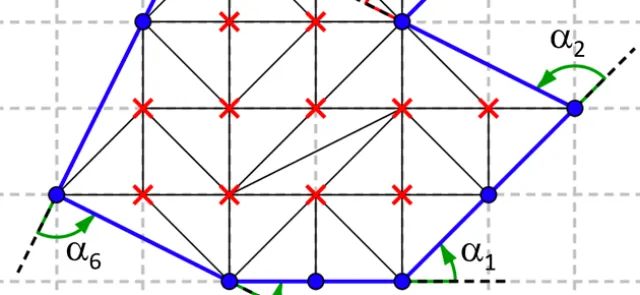
Some theorems, through the simplicity of their statements and the originality of their proofs, become enduring examples of mathematical creativity. Pick's theorem is one such example.
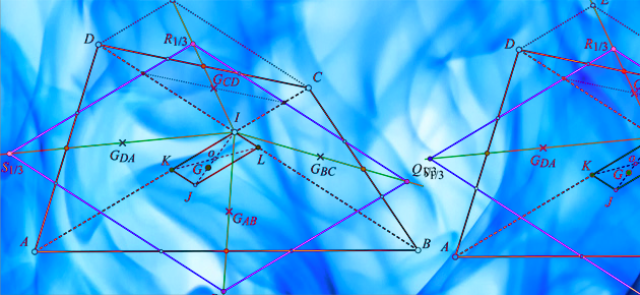
Convex quadrilaterals
Three sides completely determine a triangle, up to orientation. With four sides, infinitely many polygons can be constructed. Nevertheless, many general properties can be established for arbitrary convex quadrilaterals.

Inside and outside a polygon | Tangente
How can we systematically determine whether a point lies inside or outside a polygon? Several algorithms, including the "ray-crossing method," solve this problem.

The pitfalls of polygon convexity | Tangente
The word convex comes from the Latin convexus, meaning "rounded". What does this mean mathematically?

Regular polygons
Regular polygons are particularly harmonious, thanks to their symmetries. At first glance, one might think they had long since yielded all their secrets. Yet the notion of duality reveals a wealth of surprises.
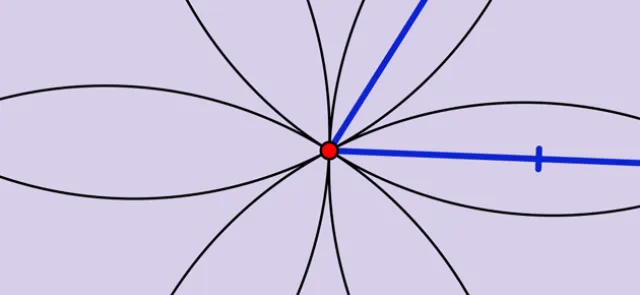
A few constructions
It is always useful to know how to construct the first constructible regular polygons with straightedge and compass. These procedures directly provide methods for calculating the various lengths in the figure.

What is a polygon? A rigorous definition | Tangente
The definition of a polygon seems intuitive and obvious. Yet when we try to pin down this mathematical object more precisely, several definitions are possible, and the most recent ones may defy common sense.

Quadrilateral types and names | Tangente
For the familiar convex quadrilaterals, the classification criteria are, first, whether the sides are parallel, then whether their lengths are equal, and finally whether there are any right angles.

All about triangles: types and names | Tangente
Thanks to its simplicity, the triangle is surely the king of polygons. As its name suggests, it has three angles and therefore three sides.