



Amazing Math
Surprising or counterintuitive mathematical results and proofs
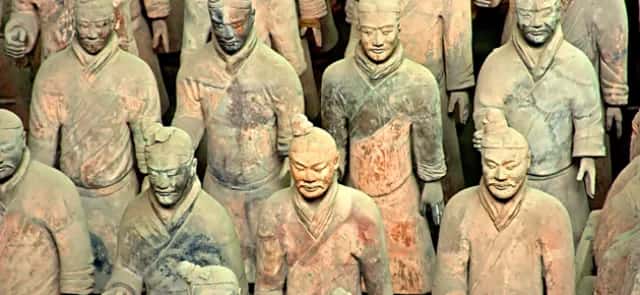
The Chinese remainder theorem
The periodic nature of planetary revolutions naturally gives rise to the notion of congruence. The earliest surviving written problem on this theme is known as the Chinese remainder theorem. Its universality has led to many fundamental applications in the theory of numbers and polynomials.

An incongruous little tour through the world of congruences
Cooks have long known that making the most of leftovers is an art. The same is true in mathematics, where congruence is a remarkably rich concept. This notion has applications ranging from everyday life to highly theoretical settings.
Are the French averse to assessment? | Tangente
An attempt to analyze young French people's poor performance in international assessments.
Littéramath: the mathematical literature site | Tangente
A project highlighting the links between mathematics and literature
Constant mean curvature surfaces
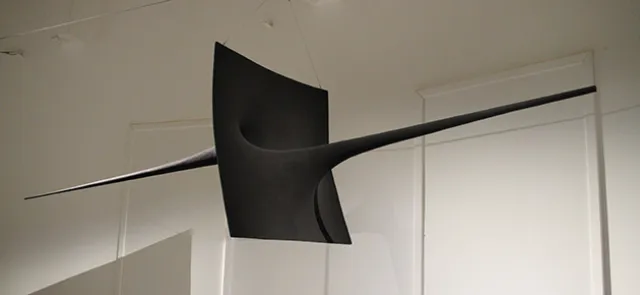
The study of surfaces still holds plenty of surprises! Anyone who enjoys making bubbles with soapy water will be familiar with minimal surfaces. Constant mean curvature surfaces, such as catenoids and unduloids, are less well known.
From intuition to rigor:
From Cauchy to Weierstrass, rigor steadily took hold in analysis throughout the 19th century. A variety of counterexamples swept away mistaken beliefs and forced mathematicians to define the relevant concepts more precisely. Some "monstrous" functions were introduced, fascinating to some and repellent to others.
A history of modular arithmetic
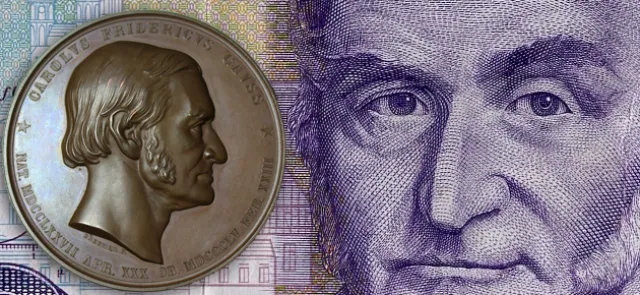
The idea of working with the remainders obtained when numbers are divided by certain integers, rather than with the numbers themselves, gradually gained ground. Gauss formalized the idea with his notion of congruence, giving rise to modern modular arithmetic. Congruences have quite a history!
Poincaré: psychology of mathematical invention | Tangente
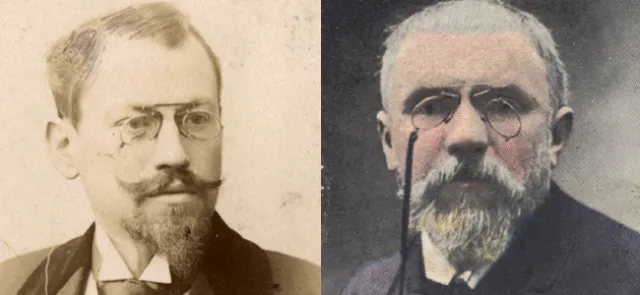
Henri Poincaré wrote extensively about his experience as a mathematician and the role of intuition in mathematics. Less well known is that he also agreed to take part in a clinical study conducted by the psychiatrist Dr Toulouse. Even so, the origins of mathematical creativity remain mysterious.
Poincaré and his heirs: the documentary | Tangente
Henri Poincaré, l'harmonie et le chaos (Henri Poincaré: Harmony and Chaos) is a 53-minute documentary made by Philippe Worms in 2012 and available online. Its unusual premise: the director brought six scientists together in a manor house for a weekend and filmed their informal conversations about Henri Poincaré.

Euclid's algorithm, et cetera
A history of arithmetic—or how an algorithm dating from the third century BCE has endured through the ages and evolved to serve modern disciplines, particularly computer science and cryptology.

Creators' secrets
Where do ideas come from when creating a mathematics problem? How can anyone still find original material when so many topics have been explored over the centuries? How do you keep coming up with something new after devising hundreds of problems? How do you entice and engage the reader?
Martin Gardner's challenge: paradoxes | Tangente
Can a game in which one player's gain is the other's loss benefit both players? That was the question Martin Gardner posed in 1980 with his "Loser Takes All" problem. More than forty years on, the paradox remains as relevant as ever!
A Goncourt for a mathematician | Tangente
Mathematics scored twice in 2021, with two Goncourt Prizes.
Friendship among numbers | Tangente
In mathematics, being amicable is not the same as having friends...
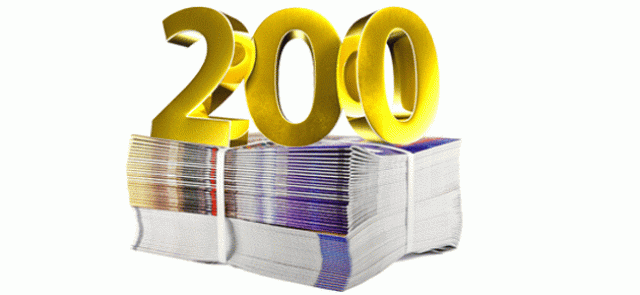
200, a number like no other!
It can be written as a numeral, 200, or in words, two hundred. Even so, at first glance, the number does not seem particularly interesting. Admittedly, it is not perfect, unlike the eponymous issue of Tangente, but, like Achilles, it is powerful... and therefore fascinating. Here is a brief survey of its arithmetic properties.
Timeless mathematical puzzles | Tangente
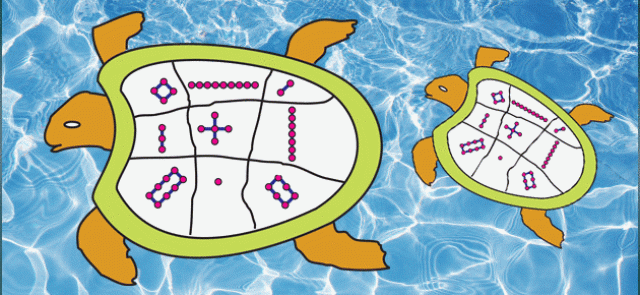
Puzzles have been part of human culture since earliest antiquity. At first, inventing puzzles was bound up with mythology or religion; gradually, it became a purely intellectual game, independent of any purpose or practical application.
Xenakis’s UPIC: mathematics and music | Tangente
One of the pioneers of the digital revolution in music was the composer Iannis Xenakis (1922–2001). Music has always had an underlying structure closely related to mathematics, but with a composer like Xenakis, this synergy found concrete expression.
Penrose and the Kleenex affair | Tangente
In the 1970s, Roger Penrose filed patent applications for several of his aperiodic tilings (!) and founded a company, Pentaflex, to manage the patent rights.

Stochastic processes:
How can we model a phenomenon that evolves randomly over time? To tackle this question, it was first necessary to ask what randomness is, formalize it, and incorporate it into mathematical models. That is what stochastic processes seek to do.
Homo academicus in his labyrinth | Tangente
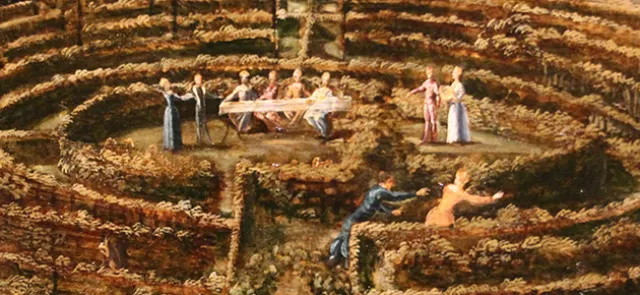
Exploring the literary corpus offers an opportunity to highlight some of the logical and paradoxical arguments that can be brought to bear. Let us take a closer look at Le Stratagème (The Stratagem), a story from Jorge Luis Borges's Le Livre de sable (The Book of Sand).