



Math for everyone
Mathematical content accessible to everyone
Statistics comes into vogue: music and maths | Tangente
Largely independently of scientific development, a craze for statistics swept through France from 1827 onward.
How is life expectancy calculated? | Tangente
Life expectancy is undoubtedly one of the most widely used statistical indicators. Yet how it is calculated sometimes remains a mystery.

Automated classification: K-means | Tangente
Your data collection has been highly effective: you now have a scatter plot revealing an impressive point cloud. How can these points be grouped into classes? How many classes will emerge? Today’s methods are advanced enough to automate the process.
Random sequences—Monte Carlo method | Tangente
Random numbers are used to obtain approximate numerical solutions to problems that may be too difficult to solve exactly (Monte Carlo methods are a typical example).
Extreme values — rare events | Tangente
The human, economic and financial repercussions make it essential to guard against extreme risks—that is, events that are unlikely to occur but have a major impact.
GPS: Mathematics and positioning | Tangente
By knowing the Sun's altitude above the horizon and the exact time, navigators were able to determine their longitude and latitude.
What makes modern statistics distinctive | Tangente
Anne Philippe is a professor at Nantes Université and a statistics researcher at the Jean-Leray laboratory. Since 2021, she has served as president of the French Statistical Society (SFdS).
Wittgenstein and the philosophy of mathematics | Tangente
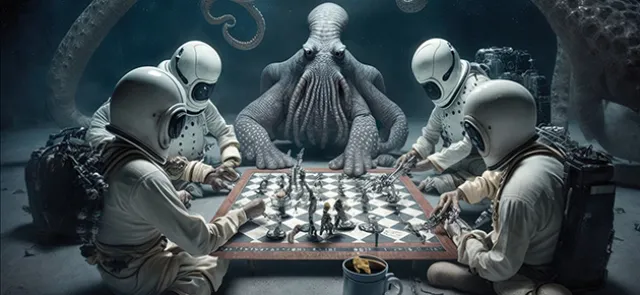
The relationship between language and reality lies at the heart of Wittgenstein's thought. The issue takes on its full significance when it comes to mathematical entities. What if philosophers speculating about the rigorous logical foundations of these abstractions were on the wrong track?
Artists’ visions: knots in art and maths | Tangente
Three artists share their visions of knots.
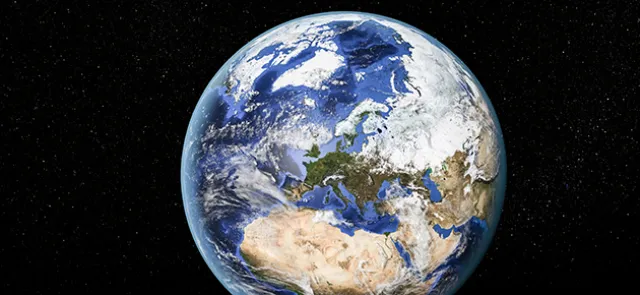
Stereographic projection
Since 2021, the Bourse de commerce in Paris has been open to the public, showcasing contemporary art from the Pinault Collection. Its superbly renovated interior offers mathematicians an opportunity to explore… stereographic projections!

Vaughan Jones, a "pure genius" of knot theory
If ever there was a knot theorist, it was Vaughan Jones. This New Zealand-American mathematician, a 1990 Fields Medalist, is now renowned worldwide for his contributions to knot theory. French mathematician Alain Connes (born in 1947 and himself a Fields Medalist) described his discoveries as "work of pure genius".
Optimal control and Zermelo problems | Tangente
A particularly important class of optimal control problems consists of Zermelo-type problems: their applications have proved rich and fruitful in mathematics… and beyond. They are studied using a combination of geometric and numerical methods.
The sphere effect
The sphere came to be seen as a model of the world because of its perfection. Greek mathematicians soon sought to measure its properties, laying the groundwork for calculation techniques that would not bear fruit until centuries later.
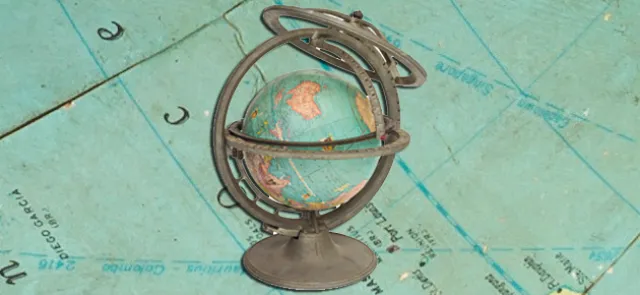
Mapping and the geometry of the Earth | Tangente
Understanding the shape of the planet we live on, and then depicting it, has been an adventure since the earliest days of antiquity. At every stage, the model has been refined and improved, drawing ever closer to the one we use today: the geoid.
Links and graphs: a two-way connection | Tangente
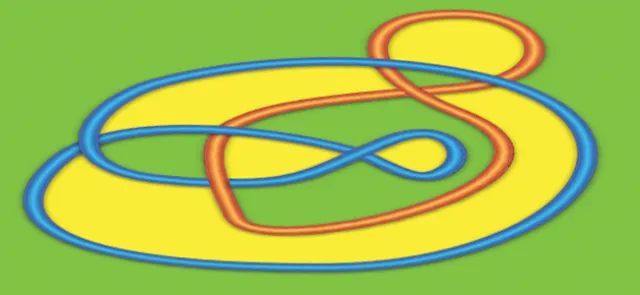
What do links and planar graphs have in common? They are connected by a relationship that associates a graph with any given link and, conversely, provides a simple way to encode—and therefore draw—any link using a graph.
Identifying knots with Gauss codes | Tangente
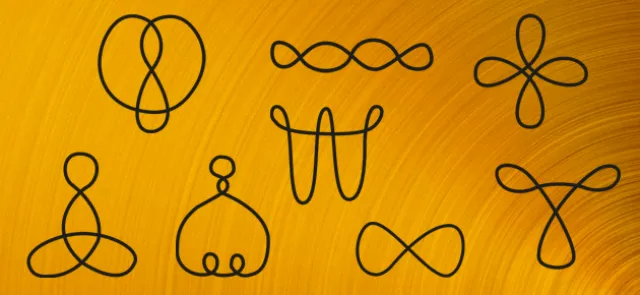
A visual encoding introduced by Gauss to make knots easier to recognize and manipulate leads to surprising developments in combinatorics, algebra and topology. Armed with paper, pencil and a few pieces of string, let's explore this world.

Classifying knots: topology and invariants | Tangente
Knots can be combined to form new ones—or, conversely, simplified. We can borrow the vocabulary of number theory and classify them rather like the chemical elements. What varied and unexpected facets knot theory has!
École polytechnique’s maths special | Tangente
La Jaune & La Rouge, the monthly magazine of the École polytechnique alumni and graduates association (AX), devotes its February 2023 feature section to mathematics.

Charles V's letter finally deciphered | Tangente
An encrypted letter from Charles V (1500–1558), Holy Roman Emperor, addressed in 1547 to Jean de Saint-Mauris, his ambassador to the king of France, and housed in the autograph collection of the Bibliothèque Stanislas in Nancy (Meurthe-et-Moselle), has just been not merely read but deciphered. Long passages in the letter are encoded.
AI improves the general algorithm for matrix multiplication
Every science student knows how to multiply two matrices. So why call it an "open problem"?