



Geometry
Explore mathematics articles on the theme of geometry.

Art Nouveau: a movement of curves | Tangente
Art Nouveau was a total art movement that flourished across several European countries in the late 19th century. Never before had an artistic movement placed such emphasis on the beauty and variety of curves.
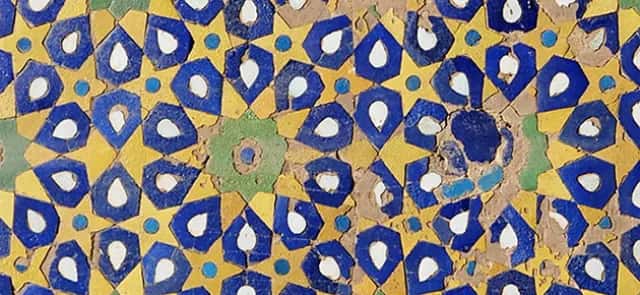
Persian tilings and Islamic geometry | Tangente
A highly debatable approach to Persian pentagonal patterns has been repeated so indiscriminately in scientific journals that it has become received wisdom. It is high time to offer another perspective.

Kissing numbers: kisses in geometry | Tangente
Kiss anyone you like...

Optimal packing of squares in a larger square | Tangente
You'll never arrange your boxes the same way again!
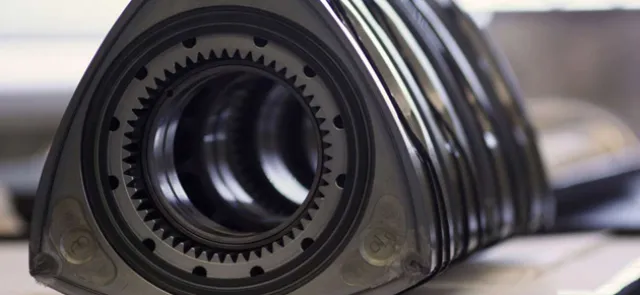
Rollers: when a triangle rolls | Tangente
The circle always seems to be the ideal shape for moving an object on rollers. Yet this is not so: a kind of equilateral triangle with rounded sides proves better suited to certain everyday situations.

Cosmology and polyhedra: Plato to Kepler | Tangente
Regular polyhedra appear in many theories. These five solids fascinate us with their remarkable symmetries.

Equilateral triangles from any triangle | Tangente
There are at least two ways to derive an equilateral triangle from any triangle T—in other words, to obtain a triangle with the greatest possible symmetry from one that initially has none.

Simson line and Steiner's hypocycloid | Tangente
This delightful geometric property was familiar to French secondary-school students in the 1970s, although few knew how to prove it.
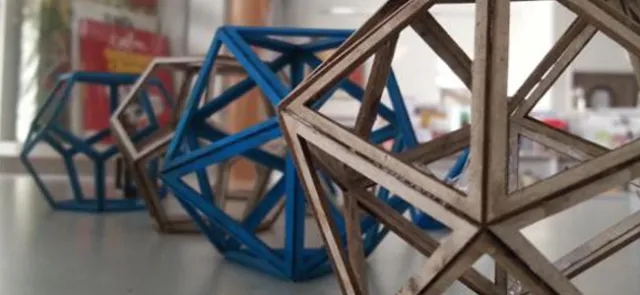
Leonardo da Vinci, master of polyhedra | Tangente
Leonardo da Vinci studied mathematics with Luca Pacioli, the greatest mathematician of the age. But the pupil soon surpassed the master! The artist-geometer's depictions of polyhedron nets upend some firmly held beliefs about the Renaissance.

Pythagoras: Leonardo's proof | Tangente
Leonardo da Vinci was not strictly speaking a mathematician, but the subject interested him, as it did many educated men of the Renaissance. We owe him an elegant proof of the Pythagorean theorem.

World harmony dictated by mathematics | Tangente
Beginning with painting, Leonardo da Vinci developed a vision of world harmony governed by mathematics.

South America: Fondation Cartier's ode to geometry | Tangente
Until 24 February 2019, Fondation Cartier is exploring the presence of geometry in art across South America, from Mexico to Tierra del Fuego, spanning pre-Columbian and contemporary art as well as Indigenous American cultures.
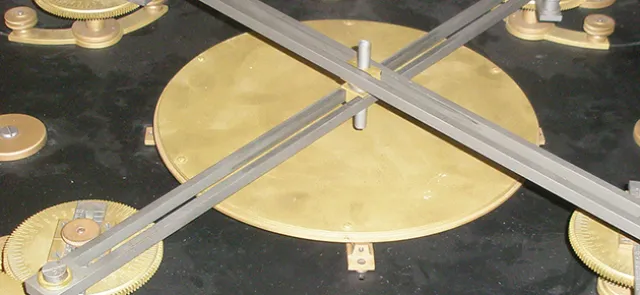
The campylograph | Tangente
At the end of the 19th century, Father Dechevrens, director of the Jersey observatory, devised a curve-drawing machine. Originally designed to plot the paths of the planets as seen from Earth, it could produce many other curves besides epicycles!

Having fun with the number 60 | Tangente
Although 60 is no longer the retirement age, there are still plenty of opportunities to play with the number 60.

Counting without counting | Tangente
Everyday language still bears traces of certain ancient counting practices.

Coloring the plane: when geometry gets involved | Tangente
For plane coloring, we already knew that four colors were enough to color any map so that no two neighboring countries ever had the same color.

Knot theory according to Jean-Michel Othoniel | Tangente
Jean-Michel Othoniel is an original sculptor in more ways than one. His exhibition "Géométries amoureuses" was held in Sète (Hérault) in 2017, and his current exhibition "Face à l'obscurité" has just closed at the MAMC in Saint-Etienne (Loire).
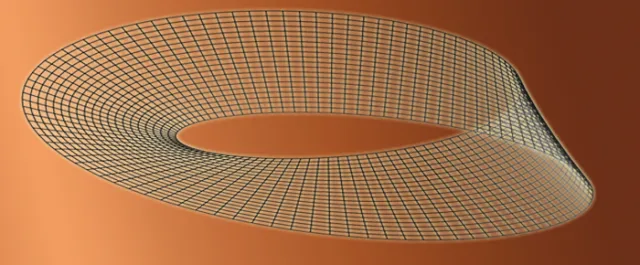
This is not a Möbius strip! | Tangente
Think you know everything about the Möbius strip, topology's quintessential object? Think again! Paper models of it have thickness, which undermines some of their properties. Let's explore these subtleties.
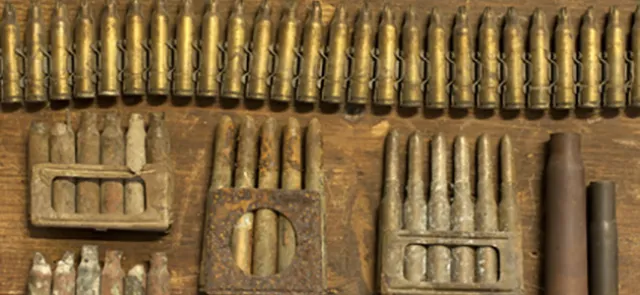
Artillery detection: trigonometry in World War I
During the Great War, artillery caused two-thirds of all casualties. Locating enemy batteries was therefore important so that counter-battery fire could silence them. Surprisingly, the search leads to an old geometry problem!

The Archimedean hairspring at the heart of watchmaking
Once again, we turn to a "spiral"—not in a field or on a canvas, but… inside a watch.