



Geometry
Explore mathematics articles on the theme of geometry.

Kinetic art and geometry: Vasarely, Le Parc, Morellet
The last time Argentine sculptor and painter Julio Le Parc exhibited in New York was in 1973. The artist has just brought a successful exhibition in Paris to a close at the Perrotin gallery in the 3rd arrondissement. In the meantime, kinetic art had faded from view.
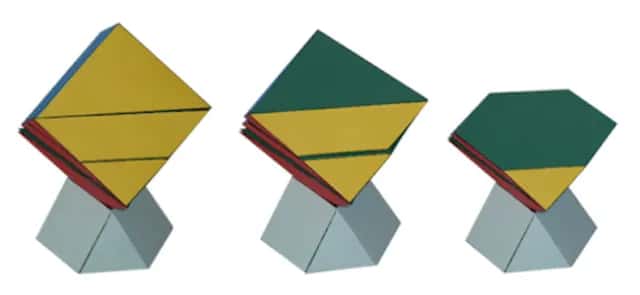
Making a sliced cube: net and assembly
Theory done—now for the hands-on part! Build your own sliced cube. A photo sequence illustrates each stage of the process step by step. Grab some glue and scissors, download and print the pieces to cut out, and... have fun!
The cube’s geometric tricks: cross-sections and symmetries
The cube is such a familiar object that few people know its formal name: the regular hexahedron. Yet that familiarity is deceptive... To see why, let’s slice a cube into sections: this old familiar shape still has a few surprises in store!
The ruler: history of a measuring instrument
Let's rediscover this object we think we know...

Trompe-l'oeil geometry: razzle dazzle camouflage
Hard though it may be to believe, geometry has sometimes helped to fight the enemy in wartime—or at least to limit the severity of its attacks.

The first America: Mathematical cartography in 1507
This little "green globe," dating from the early 16th century and measuring just fourteen centimeters in diameter, is the first to bear the name "America"—in four places, no less, as if to proclaim the discovery beyond doubt.

The fascination of gears: geometry and mechanics
Gears are both objects of fascination and symbols of mechanics. Determining the shape of their teeth is a sophisticated mathematical problem. Yet this long history, which stretches back to antiquity and is still being written, remains remarkably little known!
Best illusion of 2017: Dynamic Müller-Lyer
The 2017 edition of the Best Illusion of the Year Contest, an annual international optical-illusion competition, took place in early October.

Spiral Jetty: Great Salt Lake's mathematical spiral
In 1970, American land-art pioneer Robert Smithson used bulldozers to create an enormous spiral of volcanic rock northeast of the Great Salt Lake, in Utah, in the western United States

Tangente turns 30 in Brussels | Tangente Magazine
Tangente is also celebrating its 30th anniversary in Brussels. Here is the programme, built around the theme "Popularizing isn't vulgar!".
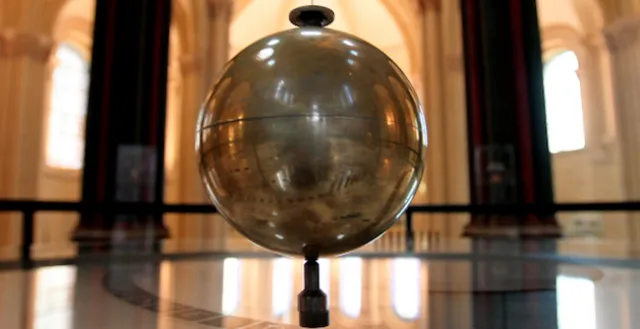
Tangente's 30th anniversary program | Tangente Magazine
Here is the programme (which will be updated regularly) for Tangente's 30th anniversary celebrations at the Musée des arts et métiers on Sunday, December 3, 2017. Admission is free for everyone!

No doubt about it | Tangente Magazine
We were used to highly faceted origami figures with clearly visible folds. Now a group of Austrian researchers has given these forms much smoother contours.

Malevitch: Geometry at the heart of Suprematism
A hundred years ago, the artist Kasimir Severinovitch Malevitch (1878–1935) was appointed commissioner for the preservation of buildings and the arts
The Earth in a ping-pong ball: Nash–Kuiper
Nothing is mathematically impossible! Although, back in the 1950s, the Dutch mathematician Nicolaas Kuiper and the American John Nash had already proved the existence of a vast class of paradoxical mathematical objects (flat tori in 3D, shrunken spheres…), they lacked the tools to visualize them

Maryam Mirzakhani: a star has just gone out | Tangente
The brilliant Iranian mathematician Maryam Mirzakhani died of breast cancer on 15 July 2017, at the age of 40

Fractals in film: from geometry to special effects
Fractal geometry was central to the earliest computer-generated imagery on the big screen. The study of self-similar forms found in nature gave rise to the first computer-generated images… and thus spawned an entire entertainment industry!
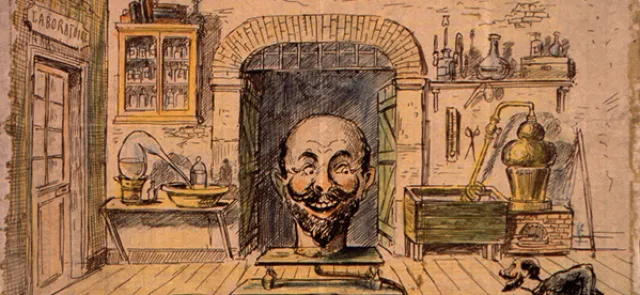
Georges Méliès: special effects, anamorphosis and maths
Georges Méliès is often described as the creator of cinematic spectacle, while the Lumière brothers are the inventors of the cinematograph. In fact, Méliès was passionate about technology. He found solutions to problems that can readily be expressed in mathematical terms.
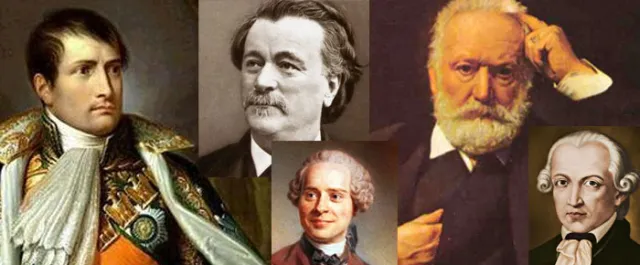
Mathematical calligrams | Tangente Magazine
A calligram is a poem arranged on the page to form an image, usually related to its subject. Here we present several quotations about mathematics in the form of calligrams.
Poets talk to us about math… and vice versa
Mathematics and poetry are two ways of making sense of the world. Worlds apart? Not quite.

Holiday geometry | Tangente Magazine
The holidays are also a chance to uncover the mathematics all around us