



Mathematical Themes
Explore the major mathematical themes: geometry, algebra, analysis, arithmetic, logic, and many other fascinating fields.

Marie Lhuissier awarded the d'Alembert Prize | Tangente
Marie Lhuissier is the 2022 winner of the Société mathématique de France's d'Alembert Prize.

The Mathematics of Tchoukaillon
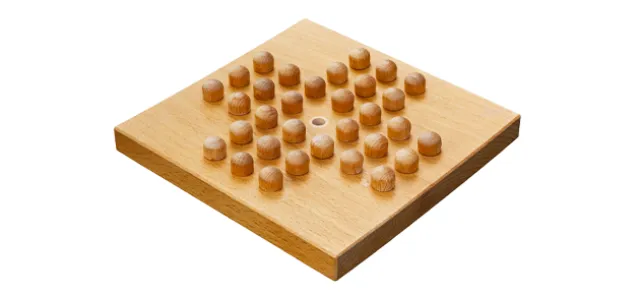
Mancala is the generic name for traditional sowing games in Africa and Asia. One of the solitaire variants of these games gave rise to a mathematical recreation with unexpected properties and consequences.
Solitaire on a line
Are solitaire games board games? Whatever answer you give to that question, this article and the next show that their mathematical treatment is in no way inferior to that of multiplayer games.
A family of five games: Blokus and its variants | Tangente
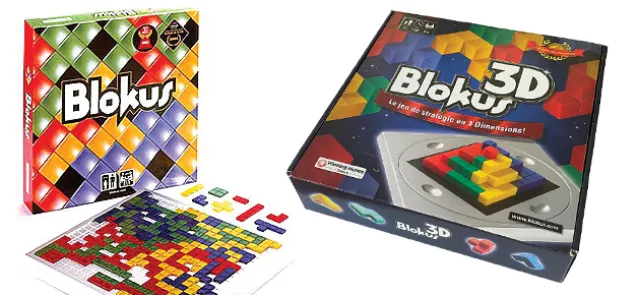
What's presented here isn't a game of five families, but a family of five games (siblings and cousins!) — blocking games, in which a player leaves the game once they can no longer play. All of them concern geometry. In particular, the pieces in these games take many forms, made up of squares, triangles, line segments and cubes.

Quarto!: Combinatorial reasoning and strategy | Tangente
Shape, color, size and topology (with or without a hole) are the four characteristics of a Quarto! piece. Since each has two possible values, the players facing off in this thrilling combinatorial game — one of the most award-winning in the world — must contend with sixteen pieces.

The projective geometry behind the Dobble game | Tangente
You would never guess it while playing Dobble: combinatorics, projective geometry and modular arithmetic can offer a new approach to constructing the game's various variants.

Mathador: the mental arithmetic game | Tangente
Mathador (Réseau Canopé, L2D), inspired by the famous television game shows "Des chiffres et des lettres" and "Le compte est bon", was created in 1999.
GTO: game theory applied to poker | Tangente
Game theory is not reserved for games "with complete information." It also applies to games where chance plays a part. In poker, it has today given rise to tools, available to online players, that let them play optimally in the first round of betting.
Learning maths through Go at school | Tangente
With adapted rules and smaller boards, Go provides a way to learn mathematics that can be introduced as early as preschool.
Ko in Go: rules and strategies | Tangente
A ko arises when a stone is threatened with capture, but after the opponent captures it, the capturing stone is itself in a position to be captured.
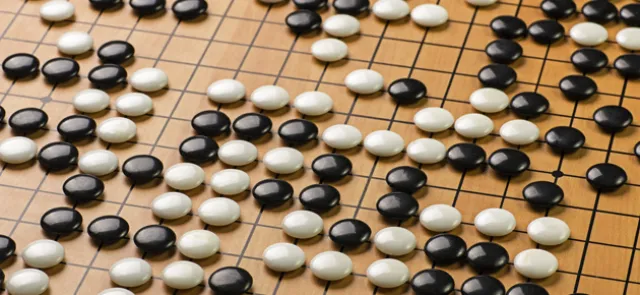
A short mathematical history of the game of go
Both millennia-old, as a game and as a science, go and mathematics are two worlds of phenomenal depth that intertwine, enrich each other, and shed light on one another. Go constantly draws on various forms of mathematics, to the point of becoming a research subject in its own right.

Grundy's game: graphs and winning strategy | Tangente
Graphs are crucial to strategies in games of complete information, provided the positions are not too numerous and can be represented. Patrick Grundy devised a game to formalize these strategies.

Symmetric play in chess: does it work? | Tangente
In some two-player sequential games with complete information, one player may be tempted, when possible, to mirror the opponent's moves. When this gives one player a winning strategy, the game loses all interest unless the rules are changed to avoid this pitfall.
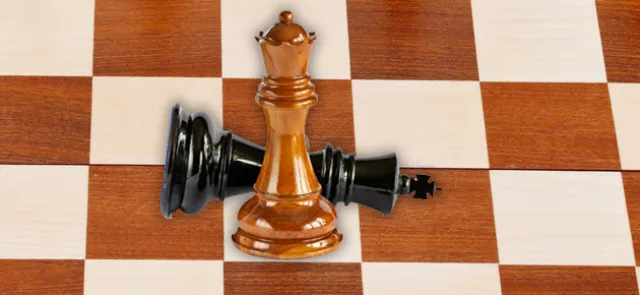
A strategy for moving the queen
Two players take turns moving a queen across a chessboard. This seemingly innocuous game offers a way to discover and illustrate a major result in game theory: the Sprague–Grundy theorem. It also has another mathematical surprise in store…

Welcome to regulous geometry
Algebra and geometry are intimately linked. Building a kind of dictionary between the two makes it possible to solve questions elegantly that would remain extremely difficult without these complementary perspectives. We can even have fun constructing new geometries…
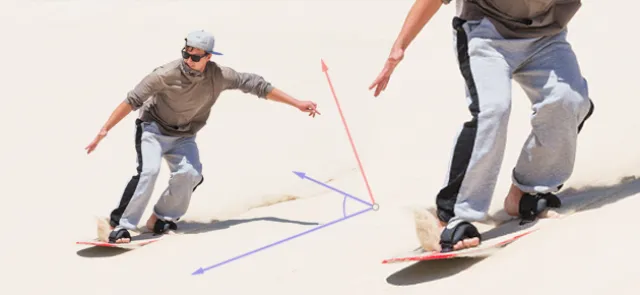
Polar vectors and axial vectors
In physics, forces and velocities are usually represented by vectors, mathematical objects with both magnitude and direction. Yet their behavior under a change of frame reveals two types of vectors, depending on the orientation of space: polar and axial.

Mathematics points the way
We encounter broken symmetries every day, allowing us to distinguish up from down and right from left. Likewise, when objects in our mathematical spaces can be oriented, their orientation inevitably rests on an arbitrary definition.

Tangente Awards 2022: take part | Tangente
As usual, the Club Tangente is delighted to invite you to take part in several awards. Whether or not you read Tangente, there is bound to be a category that sparks your interest.

A tribute to Gérard Cohen-Zardi | Tangente
Sad news. A few days after André Antibi, another friend of Tangente has passed away. Gérard Cohen-Zardi, who taught mathematics at the Université de Jussieu, was passionate about popularizing mathematics and exploring its links with other disciplines.

A delightful conjecture by Paul Erdős…
The convergence of certain series is a classic topic in analysis (see Suites et Séries, Bibliothèque Tangente 41, 2011). For example, it is fairly easy to prove that the harmonic series—the sum of the reciprocals of the positive integers—diverges.