



Mathematical Themes
Explore the major mathematical themes: geometry, algebra, analysis, arithmetic, logic, and many other fascinating fields.
Bachelier, father of financial mathematics | Tangente
In 1900, the young French mathematician Louis Bachelier defended his doctoral thesis on Théorie de la spéculation (Theory of Speculation) at the Sorbonne.
Poincaré's mathematical physics lectures | Tangente
In the second half of the 19th century and the early 20th century, Henri Poincaré was the sole scientist keeping alive the great French dynasty of mathematical physicists, whose ranks included Laplace, Ampère, Poisson and Fourier.

Henri Poincaré prize in mathematical physics | Tangente
The Henri Poincaré Prize, sponsored by the Daniel-Lagolnitzer Foundation in partnership with the International Association of Mathematical Physics, now ranks among the major scientific prizes.
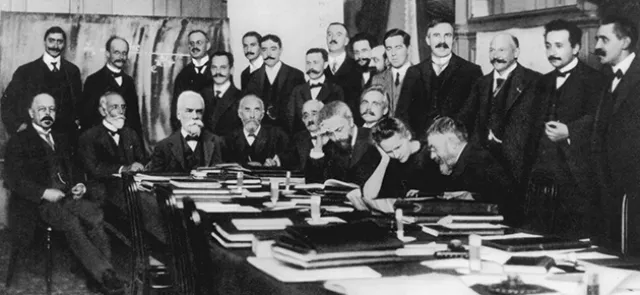
Poincaré and the context of the Belle Époque | Tangente
Poincaré's era was exceptionally fruitful for science: the twenty years around 1900 saw extraordinary conceptual advances and feats of intellectual ingenuity, fostered by increasingly international exchanges through publications and meetings.
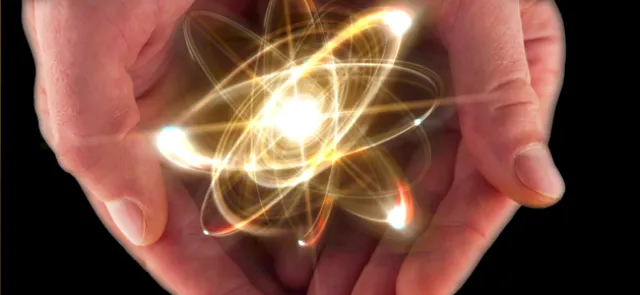
Special relativity: Poincaré forgotten? | Tangente
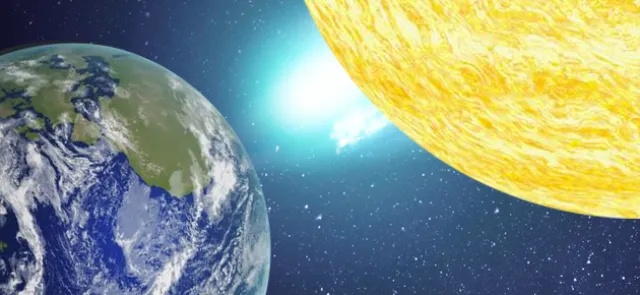
At the dawn of the 20th century, spectacular advances in science reveal the limitations of Newtonian theories in physics. A revolution is in the air, and it will take shape with the advent of general relativity. Many scientists, including Lorentz and Poincaré, are working towards it. History will remember Einstein, who publishes a groundbreaking paper in 1905.
The origins of chaos theory with Poincaré | Tangente
The birth of "deterministic chaos" grew out of Henri Poincaré's entry for a prize offered by King Oscar II. The French mathematician's paper would go down in history for containing a major error—one that proved extraordinarily fruitful for science.

Archives Henri-Poincaré: history of science | Tangente
A transdisciplinary team built around Henri Poincaré's name and work
Poincaré, the last great polymath | Tangente
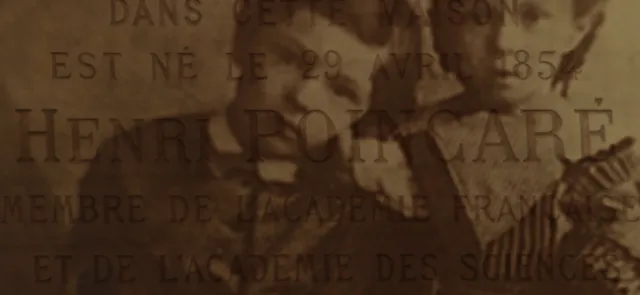
Henri Poincaré embodies an ideal of scientific unity: he mastered every field of science in his day. His name remains associated with a staggering number of mathematical ideas, concepts and objects. More than a century after his death, he continues to inspire mathematicians, physicists and philosophers.

Poincaré: a frequent traveler to scientific congresses | Tangente
Henri Poincaré traveled extensively for academic visits, meetings, and lectures.

Poincaré and free inquiry in Brussels | Tangente
"Freedom is to science what air is to an animal; deprived of freedom, science dies of asphyxiation, like a bird deprived of oxygen."
Poincaré's childhood utopian government | Tangente
In 1867, having just visited the Exposition universelle, 13-year-old Henri came up with the idea of establishing a three-part system of government in the large garden at Arrancy, where he spent his holidays: a kind of federation he called Trinasie.
Mathematical events in Europe | Tangente
The new Pop Math website aims to catalogue mathematical events across Europe.
Beyond the white dimension | Tangente
A Tale of Synapse is a video game that immerses players in a mathematical universe.
Poincaré's irony about logicism | Tangente
Henri Poincaré regarded experience and intuition as essential to the foundations of mathematics. He was therefore often ironic, even caustic, toward those who relied on abstract logic to provide a foundation for arithmetic

Poincaré vs Hilbert: intuition and logic | Tangente
The debate between Henri Poincaré and David Hilbert illustrates two opposing views of the nature of mathematics.

Tokyo Olympics: a mathematician strikes gold | Tangente
Mathematician Anna Kiesenhofer won a cycling gold medal at the Tokyo Olympic Games.
Jacques Dominioni, painter of geometry | Tangente
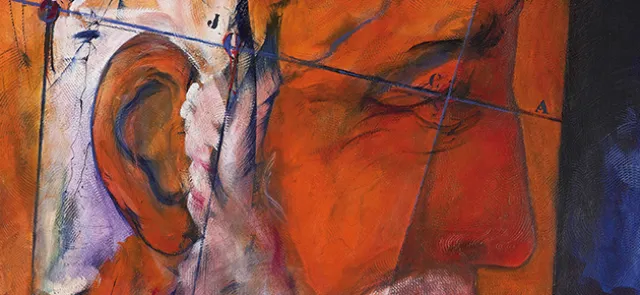
The work of the painter Jacques Dominioni (1934–2014) belongs primarily to lyrical abstraction. Yet his mastery of basic geometric forms—lines, circles and the grid structure underlying his paintings—is thought-provoking... and moving. Let's explore the different periods of his artistic output.

Euclid's algorithm, et cetera
A history of arithmetic—or how an algorithm dating from the third century BCE has endured through the ages and evolved to serve modern disciplines, particularly computer science and cryptology.

Problem-writing competition | Tangente
To mark the publication of issue 200, Tangente organized a problem-writing competition. Nine of the forty-three puzzles submitted received prizes, but many others deserved one too. We asked the jury members to single out their personal favorites.

Creators' secrets
Where do ideas come from when creating a mathematics problem? How can anyone still find original material when so many topics have been explored over the centuries? How do you keep coming up with something new after devising hundreds of problems? How do you entice and engage the reader?