



Mathematical Themes
Explore the major mathematical themes: geometry, algebra, analysis, arithmetic, logic, and many other fascinating fields.

The rider's technique in show jumping
The properties of centers of mass can be cleverly exploited to improve how a rider and horse clear obstacles. Geometry, too, can serve the cause of sport!

Discovering barycentric curves
Barycentric curves do exist!

Convex sets and line segments | Tangente
It is fairly easy to tell whether or not a subset of the plane is convex.

The mathematics of chance at the heart of physics
The idea of introducing probability measures into models of physical phenomena dates back to the 19th century and runs through the work of Josiah Gibbs. The approach can be illustrated quite simply using... two magnets.
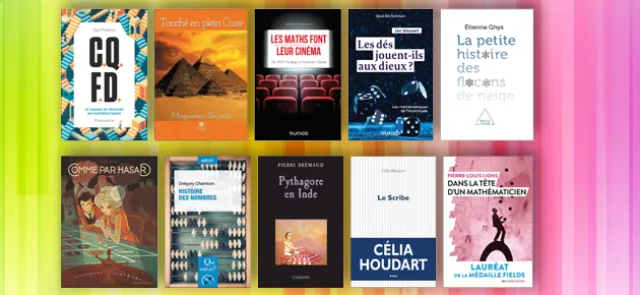
Tangente Awards: take part! | Tangente
The awards organized by the Club Tangente continue to go from strength to strength! Enthusiasm seems to grow every year: publishers keep an eye on the literary prizewinners, while readers submit articles or puzzles and vote for their favorite books.

Elegant problem-solving methods (2) | Tangente
The beauty of mathematical problems often lies in an imaginative method—a "haha," as Martin Gardner called it—that makes the solution seem obvious, provided we can find a fresh perspective.

Area and barycenter
Barycentric coordinates offer a fresh approach to Routh's theorem and its applications to several results in Euclidean geometry.

Weighted systems in astronomy
Planetary systems are represented mathematically using barycenters.
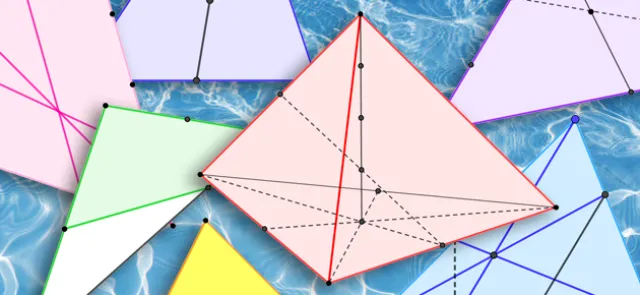
Using barycenters in proofs
First used in physics and mechanics, the concept of the barycenter has proved a rich source of mathematical results. Alignment, incidence, construction and locus problems: geometry can hardly do without it!
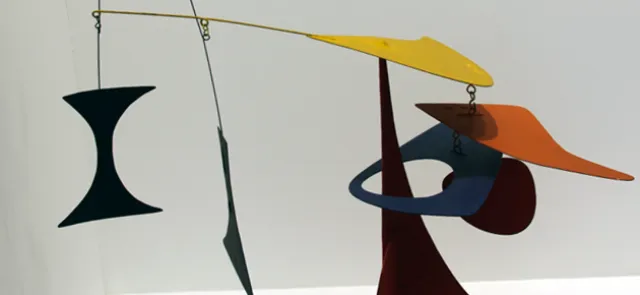
An affine concept inspired by physics
The midpoint of two points and the center of gravity of a triangle are familiar concepts from middle school onward. What do they have in common? How can they be generalized? In the early 19th century, a new approach to geometry put them on a firm mathematical footing through the concept of the barycenter.

Vote for the 2021 Tangente Prize | Tangente
Every year, Tangente's online followers and regular readers are invited to vote for their favorite popular mathematics book.
An Interview with Cédric Villani | Tangente
A 2010 Fields medallist and member of the Académie des sciences, Cédric Villani has become a leading advocate for mathematical culture. In early 2017, following Emmanuel Macron's rise to power, he became an MP for Essonne. What impact has this eminent mathematician's entry into politics had?

The haberdasher's puzzle and Dudeney's puzzle
Any polygon can be cut into finitely many pieces and rearranged to form any other polygon of the same area. This property holds in the plane, but its three-dimensional counterpart is false. It was conjectured by the Hungarian mathematician Farkas Bolyai (1775–1856).

Euler's 36 officers problem | Tangente
In 1779, while the Swiss mathematician Leonhard Euler was at the court of Catherine of Russia, she asked him to investigate a problem that had been circulating in Saint Petersburg for some time, but that no one had managed to solve.

Sylvester's problem | Tangente
In 1893, the British mathematician James Joseph Sylvester (1814–1897) posed the following question in the Educational Times.

Forerunners in mathematics publishing | Tangente
On a more modest scale, several French-language magazines preceded Tangente. Some of those featured on this page even ceased publication to help launch Tangente.

The mystery of the little pyramids
The triangle is undoubtedly one of the simplest figures in the plane, and its geometry is well understood. In three dimensions, however, the study of tetrahedra remains an active field full of surprises! One problem has just been completely solved, more than forty years after John Conway and Antonia Jones first posed it.

Martin Gardner's challenge: paradoxes | Tangente
Can a game in which one player's gain is the other's loss benefit both players? That was the question Martin Gardner posed in 1980 with his "Loser Takes All" problem. More than forty years on, the paradox remains as relevant as ever!

A driving force for innovation in education
Tangente reaches a great many teachers and is also available in secondary-school libraries across France and the French-speaking world. Alongside its initiatives aimed directly at teaching, its support for more diverse approaches to learning has proved extremely valuable. Experts attest to this.

Tangente: a catalyst for mathematical culture | Tangente
A magazine devoted to mathematical culture—that is sure to surprise more than a few people! When Tangente arrived in 1987, it transformed the way mathematics was viewed. It inspired some readers to pursue a path they had never considered and others to embark on initiatives to popularize mathematics. Many prominent figures bear witness to this.