In doing so, he revived the approach of Girard Desargues (1591–1661) and Blaise Pascal (1623–1662), which had been neglected for two centuries, eclipsed by the effectiveness of Cartesian methods. Back in France, he published his Traité des propriétés projectives des figures in 1822. The ellipse, hyperbola and parabola were now simply different guises of a single conic, whose properties invariant under projective transformations he studied. He also introduced the concept of duality, which would subsequently be developed extensively. This new perspective held the seeds of a complete renewal of geometry, shifting the focus from the study of figures to that of transformations.
Poncelet's two theorems
------------------------------
Poncelet's approach makes it possible to prove, in full generality, properties that have concrete interpretations in ordinary geometry.
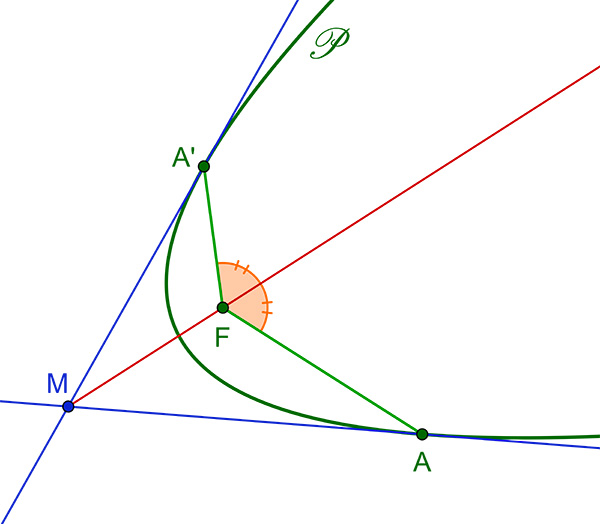
Let be a parabola with focus F, and let A and A' be two points on it. Let M be the point where the tangents to at A and A' intersect. Poncelet's first theorem tells us that the line (*MF ) is an angle bisector of .