



L’analyse mathématique a été créée initialement pour résoudre des problèmes concrets, comme le calcul d’aires, la recherche du maximum d’une fonction ou encore la détermination de la tangente à une courbe. Cette théorie a une longue histoire qui n’a pas cessé de se développer depuis l’Antiquité ; elle repose fondamentalement sur le concept d’infini. À la suite d’Aristote, celui-ci peut être envisagé comme actuel ou potentiel. Croire en l’infini actuel, c’est admettre l’idée que l’infini existe pour de bon et qu’il n’y a pas de restriction à l’utiliser, si ce n’est la nécessité de faire attention. N’accepter l’infini que comme potentiel, en revanche, revient peu ou prou à considérer l’infini comme une idéalité, certes commode mais qui n’existe pas réellement.
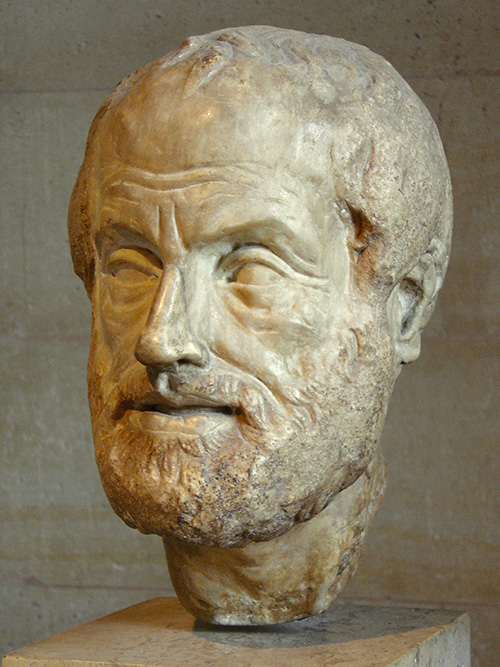
Aristote, philosophe grec du IVe siècle avant notre ère.
Dans sa Physique, il propose, le premier, la distinction entre infini actuel et infini potentiel.
Jusqu’à l’époque de Cauchy, cette ligne de partage définissait plus ou moins deux camps entre les mathématiciens. Les plus réticents rejetaient purement et simplement l’idée des infinitésimaux, c’est-à-dire des quantité « infiniment petites ». Le calcul différentiel et intégral ayant pourtant un besoin impérieux de ce type d’objets, les plus rétifs à l’infini raisonnaient en terme de limites, se cantonnant à un infini potentiel. Leurs opposants, quant à eux, admettaient l’existence d’infinitésimaux, et ils les utilisaient donc comme des outils réels de leur infini actuel.