If we are to believe the German philosopher Friedrich Nietzsche (1844–1900), number was invented out of fear of the incalculable: human reason needed, very early on, to catalogue natural phenomena and to tame uncertainty. Yet existence, by definition, seems to escape the grip of reason. In its literal sense, "to exist" means "to be posited beyond oneself," "to defy all prediction." How can mathematics account for this reality? Is there an equivalence relation between mathematical objects and natural objects?
These questions are at the heart of Galileo's project. In The Assayer, Galileo proposes a model of intelligibility in which mathematical symbols and natural phenomena coincide perfectly; cosmology and experience are no longer separated as they were in the Greek world. He declares: "Philosophy is written in this vast book that stands ever open before our eyes, I mean the universe, but it cannot be understood unless one first learns to comprehend the language and know the characters in which it is written. It is written in the language of mathematics, and its characters are triangles, circles, and other geometric figures, without which it is humanly impossible to understand a single word of it."
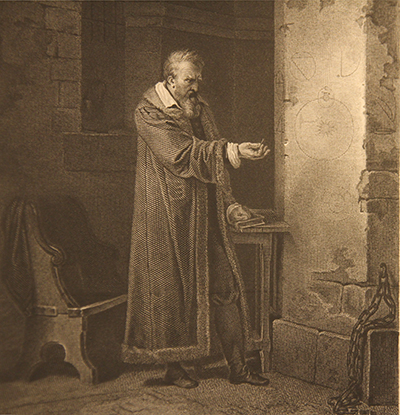
Galileo Galilei (1564–1642) in the prison of the Inquisition. Copper engraving, Antoine Joseph Chollet, 1825, detail, after a painting by Jean Antoine Laurent Le Vieux and a drawing by Achille Devéria.
The order of nature
-------------------