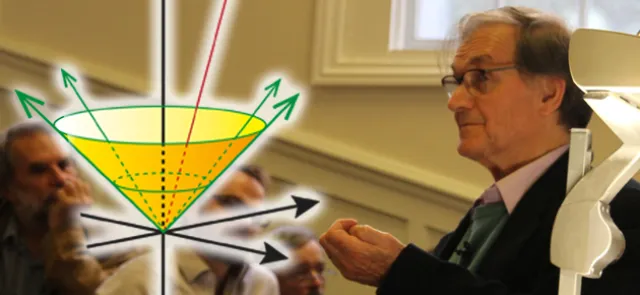




Les travaux d’Yvonne Choquet-Bruhat se situent dans le champ des mathématiques de la relativité générale. Pour les comprendre ainsi que découvrir qui était cette mathématicienne de très haut vol, première femme à entrer à l’Académie des sciences en 1979, Tangente a contacté l’un de ses anciens collègues, Piotr Chruściel, professeur de physique gravitationnelle à l’université de Vienne.
Piotr Chruściel en 2005.
Tangente : Tout d’abord, quand et comment avez-vous rencontré Yvonne Choquet-Bruhat ?
Piotr Chruściel : Nous nous sommes rencontrés la première fois en 1983, alors que j’étais encore en thèse. J’étais un des participants de l’École de physique des Houches* où Yvonne donnait une série de cours [elle avait alors 60 ans, NDLR]. Il y avait également Stephen Hawking, qui ne pouvait déjà presque plus parler de façon compréhensible : un de ses thésards répétait à voix haute ce que Hawking exprimait (il n’avait pas encore un synthétiseur de voix à l’époque). On s’est ensuite croisés quelques fois. Mais c’est en 2006, lorsque j’avais un doctorant qui travaillait sur les équations d’Einstein, que nous nous sommes côtoyés plus longtemps, à l’institut Max-Planck à Potsdam. Nous y discutions des résultats obtenus par elle, par mon étudiant et par moi-même, ce qui a abouti à notre premier travail commun. Il a néanmoins fallu attendre 2008 pour commencer à véritablement travailler avec elle.
(* Fondée en 1951 par la physicienne Cécile DeWitt-Morette dans la ville des Houches en Haute-Savoie, l’École de physique des Houches propose des cours et des ateliers de haut niveau et accueille des chercheurs du monde entier. De nombreux lauréats du prix Nobel y sont passés.)
Je copilotais, à l’institut Mittag-Leffler dans la banlieue de Stockholm, un programme de recherche intitulé « Géométrie, analyse et relativité générale ». Je l’ai évidemment invitée à y participer, ce qu’elle a accepté malgré un âge déjà avancé (85 ans !). Pour l’anecdote, cet institut était initialement la résidence du mathématicien suédois Gösta Mittag-Leffler, qu’il a ensuite léguée pour en faire un centre de recherche en mathématiques. C’est une magnifique maison qui surplombe un des nombreux lacs de l’archipel de Stockholm et, comme j’étais l’un des organisateurs, j’avais un très beau bureau ; lorsqu’Yvonne est arrivée, je ne pouvais pas lui donner un bureau moins beau que le mien, donc je le lui ai cédé et suis allé travailler dans un bureau plus petit. Il me semblait inconcevable de ne pas l’accueillir comme il se devait.
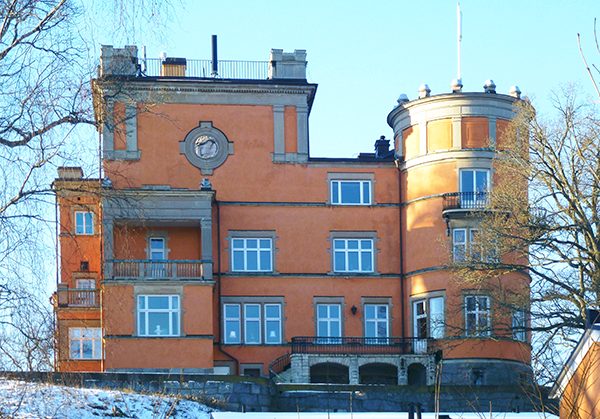
Vue de l’institut Mittag-Leffler.
Vous avez travaillé ensemble sur les équations d’Einstein, sujet sur lequel Yvonne Choquet-Bruhat a fait ses premiers travaux.
Albert Einstein a établi des équations, mais le problème est de cerner les solutions de ces équations. Yvonne a réalisé en 1952 (voir encadré) le travail immense et pionnier de montrer comment on peut paramétrer ces solutions et étudier leurs propriétés mathématiques. Il ne s’agit pas de méthodes d’approximation, de troncature ou d’hypothèses simplificatrices, mais bien d’un travail rigoureusement mathématique. Je précise que, dans le domaine de la physique, ce qui a été fait auparavant est très louable, de même ce qui est fait depuis. Mais, à la différence de ce qu’Yvonne a démontré, il ne s’agit pas de méthodes exactes. Elle n’a d’ailleurs pas mis au point une liste de solutions mais plutôt un outil pour les décrire. Cela offre une façon exacte de construire des espaces-temps, et ainsi comprendre la structuration mathématique des équations d’Einstein, lui qui n’avait pas eu la prétention de faire des maths, mais bien de la physique. En gros, on peut résumer son résultat le plus important, qui est au cœur de la compréhension mathématique des équations d’Einstein, comme ceci : pour toutes données initiales pour les équations d’Einstein, il existe un unique espace-temps qui est maximal (la notion de maximalité en géométrie différentielle signifie à peu près qu’on ne peut pas prolonger plus l’objet) dans la classe d’espaces-temps qui ont de bonnes propriétés causales (ces « bonnes propriétés causales » sont, par exemple, liées au fait que le voyage dans le temps n’est pas permis dans les espaces-temps construits par Yvonne).
Dans son livre, Une mathématicienne dans cet étrange univers, elle évoque ses échanges avec Einstein. Vous en a-t-elle parlé ?
Yvonne m’a effectivement raconté qu’elle était très émue lors de sa rencontre avec Einstein, qui s’est montré très gentil avec elle. Néanmoins, l’idée générale qui est sortie de leur entretien autour de son théorème de 1952 peut grosso modo se résumer comme ceci : « c’est très bien mais sans plus. » Cela est dû au fait que cet aspect purement mathématique travaillé par Yvonne n’était absolument pas une préoccupation d’Einstein. Lui faisait des modèles physiques : on prend des équations, puis des solutions exactes dans des cas simplifiés, enfin on extrapole. Elle, au contraire, a fait un travail purement mathématique avec l’idée d’identifier des propriétés de l’ensemble des solutions.
Pourtant, ce théorème est très important.
Fondamental ! J’aime dire qu’Yvonne est la mère des mathématiques de la relativité. Les équations d’Einstein sont une chose plutôt compliquée, que les physiciens ont décortiquée de manière très intéressante mais, en ce qui concerne les mathématiques, son article est vraiment le premier qui ouvre la théorie : il montre qu’on peut construire toutes les solutions des équations d’Einstein à partir de données initiales, ce qui n’était pas connu. Cela dit, force est de reconnaître qu’il a fallu du temps pour qu’on apprécie le théorème : à l’époque, s’intéresser aux mathématiques de la relativité générale était une occupation de niche. En revanche, aujourd’hui, c’est devenu une branche honorable des mathématiques. C’est sans doute grâce à trois grands résultats : le théorème d’Yvonne de 1952, le théorème d’Yvonne et de Robert Geroch de 1970 sur le fait que le domaine de dépendance détermine l’évolution d’un espace-temps, et le théorème de Richard Schoen et Shing-Tung Yau de 1979 sur le fait que la masse d’un espace-temps asymptotiquement plat est positive.
En 2002, vous avez organisé une summer school pour célébrer les 50 ans du théorème.
C’était au mois d’août à Cargèse en Corse. Depuis les années 60, il existe un Institut d’études scientifiques de Cargèse rattaché à l’université de Corse. Il y avait du beau monde qui s’était réuni pour célébrer Yvonne : Robert Geroch, Jean-Pierre Bourguignon, Jim Isenberg, Vincent Moncrief, Robert Bartnik, Sergiu Klainerman… Quand on regarde la liste des élèves de cette École d'été, c’est un plaisir de voir que beaucoup d’entre eux sont devenus des fameux chercheurs dans notre domaine.
Revenons à votre collaboration avec Yvonne. Pouvez-vous nous parler du théorème que vous avez démontré ensemble ?
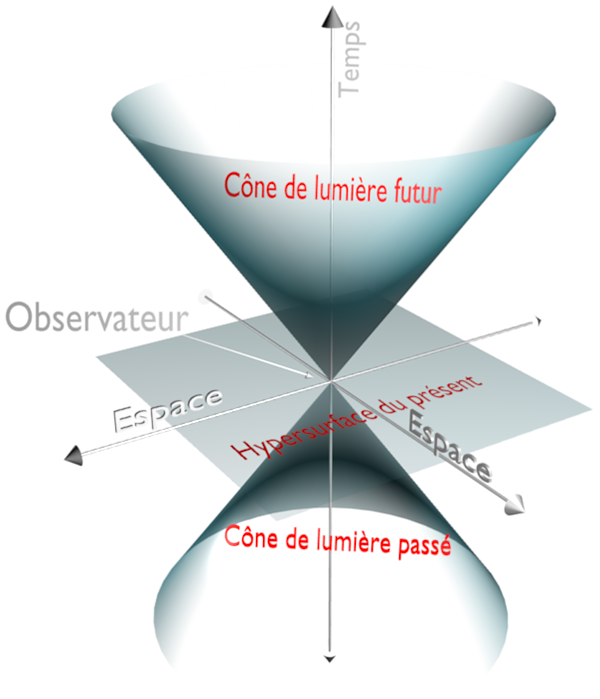
Il s’agissait de notre deuxième article en commun. Nous avons commencé à collaborer au sein de l’institut Mittag-Leffler sur les solutions des équations d’Einstein dans un cône de lumière\\. Après avoir « nettoyé » le problème, nous avons démontré un joli théorème qui montre de façon très imagée le fait que la gravité est une force attractive pour l’espace-temps. Plus précisément, le théorème dit ceci : on prend un point et on envoie des rayons lumière dans toutes les directions puis on mesure l’aire que forme le front d’onde à chaque instant. Si on accepte les équations d’Einstein et qu’on est soit dans le vide soit dans un champ de matière à énergie positive, alors la surface est plus petite que celle qu’on a dans l’espace de Minkowski et on a l’égalité si et seulement si on est dans l’espace de Minkowski. Cela montre que les distances d’espace diminuent quand on y met de la matière ou du champ gravitationnel. Je précise que cet article nécessitait, outre des questions mathématiques, une certaine puissance computationnelle pour résoudre des calculs formels très lourds, ce qui nous a été permis grâce à une collaboration avec José Martin Garcia. Cette recherche à l’institut Mittag-Leffler a abouti à plusieurs articles communs, qui se trouvent avoir été quasiment ses derniers articles.
(\\ L’espace de Minkowski modélise l’espace en trois dimensions ainsi que le temps, quatrième dimension de l’espace. Il a la particularité d’être dépourvu de gravité : il est « plat » car il représente le vide absolu. On appelle cône de Minkowski un cône de lumière dans l’espace de Minkowski. Dans l’espace de Minkowski, la lumière se propage à la vitesse c, donc le front d’onde a un rayon ct, dont l’aire vaut 4πc 2t 2.)
Pouvez-vous enfin nous parler de sa personnalité ?
Elle était très simple, gentille et modeste. Cela peut sembler une banalité mais c’est vrai. C’était un plaisir d’être avec elle et avec nos amis communs. Mon épouse adorait Yvonne. J’aurais aimé continuer à travailler avec elle car elle avait une manière d’aborder les choses très originale, une imagination mathématique fantastique. Vous savez, quand on a un problème mathématique à résoudre, il faut trouver une voie d’approche : on essaie telle ou telle technique, on tente de transformer le problème en un problème équivalent… Tout le monde, dans le métier, connaît beaucoup d’astuces pour arriver à creuser un problème. Mais Yvonne, elle, avait toujours des idées pour contourner les difficultés, elle savait mettre ensemble les bonnes astuces pour aboutir à une résolution. C’est une chose qui demande beaucoup d’inventivité. Du point de vue mathématique, c’était l’une de ses très grandes qualités.