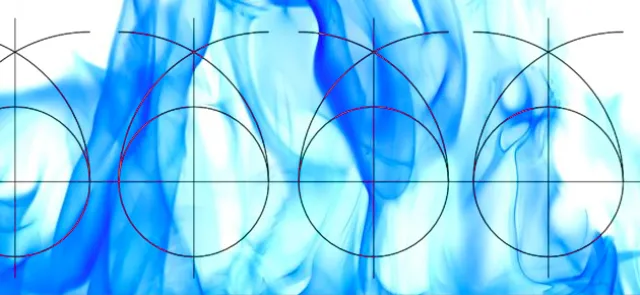
In the beginning was number! But the discovery that is irrational led the Greeks to reconsider their notion of rational perfection. With an almost religious rejection of mechanics—that is, of motion—Greek mathematicians henceforth accepted only constructions using lines and circles, commonly, if imprecisely, described as straightedge-and-compass constructions.
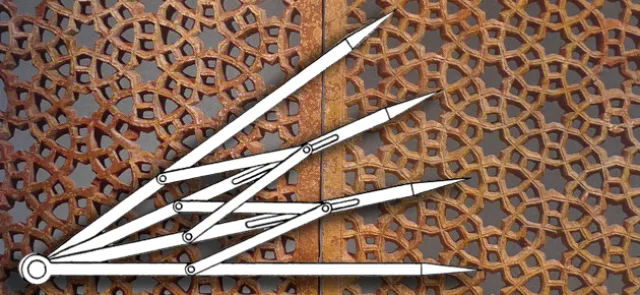
They soon encountered three problems that became historic because of their difficulty: doubling the cube, trisecting an angle and squaring the circle. It was not until the 19th century that algebra revealed why these constructions were impossible. Yet as early as antiquity, these problems were tackled using a neusis construction, involving a marked straightedge that could slide and pivot. This unorthodox method can trisect any angle, double the cube, and construct regular polygons with seven, nine or thirteen sides—as well as polygons whose numbers of sides are these numbers multiplied by powers of 2, of course. The iconoclasts Dinostratus, Nicomedes and Archimedes had no qualms about using motion.
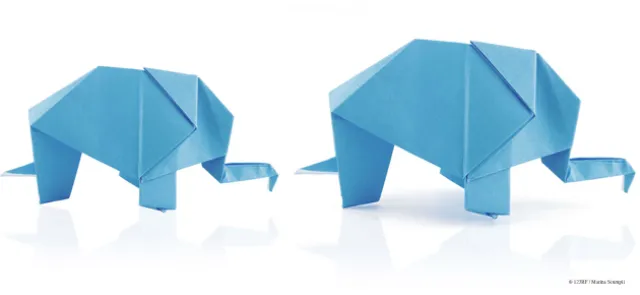
Another way of tackling these classic problems is origami, the ancient Japanese art of paper folding.
The art of folding
------------------
The mathematical formalization of origami dates back only to the late 20th century. Just as Euclid based his geometry on a number of axioms, origami theory rests primarily on six axioms, known as the Huzita–Hatori axioms but discovered in 1986 by the French mathematician Jacques Justin (1926–2020). Let's review them to see what each axiom contributes to the construction of points in the plane.