



All articles
Dive into the fascinating world of mathematics with our captivating articles, written by passionate experts. Whether you are a curious amateur or a seasoned mathematician, our articles cover a wide range of topics, from fundamental concepts to the latest discoveries, including practical applications and philosophical reflections.
The famous number 1729: Hardy and Ramanujan | Tangente
The smallest integers that can be written as a sum of two cubes in three different ways, then four different ways, and so on, are often called taxicab numbers.
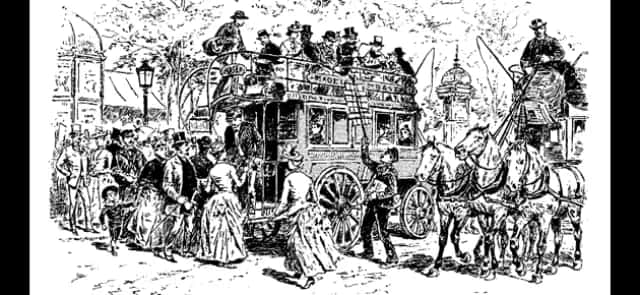
Did Pascal invent public transport? | Tangente
A great many websites hail Pascal as the brilliant inventor of public transport. Is there any basis for this claim? Was Pascal one of the architects of this revolutionary, modern system of travel?
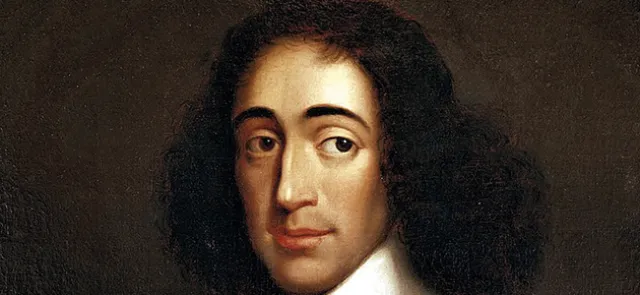
Spinoza and mathematical order in philosophy | Tangente
The Dutch philosopher Baruch Spinoza drew inspiration from mathematicians’ methods of inquiry and exposition in his "search for truth." Otherwise, he maintained, we prove nothing, merely supporting preconceived theses with plausible arguments.
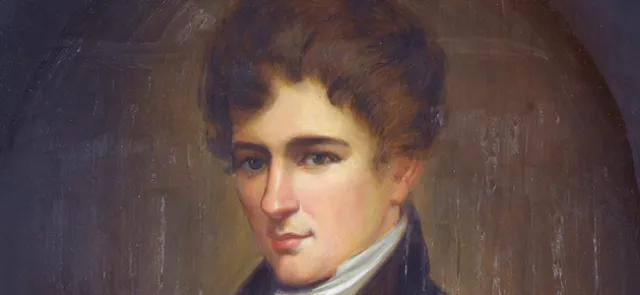
François Plantade: Abel, a mathematical genius | Tangente
For Tangente, François Plantade looks back at the life of Niels Henrik Abel, a 19th-century Norwegian mathematician who remains little known despite his major influence on the mathematics of his day. He died at 26, and his work only began to gain recognition toward the end of his life.
Hervé Lehning, a popularizer of mathematics | Tangente
It is impossible to sum up the scientific and educational work of a man such as our colleague and friend Hervé Lehning. More than a thousand articles bear his name! One way to gain a sense of the man is through his vast body of writing.
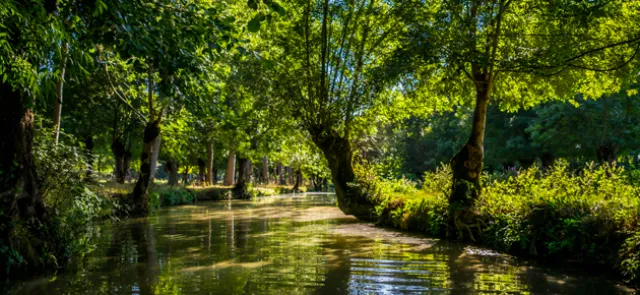
Draining the Marais Poitevin in the 17th century | Tangente
Known far beyond France’s borders, the Marais Poitevin has become a haven for many plant and animal species: today, the “Green Venice” covers nearly 100,000 hectares of lush natural landscape! But do you know its history?
The pascal: the SI unit of pressure | Tangente
Pressure—the magnitude of a force per unit area—is often measured in pascals, denoted Pa.
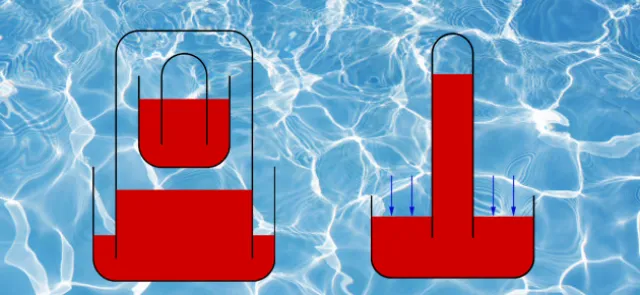
Pascal: The man who wasn't afraid of the void | Tangente
In the 17th century, following the Ancients, it was held that "nature abhors a vacuum." By restoring physical experimentation to the heart of scientific inquiry, French scholars of the period would thoroughly reassess this claim. Pascal would devise an ingenious apparatus for "creating a vacuum."
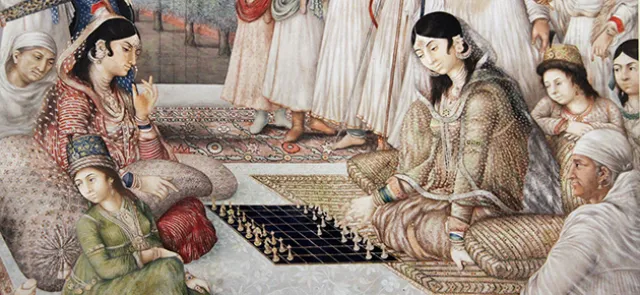
From Sissa to RSA
What use is there in raising numbers to powers, except for the fun of uncovering some arithmetical property of the natural numbers? Unexpectedly, this ancient computational art lies at the heart of modern cryptography and secure data transmission.
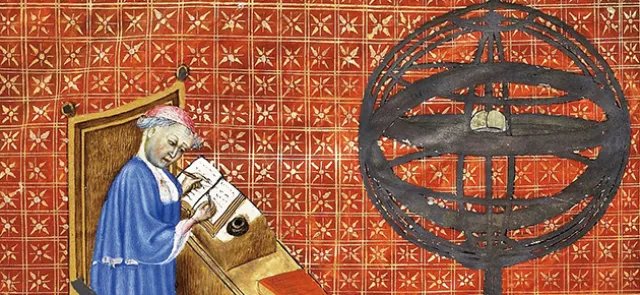
The fifth operation
Although the four operations—addition, subtraction, multiplication and division—are studied from elementary school onward, students must wait until their third year of secondary school to discover a fifth: raising a number to a power.
A Pascal-inspired teaching tool | Tangente
The best way to grasp the basic idea behind the Pascaline is to try it for yourself. Unfortunately, playing with the few surviving models held in museums is obviously out of the question.
The birth of Pascal — Niklaus Wirth | Tangente
The Pascal programming language was specified in 1968 and designed in the 1970s by Niklaus Wirth (born 1934) at the Swiss Federal Institute of Technology (ETH) in Zurich, Switzerland.
A brief history of Grandi's series
Grandi's series is the infinite sum 1 – 1 + 1 – 1 + 1 – 1 + … Mathematicians have studied it for more than three hundred years. Its history can be divided into three stages.
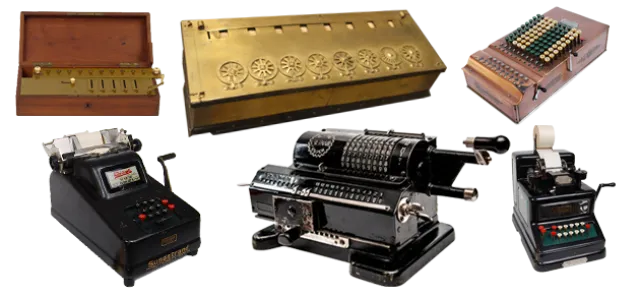
Mechanical secrets of the 1642 Pascaline | Tangente
Electronic calculators, now built into our phones, have made us forget the mechanical marvels that came before them. At just 19, Blaise Pascal developed the first calculating machine and, after a hard struggle to perfect his invention, captivated his contemporaries.
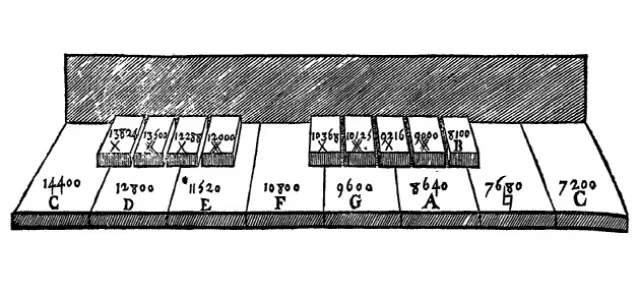
Writing a treatise on sound at the age of 11 | Tangente
The links between music and mathematics are well established. There was a time when it was not unusual for the most learned minds to pursue both with equal delight. Pascal, too, is said to have explored questions relating to sound, further evidence of his astonishing precocity.
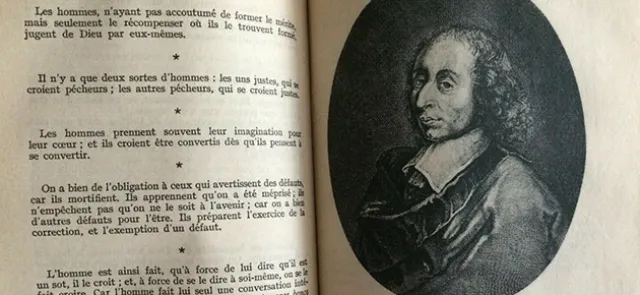
Pascal's rhetoric of chiaroscuro | Tangente
Pascal's dialectic consists in identifying the paradoxes and contradictions in another person's discourse. He thus unsettles his readers, making them realize that where they thought they had knowledge, they know nothing. Antithesis is one of his favorite weapons.
Betting on God's existence—Pascal's Pensées | Tangente
Pascal's Pensées abounds in arguments and reflections that assess the probability of a supreme being's existence. A careful, unabridged reading of the various fragments reveals a philosopher steeped in doubt and possessed of extraordinary subtlety.
Properties of the arithmetic triangle
Although Blaise Pascal did not invent the triangle that bears his name, the name pays tribute to his study of it in a treatise that has remained famous in the history of mathematics. Let's delve into this extraordinary text!

A neatly wrapped gift—Divisibility | Tangente
Is the integer 19,061,623 divisible by 37? It is hard to answer "quickly." Yet there is a way to devise simple, effective divisibility tests in no time, without having to perform the division by hand. Blaise Pascal has an arithmetic gift for you!
The art of fair division
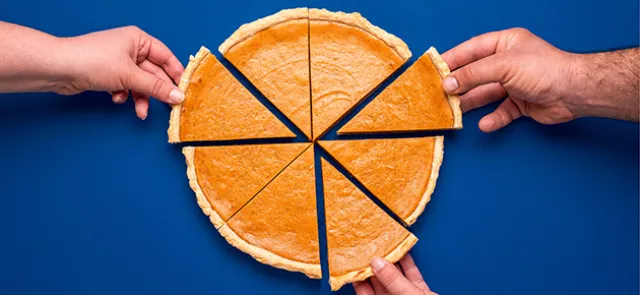
Blaise Pascal had a gift for illuminating all manner of situations through sound, precise analysis, pinpointing the difficulties and explaining himself with unsurpassable clarity. One of the most famous questions in probability—the problem of points—was a case in point.