



All articles
Dive into the fascinating world of mathematics with our captivating articles, written by passionate experts. Whether you are a curious amateur or a seasoned mathematician, our articles cover a wide range of topics, from fundamental concepts to the latest discoveries, including practical applications and philosophical reflections.
 Podcast
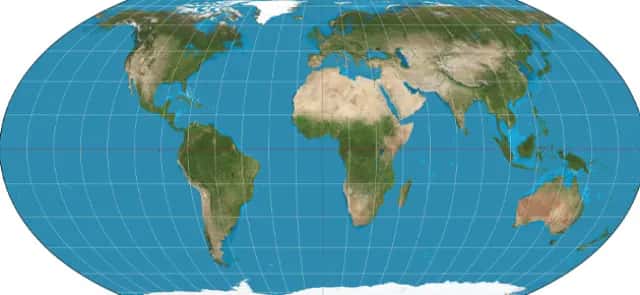
Mercator projection: anatomy of a geopolitical map
We tend to think of mathematics as a perfectly neutral science. Yet, like any human construct, its uses can prove more political than they appear. That is how an age-old geometry problem found its way into diplomatic debates in recent months.
 Podcast
Regular polygons with integer-coordinate vertices: one proof for all n
Discrete geometry is a recent field of research concerned with "discrete objects," such as graphs and tilings. But it also offers a fresh perspective on problems that are difficult to solve in a continuous setting, including the existence of regular polygons with integer-coordinate vertices.
 Podcast
Integer points on a line: methods of solution
Many problems in discrete geometry are simply stated and can be used in teaching to make certain concepts easier to understand. Searching for points with integer coordinates on a line naturally leads to applications of theorems from number theory.
 Podcast
Moving on the discrete plane: generating sets and minimality
Exploring how one can move around a grid leads to the concepts of generating sets and minimality. This example shows the power of discrete geometry as a tool for better visualizing and exploring complex ideas from classical geometry or algebra.
 Podcast
Knuth and Conway notations for mind-boggling numbers
When it comes to representing extremely large numbers, the standard operations, including exponentiation, are no longer enough. With considerable imagination, Donald Knuth and John Conway devised notations to overcome this limitation.
 Podcast
Long and short scales: billion, trillion, milliard—how to name large numbers
From colossal fortunes to the limits of mathematical language, words struggle to keep pace as numbers explode. From long and short scales, through international conventions, to mathematicians' bold inventions, the way we name extremely large quantities tells a story in which language, science and imagination meet.
Skewes's numbers: enormous bounds in number theory
Skewes's numbers are among the large numbers encountered in arithmetic.
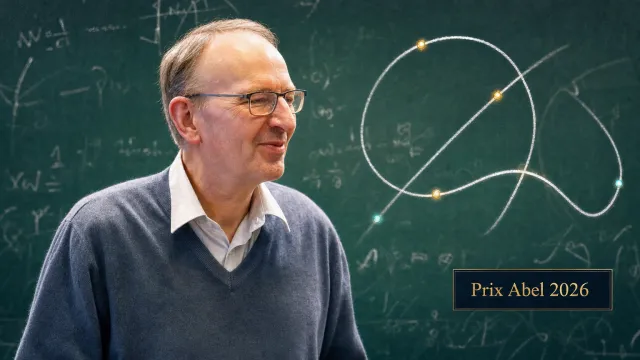
The 2026 Abel Prize
Awarded annually by the Norwegian Academy of Science and Letters since 2003, the Abel Prize is one of mathematics’ most prestigious honors: for many, it is the field’s equivalent of a "Nobel Prize."
 Podcast
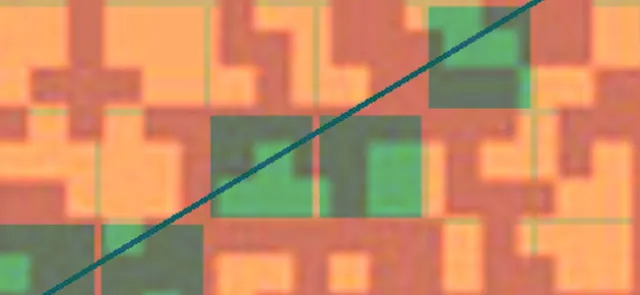
Discrete lines: the birth of a new geometry
Problems involving representation on a pixelated screen belong to discrete geometry. But beyond mere aesthetic considerations, are these new subjects of study—including discrete lines—tools for exploring Euclidean geometry more deeply, or objects of a new geometry?
 Podcast
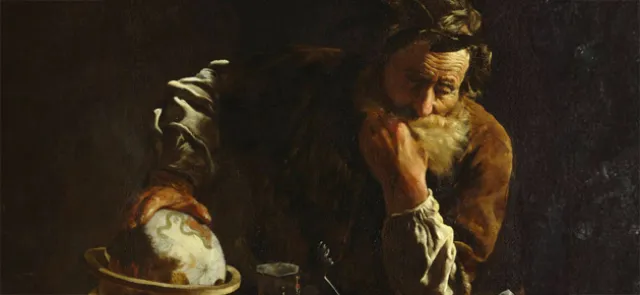
Archimedes' Sand Reckoner: counting the grains of sand in the universe
If the universe is finite, then it can be filled with grains of sand. Yes, it would take a great many, but the quantity required would still be a finite number—one that can be expressed. Drawing on the most advanced astronomical knowledge of his time, Archimedes set out to do just that.
Patrice Jeener: the mathematical engraver who turned equations into art
Patrice Jeener (1944–2026) passed away on March 3 in his village of La Motte-Chalancon, in the Drôme.
 Podcast
Theaetetus and the diagonal: why stop at √17?
How should we understand the famous passage in the Theaetetus where Theodorus mysteriously stops at the square root of 17? A new hypothesis emerges, involving continued fractions and triangular numbers.
CNRS public consultation: how French people relate to mathematics
33,000 citizens took part in the CNRS's major nationwide consultation on mathematics. Discover what this landmark survey reveals about access to maths.
 Podcast
Cédric Aubouy, math clown and author of “Je ne sais pas”
Cédric Aubouy, a mathematical clown and founder of the L’île logique company, agreed to meet us to mark the publication of his first novel, Je ne sais pas ou la disparition des mathématiciens.
The 2026 Tangente Prize shortlist
Each year, the Tangente Prize is awarded to a book that inspires a broad readership to explore mathematics and see it in a new light.
 Podcast
Updated Littéramath lists
Littéramath is an association dedicated to promoting mathematical literature in all its forms.
 Podcast
At last, women mathematicians on the Eiffel Tower!
In February 1889, Gustave Eiffel decided to inscribe in gold lettering, on the first floor of the Eiffel Tower, the names of 72 scientists who had brought honor to France since 1789.
 Podcast
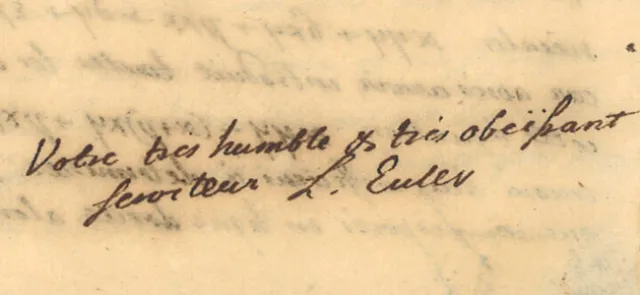
Euler–Cramer paradox: Are 9 points enough to define a cubic?
The Euler–Cramer paradox: If nine points seem sufficient to determine a cubic curve, how can two distinct cubics also pass through those same nine points?
 Podcast
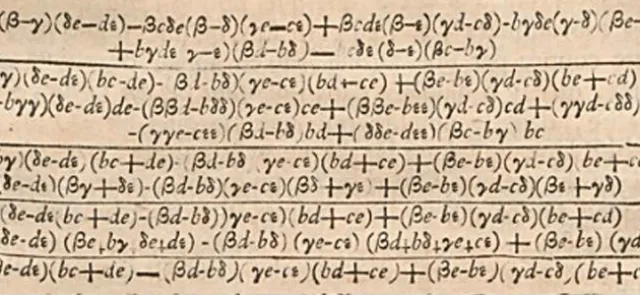
Gabriel Cramer and Cramer's rule in the 18th century
The appendix to Gabriel Cramer's Introduction à l’analyse des lignes courbes algébriques contains the famous rule for solving systems of linear equations and Bézout's theorem.
 Podcast
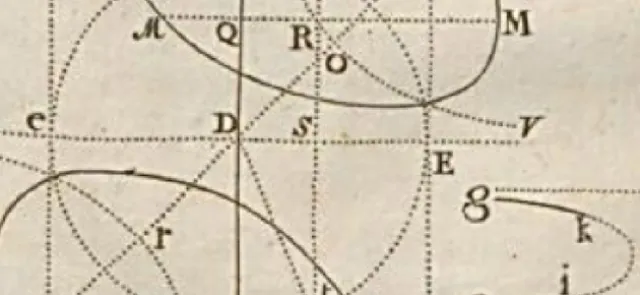
Plotting algebraic curves in the 18th century: Newton’s and Cramer’s analytic methods
How did Gabriel Cramer plot algebraic curves in 1750? Discover Newton's analytical parallelogram and Cramer's analytical triangle.