



All articles
Dive into the fascinating world of mathematics with our captivating articles, written by passionate experts. Whether you are a curious amateur or a seasoned mathematician, our articles cover a wide range of topics, from fundamental concepts to the latest discoveries, including practical applications and philosophical reflections.

Phi is irrational: a geometric proof | Tangente
Let's see how to prove that φ is irrational.

When mathematics meets comics | Tangente
Mathematics may not be the first thing that springs to mind for comic-book enthusiasts. Yet the two fields are far from as separate as one might think; when they come together, the results can be real gems.
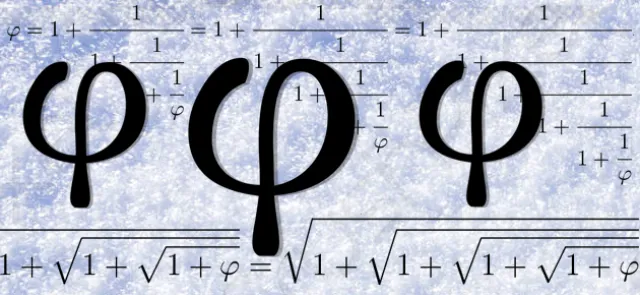
Remarkable mathematical properties
At first glance, the golden ratio, despite its mythical name, is nothing exceptional mathematically: it is simply the positive solution of a quadratic equation. Much ado about nothing? Let's see, then, what surprises it has in store.

Combinations and permutations in modern art | Tangente
Permutations appear in many works of conceptual art. Let's look at a few iconic examples to see how artists have readily embraced the concept of a group.

An example of a group in the social sciences
A simple, classic, real-world application of the mathematical concept of a group can be found in social anthropology. It was brought to light by the anthropologist and ethnologist Claude Lévi-Strauss, working with the mathematician André Weil.

Cryptology revisited
Groups were first used in cryptography in the 1920s and 1930s. The best-known example is the breaking of the Enigma machine. In the 1970s, groups opened the way to new encryption methods, including RSA and elliptic-curve cryptography.
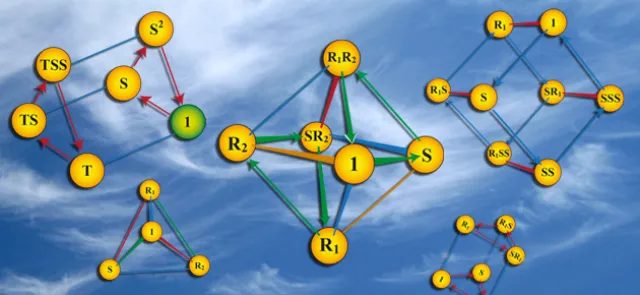
The Cayley diagram
How can we grasp the structure of a finite group at a glance? The Cayley diagram provides the answer!

Lie groups
The groups introduced by mathematician Sophus Lie have become indispensable tools in theoretical physics.

The Erlangen program
On his appointment as a professor at the University of Erlangen in 1872, Felix Klein, then only 23, presented a research program in geometry that has since become known as the "Erlangen Program." The concept of a group lies at its heart.

The Klein group and its many guises
When we first start working with groups, we patiently draw up the tables for those with only a few elements. A one-element group consists solely of the identity element and is therefore unique. Similarly, groups with two or three elements are unambiguously determined. The surprises begin with four elements...

Editorial
"The concept of a group already exists in our minds, at least potentially. It forces itself upon us, not as a form of our sensibility, but as a form of our understanding." Henri Poincaré, La science et l'hypothèse, 1902.

The language of groups
The word "group" was introduced by Évariste Galois himself in the 19th century, without a precise definition. The emergence of this concept called for a new vocabulary.

Group theory's founders: Galois, Cayley, Jordan | Tangente
The concept of a group did not simply appear overnight. Like many mathematical concepts, the idea took time—a great deal of time—to emerge, however "elementary" it may be, along with definitions… that now seem so obvious to us.

Groups: a matter of relationships
The concept of a group emerged in the early 19th century to solve polynomial equations and very quickly spread to other fields, including those outside mathematics: it allows us to focus on relationships between objects rather than on the objects themselves.

In the school curriculum
The era of so-called "modern mathematics" brings back many memories, some pleasant, others decidedly less so. But does that mean we should throw the baby out with the bathwater?

Groups of geometric transformations
The notion of a group—abstract and purely algebraic? Not at all! In geometry, it keeps us from being overwhelmed by the apparent profusion and diversity of transformations, and helps us understand the different kinds of symmetry we may encounter.

The Monster: the largest sporadic group | Tangente
The Monster is a group with more elements than there are atoms on Earth. Let’s meet it...

Early formalizations
Évariste Galois's tragic death lent an epic quality to the introduction of the group concept in mathematics. What followed is less familiar but fascinating, culminating in brilliant theorems that are still taught today. Sixty years later, the notion of a group was finally established.

The classification of finite simple groups
Are finite groups simple? Not so fast: although the classification of finite simple groups began more than a century ago, a complete proof is still being written! Work on this proof began in the late 1980s and should be completed in 2025. But the task is daunting…

Symmetries that leave objects invariant
In geometry, what could be more natural than to seek, for each object, the transformations that leave it unchanged? This means dissecting those transformations and identifying the object's symmetries—and, surprise, groups emerge quite naturally...