



All articles
Dive into the fascinating world of mathematics with our captivating articles, written by passionate experts. Whether you are a curious amateur or a seasoned mathematician, our articles cover a wide range of topics, from fundamental concepts to the latest discoveries, including practical applications and philosophical reflections.
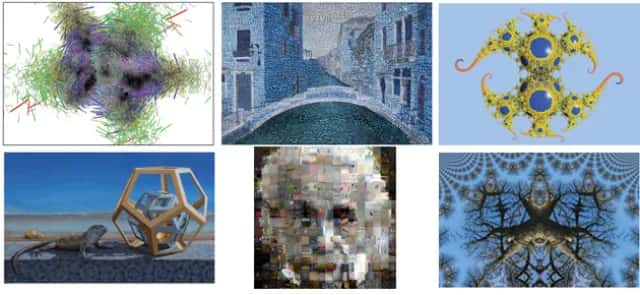
Artworks from Tangente's central insert | Tangente
Don't wait any longer—buy issue 200 of Tangente to get the magnificent artworks below in A3 format and display them in your home!
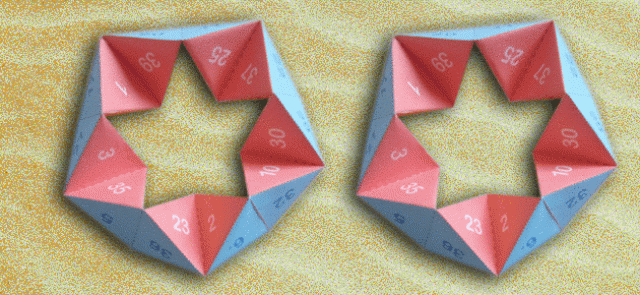
The magic ring of tetrahedra | Tangente
Details on how to build the ring of tetrahedra that you can cut out from the pull-out section of Tangente 200. An explanation of how the numbers on its forty faces were chosen, using a rule that generalizes the concept of a magic square.

Magic and curiosities: 7th Math Night | Tangente
For its seventh edition, Math Night will once again be held in Mareau-aux-Prés, a Loire Valley town near Orléans whose mayor, Bertrand Hauchecorne, is none other than the editor-in-chief of Tangente.

Maurice Glaymann, a leading figure in mathematics education | Tangente
Maurice Glaymann was an outstanding figure in French mathematics education.

A Goncourt for a mathematician | Tangente
Mathematics scored twice in 2021, with two Goncourt Prizes.
Collective decision-making and mathematics | Tangente
Arrow's classic impossibility theorem has often been invoked in political theory to demonstrate the irrationality of democracy. But is this result truly relevant to political science? Let's also revisit some of the mathematical arguments used in the epistemic theory of democracy.

Friendship among numbers | Tangente
In mathematics, being amicable is not the same as having friends...
200, a number like no other!
It can be written as a numeral, 200, or in words, two hundred. Even so, at first glance, the number does not seem particularly interesting. Admittedly, it is not perfect, unlike the eponymous issue of Tangente, but, like Achilles, it is powerful... and therefore fascinating. Here is a brief survey of its arithmetic properties.

Napoleon's problem
In this bicentenary year of 2021, let's revisit a result that bears his name. The emperor is said to have had a keen interest in geometry; according to one story, he once discussed the subject with two mathematicians of his day, Joseph Lagrange (1763–1813) and Pierre-Simon Laplace (1749–1827).
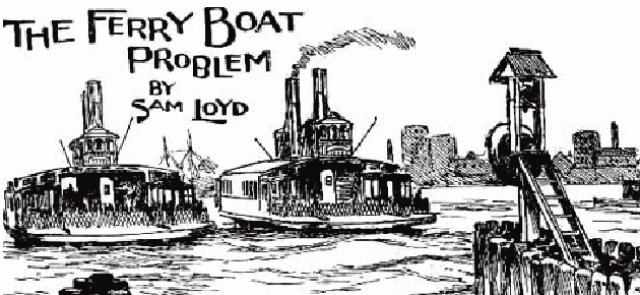
Elegant problem-solving methods
The appeal of recreational mathematics is that it requires little formal knowledge. Yet there are ingenious techniques that are hardly ever taught.
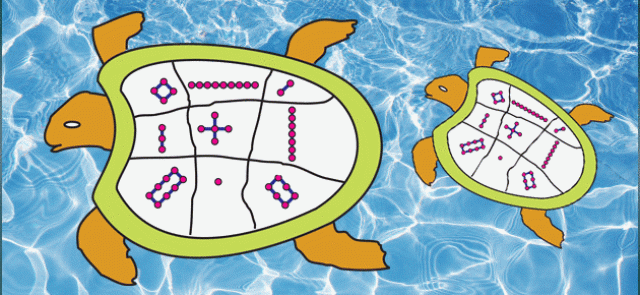
Timeless mathematical puzzles | Tangente
Puzzles have been part of human culture since earliest antiquity. At first, inventing puzzles was bound up with mythology or religion; gradually, it became a purely intellectual game, independent of any purpose or practical application.
Tangente: an extraordinary story | Tangente
How did France manage to create the world's only general-interest mathematics magazine, sold at newsstands? How did this bimonthly reach its 200th issue after a third of a century of uninterrupted publication? What a story!
Editorial
The "mathematical adventure" that began with the creation of Tangente in 1987 continues with the publication of issue 200. Its Publishing Director, Gilles Cohen, one of the magazine's founders, describes the exceptional content of this "Collector" issue.

Computer geometry: Cabri and GeoGebra | Tangente
Although computer drawing had been possible since the 1970s, so-called "dynamic geometry" software did not become widespread until the 1980s.

Compass: a universal instrument | Tangente
Compasses are made of wood or metal, in all sizes, with or without a sector.

Jacques Dominioni
The work shown on the cover of this special issue of Tangente is a painting by Jacques Dominioni.

Drawing a circle: a geometric challenge | Tangente
During the last lockdown, travel in metropolitan France was restricted to within 10 km of the address where people were staying during that period. Now there is a rule guaranteed to pique the curiosity of mathematics enthusiasts!

Give Euclid his due...
Geometric constructions are central to reasoning in Euclid's The Elements. The various methods of teaching geometry, right up to the present day, claim to follow this approach.
Why a sound method matters in geometry | Tangente
Never known how to "get started" on a straightedge-and-compass geometry problem? What matters, which points should you introduce, and which line should you construct? The classic, tried-and-tested method of analysis and synthesis provides a sound approach to such construction problems.
Through Euclid's eyes
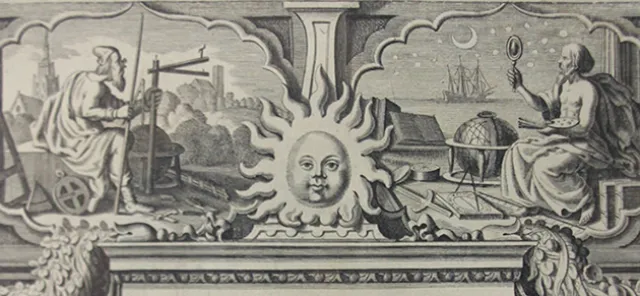
Two postulates in Euclid's Elements embody the ideal conception of the straightedge and compass inherited from Plato's realm of Ideas. The Alexandrian scholar built much of plane geometry—and the constructions he bequeathed to us—on these two postulates.