



All articles
Dive into the fascinating world of mathematics with our captivating articles, written by passionate experts. Whether you are a curious amateur or a seasoned mathematician, our articles cover a wide range of topics, from fundamental concepts to the latest discoveries, including practical applications and philosophical reflections.

Deep fingerprint detection using 3D imaging
Who hasn't seen an action-film character use a severed finger to pass through a biometric security gate? With deep fingerprint detection, that is no longer possible!

The expanding uses of photogrammetry
Photogrammetry encompasses all the techniques that use parallax to produce digital three-dimensional models of objects from images taken from different viewpoints.
An Emmy Award for Nantes University!
Patrick Le Callet, a faculty member and researcher at Nantes University's Laboratoire des sciences du numérique in Loire-Atlantique, has just been honored, through his university, with a Technology and Engineering Emmy Award from the US National Academy of Television Arts and Sciences.
The color of quarks
Matter is discrete: it consists of molecules, themselves made up of atoms, each containing a nucleus of positrons and neutrons surrounded by a cloud of electrons. All are regarded as "elementary particles"… yet there are dozens of them! How can such diversity be explained at the very foundations of matter?

Different color systems
We live surrounded by color images. But what exactly are these colors? How are they defined, broken down, or reconstructed? Different representations are used in different contexts, the best known being RGB and CMYK.
Draw me a picture!
"What is an image?" The answer to this seemingly straightforward question is far from obvious.
“Digital” or “numeric”?
Which of the two adjectives “digital” and “numeric,” both often used as nouns, should we use? Do they really mean the same thing? Their respective supporters are at loggerheads.
Graphics processors: high-performance computing for everyone?
Numerical simulation is everywhere: from re-entry into the Martian atmosphere and weather forecasting to climate projections, aeronautics, molecular-dynamics calculations, and processing vast volumes of data. High-performance computing has become a matter of public concern.
Counting protesters | Tangente
One hundred thousand protesters, according to the organizers; twenty thousand, according to the police! The discrepancy between estimates of the number of people in a march is a perennial source of puzzlement—and mockery—for outside observers. Is there really no way to provide a reliable figure for the number of protesters?
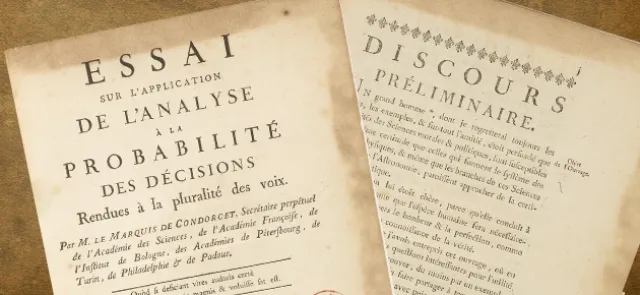
Political rationality and calculation | Tangente
Public policies are often supported by rational, even mathematical arguments. Philosophers such as Leibniz, Condorcet and Bentham sought, through a variety of approaches, to put both economic and social behavior on a mathematical footing. Yet they all came up against the fact that combining individual rationalities does not necessarily serve the common good.

Penrose and the sharing of knowledge | Tangente
Sir Roger Penrose is an outstanding popularizer, both in print and as a speaker.
Penrose and the Kleenex affair | Tangente
In the 1970s, Roger Penrose filed patent applications for several of his aperiodic tilings (!) and founded a company, Pentaflex, to manage the patent rights.
Nobel prizes in physics and mathematics | Tangente
The most famous winner of the Nobel Prize in Physics is probably Albert Einstein, honored in 1921 for his work on the photoelectric effect—not for his celebrated theory of relativity.

Stochastic processes:
How can we model a phenomenon that evolves randomly over time? To tackle this question, it was first necessary to ask what randomness is, formalize it, and incorporate it into mathematical models. That is what stochastic processes seek to do.
Penrose's impossible figures | Tangente
Penrose's name is associated with several "impossible objects."
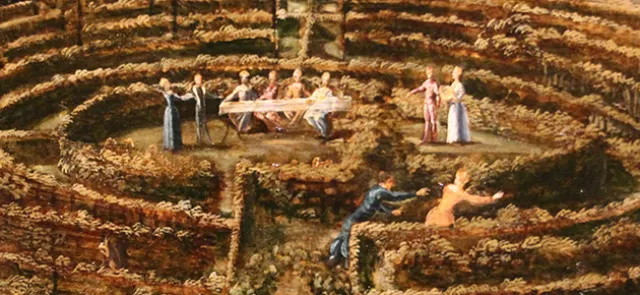
Homo academicus in his labyrinth | Tangente
Exploring the literary corpus offers an opportunity to highlight some of the logical and paradoxical arguments that can be brought to bear. Let us take a closer look at Le Stratagème (The Stratagem), a story from Jorge Luis Borges's Le Livre de sable (The Book of Sand).
Le Tellier, maths guy and Prix Goncourt winner | Tangente
With Hervé Le Tellier, who has just received the prestigious Prix Goncourt for his novel L’Anomalie, where logic and magic jostle for space, literature meets mathematics.

2021 with a twist
As it does every year, Tangente's editorial team brings you a selection of ingenious calculations to celebrate the new year. The locked-down year of 2020 is gone; the year of games has begun. Welcome to 2021!
Diagonal Ramsey numbers
The events committee (BDF) at the École des champions wants to organise a party by inviting people selected at random from the new intake.

Penrose interview: 2020 Nobel laureate | Tangente
Three books to finish. Hundreds of journalists on the lookout since the Nobel Prize in Physics was announced on October 6, 2020. Yet Sir Roger Penrose, aged 89, agreed to give your favourite magazine more than three hours of his time in a video interview. With generosity, passion and enthusiasm, he tells us the story behind some of his geometric discoveries.