



All articles
Dive into the fascinating world of mathematics with our captivating articles, written by passionate experts. Whether you are a curious amateur or a seasoned mathematician, our articles cover a wide range of topics, from fundamental concepts to the latest discoveries, including practical applications and philosophical reflections.

Shuffling an infinite deck of cards
Shuffling a fifty-two-card deck is easy enough. But suppose the deck contained infinitely many cards: could it still be "shuffled"? The answer is entirely up to you! Welcome to the world of paradoxes that play with infinity…

How mathematics powers video animation
Three-dimensional digital works, such as video games and animated films, unsurprisingly rely on mathematics to immerse us in their worlds. Angles, linear algebra, vectors and matrices play a particularly important role.

The Tangente Prize for high school students
Discover the winners of the 2019 edition, along with the ten books selected for the coming school year.
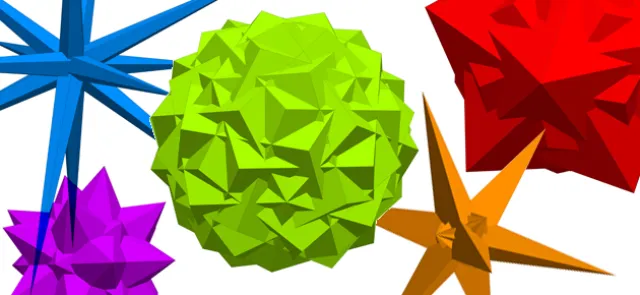
When polyhedra come in pairs
Swapping the faces and vertices of a polyhedron produces a new one, which can be built using elementary geometric constructions. This phenomenon once again demonstrates the close connection between arithmetic and geometry.

Mathematical controversy over duality | Tangente
The word "duality" comes from the Late Latin dualitas, which had displaced the classical term duales, used to describe something associated with two (duo in Cicero's Latin).
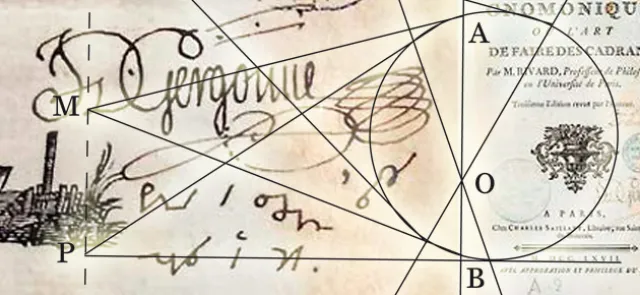
Partner-swapping in geometry
Duality has appeared in many branches of mathematics, from the Platonic solids of antiquity onward. It came into its own in projective geometry in the early 19th century, emerged soon afterward in logic with George Boole and Augustus De Morgan, and later flourished in linear algebra.

Let’s multiply in quasi-linear time!
The news broke in late March: mathematicians David Harvey and Joris van der Hoeven showed that large integers can be multiplied in "quasi-linear" time, confirming a conjecture that dates back to 1971, when Volker Strassen first suggested it. Let's revisit one of arithmetic's basic operations!

What if our universe were a hologram? | Tangente
Our universe could be a sphere whose exterior would resemble a black hole. Our world would merely be the reflection of a reality inscribed on the surface of this sphere—a kind of hologram. All information would be encoded on our cosmic horizon. A scenario that may not be so far-fetched after all…
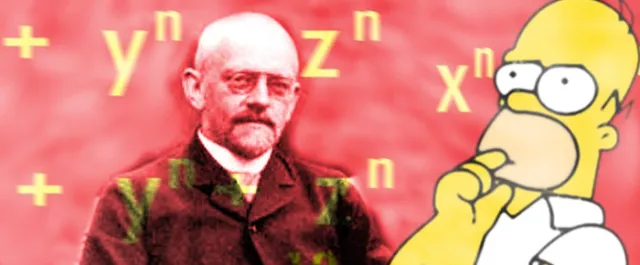
Hilbert, the twenty-three problems and physics
In his plenary address at the second International Congress of Mathematicians in 1900, David Hilbert presented the world with his famous "twenty-three problems." Some relate directly to physics; others have driven advances in both physics and mathematics.

The unforgettable Emmy Noether
A strong-willed woman and visionary mathematician, Emmy Noether defied many restrictions throughout her life and opened up new fields in mathematics and physics.

Cosmology and polyhedra: Plato to Kepler | Tangente
Regular polyhedra appear in many theories. These five solids fascinate us with their remarkable symmetries.

A point charge
A point charge is a source of mystery, like an electron with charge e in a vacuum.

Quantum computers: a threat to encryption | Tangente
Internet communications are currently secured by symmetric encryption systems such as AES, whose keys are transmitted using an asymmetric encryption system such as RSA.
Erwin Schrödinger's cat
In its century of existence, quantum physics has proved extraordinarily effective and has never been found wanting. Yet many difficulties remain when it comes to interpreting it. One emblematic example of its strangeness is a famous feline thought experiment.

Indispensable symmetry groups
Since Galileo and Newton, symmetries have played an important role in the development of physical theories. A symmetry can be identified with the invariance of a structure under a transformation.

Mathematicians and physicists: same language? | Tangente
Every term, however abstract, conjures up a mental image. That image is shaped by a combination of influences—sometimes by our first encounter with the word, or by the way we commonly use it.

The advent of a new physics
It took a great deal of questioning, rethinking and controversy for a new, "quantum" mechanics to prevail—one capable of explaining certain subatomic phenomena that classical physics could not then describe. Much ground remains to be explored.

Minkowski space and relativity | Tangente
How can the "strangeness" of relativity be described geometrically? By introducing a time dimension and mathematically redefining distance, Minkowski space provides the rigorous framework we need.
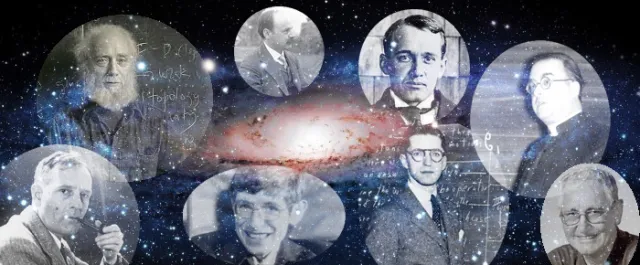
How the universe became a physical object | Tangente
The history of our universe did not take shape overnight. It took centuries to emerge and prevail amid controversies, competing models and apparent inconsistencies. Casting cosmological phenomena into equations, together with observations, brought matters into focus.

The mathematics of physics
Mathematical models enable us to understand and master the universe. But how far can this mastery extend? What are its limits? Mathematics allows us to devise models of the world around us and test them against reality.