



Amazing Math
Surprising or counterintuitive mathematical results and proofs
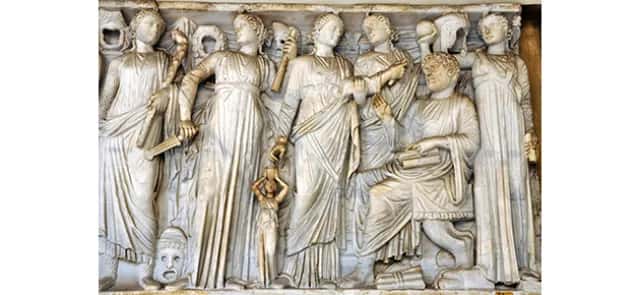
Deus ex machina: in mathematics too!
Looking for a simple, unexpected solution to a difficult problem? A deus ex machina can sometimes provide a surprise resolution to a desperate mathematical situation. Combinatorics, arithmetic and geometry are fertile ground for such an "aha!" moment.
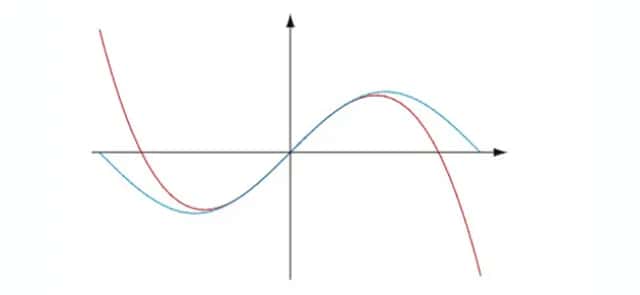
Approximating a function and following its curve
Assuming that a function is a polynomial yields useful approximation formulas. A complicated function can thus be replaced by a polynomial, simplifying most calculations. More surprisingly, interpolation lies at the heart of a secret-sharing technique.

Sphere packing:
We live in extraordinary times! Not a month goes by without a new mathematical breakthrough. The latest? A young researcher has solved the problem of the optimal packing of identical spheres in dimensions 8 and 24.
Between algebra and analysis: an indispensable world
Polynomials belong to both algebra and analysis, which can lead to all kinds of confusion! This dual nature offers a simple way to explain the subtle differences between variables, unknowns and indeterminates.

From Brel to Navier–Stokes
Beyond the poetry and the images evoked in Jacques Brel's songs lies a surprising mathematical reality: the basic models used to describe the movement of waves and dunes are identical! Moreover, they are far from having revealed all their secrets.

Fascinating prime numbers
A look at the latest theorems about prime numbers, which continue to inspire just as much as ever.
The inexhaustible prime number theorem
Prime numbers are an endless source of mathematical surprises: they are infinite in number yet rare, and attempts to count them bring transcendental functions into play, such as the Riemann zeta function, which at first glance seem far removed from arithmetic.
Euclid, master of division
With the Greek mathematicians—Euclid in particular—numbers moved from the concrete to the abstract. One key concept endured: Euclidean division and the host of developments it spawned. These methods have not aged a bit: Euclid's algorithm is still used today... by computer scientists!

Number theory in 2016: a wealth of news | Tangente
An unexpected bias in the distribution of prime numbers has just come to light. At the same time, Andrew Wiles receives the Abel Prize.

On the trail of a forgotten book: 19th-century textbooks | Tangente
The Éléments de trigonométrie rectiligne (Elements of Rectilinear Trigonometry), written by a mysterious F.J., were found in the trash of a religious institution in Damascus in the early 1990s.
The scant remainder of Euclidean division
When we divide a by n using Euclidean division, we obtain a remainder. This remainder can take only a limited range of values: there are just n of them. This new perspective can simplify many calculations and cast a whole host of problems in a different light!

Mathematician and pianist: a winning composition | Tangente
The final of the 27th international competition for great amateur pianists, bringing together 92 candidates from 27 different countries, took place on April 10 at the grand amphitheater of Assas in Paris.
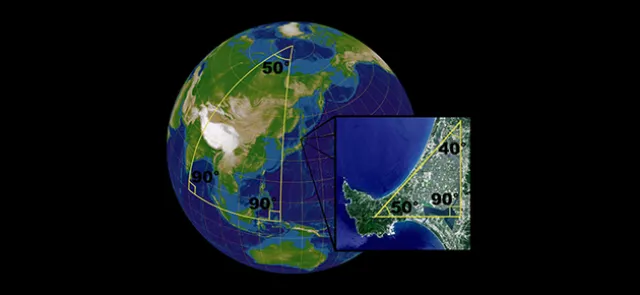
The projective line: a fruitful new perspective
The line is the simplest geometric figure imaginable. The variety of situations encountered in geometry may seem more complicated, and yet… might there be a special perspective from which the plane could be understood as a line? That is precisely what projective geometry is about!

Caustic envelopes
Lines whose direction varies continuously may reveal the curve to which they are all tangent. Such curves, enveloped by straight lines, appear in optics as caustics. Their properties give rise to geometric construction methods.

These lines that bear a name (1)
Some lines carry a mathematician's name. They are generally lines associated with the triangle, linked to certain notable points.

Without straightedge, without compass: Mascheroni | Tangente
Every straightedge-and-compass construction can be carried out with compass alone. This rather extraordinary result comes as a surprise.
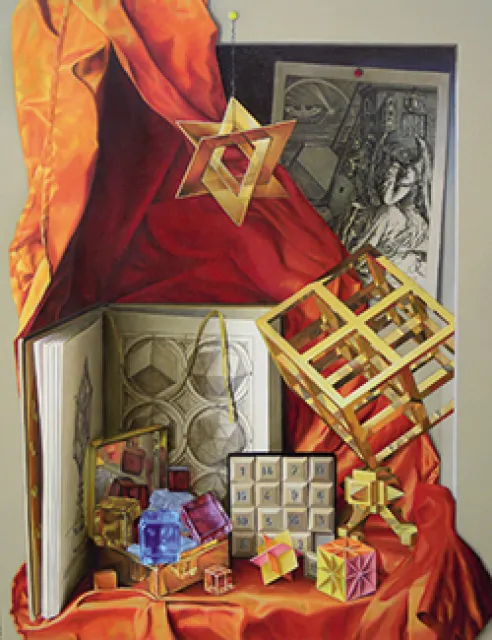
Sylvie Donmoyer, an artist fascinated by mathematics
An artist, not a mathematician, Sylvie Donmoyer is fascinated by geometric forms. In one engraving after another, inspired by Dürer and above all by Escher, she weaves connections between the two worlds of art and mathematics.
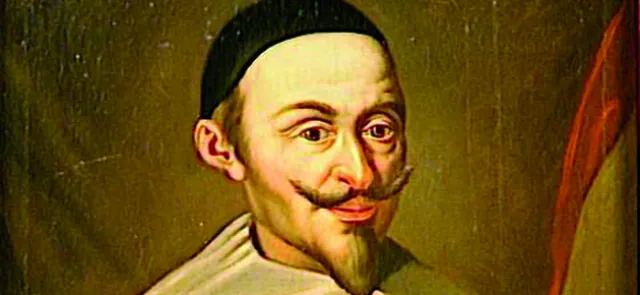
A happy identity
The famous Bézout theorem—actually proved earlier by Bachet de Méziriac—may look simple, but it opens up many avenues in both arithmetic and algebra. This discovery makes it easier to solve a great many Diophantine equations, among other things...

Three brilliant mathematicians would have turned 100
1916 evokes the Battle of Verdun. That same year, Halmos, Shannon and Apéry were born. Though very different, they would share an unconventional personality and an original contribution.
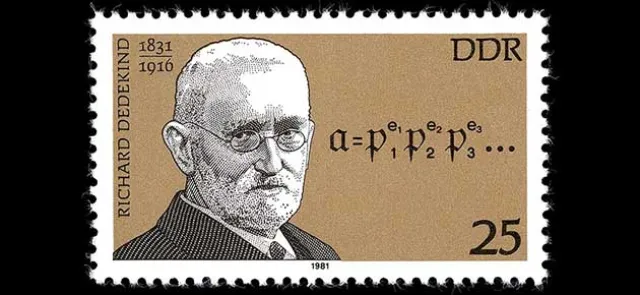
Richard Dedekind: Numbers and concepts
Richard Dedekind died on February 12, 1916. This gives Tangente an opportunity to profile a German mathematician fascinated by numbers, whose legacy continues to shape mathematics today. The concepts he introduced lie at the heart of modern algebra.