



Curiosity
Patterns, crafts, magic squares and fun mathematical content not part of the school curriculum
 Podcast
Celestial parabolas | Tangente
Imagine the Solar System as a collection of different bodies—planets, comets…—subject only to the Sun’s gravitational pull. Classical mechanics then tells us that their orbits can trace only three types of curve: ellipses, hyperbolas and parabolas.
 Podcast
Constructing a parabola | Tangente
Constructing a parabola is both fun and highly instructive. It brings its geometric properties to life and even provides an opportunity to do some arithmetic.
 Podcast
Misleading graphical proofs: the missing square paradox and more
Discover how seemingly rigorous diagrams can fool us: the missing square paradox, the astonishing proof that every triangle is equilateral, and more.
 Podcast
Fermat's false theorem
Fermat formulated many theorems, but one of them proved false: he conjectured that all "Fermat numbers" were prime, an error exposed by Euler. This notably illustrates how induction can lead us astray.

Math games: 2048 and more | Tangente
All right… a little screen time after all—not to do the arithmetic for us, but to practise mental arithmetic while having fun. The games featured on this page can be downloaded to a smartphone.
 Podcast
At Ratchinski's public school
For fifteen years, Sergei Ratchinski developed his own teaching method, based on creativity.
 Podcast
Logarithms to the rescue
Mental arithmetic usually brings to mind the four basic operations, or perhaps a few square-root calculations. Yet a little additional theoretical groundwork can take us much further, allowing us to tackle in our heads problems that might otherwise seem impossible without a calculator.
 Podcast
Is this number prime?
Prime numbers form the backbone of arithmetic. Although their distribution remains a subject of cutting-edge research, being able to decide mentally whether a number is prime is an excellent mental exercise—both enjoyable and creative.
 Podcast
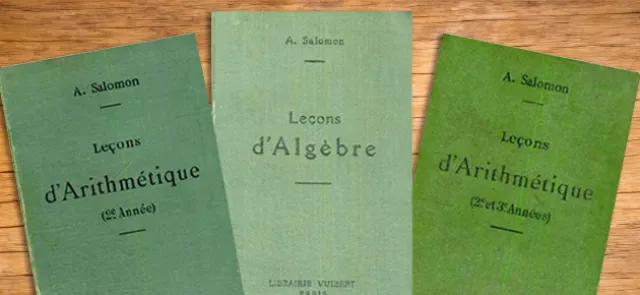
Divisibility in 19th-century textbooks | Tangente
Divisibility rules are numerous and are used by everyone who practises mental arithmetic. Blending arithmetic with common sense, they are a source of countless mathematical recreations, and have long been used in teaching.
 Podcast
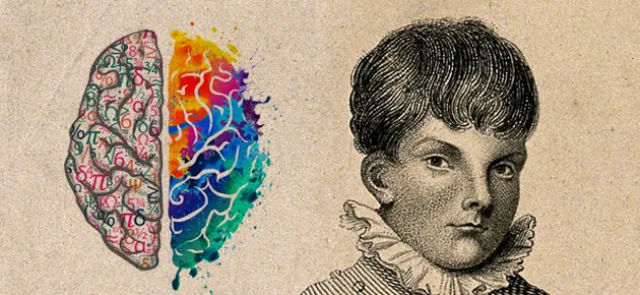
Calculating prodigies
Calculating prodigies fascinate the public with their ease in rapidly performing operations on large numbers. The tricks used by these number magicians draw on abilities that are more mnemonic than mathematical, but also on numerous methods and stratagems based on various theorems.
 Podcast
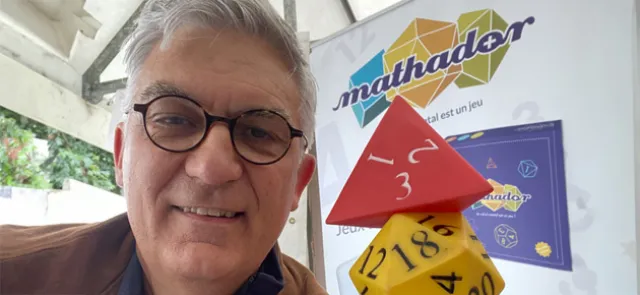
Éric Trouillot: Mental arithmetic, a path to jubilation | Tangente
The inventor of the calculation game Mathador, Éric Trouillot is one of those working to bring mental arithmetic back into teaching practice. In his view, far from being tricks performed by trained monkeys, techniques for calculating in one's head are an excellent gateway into the world of numbers, as well as an irreplaceable way to put mathematical properties — such as the distributivity of multiplication — into concrete practice.

An animal with a knack for flexing | Tangente
Les flexagones du Kangourou is a leaflet printed on thick paper, featuring a mathematical structure to cut out.
The trick wallet and flexing | Tangente
Although hexaflexagons were identified by Stone, the shape of the first tetraflexagon had been known for a very long time. This is a double-acting hinge.
 Podcast
A short history of flexagons | Tangente
Popularized by Martin Gardner, flexagons are geometric curiosities that sparked huge enthusiasm among the general public. Although their mathematical study began in the 1940s, they have not yet given up all their secrets.
 Podcast
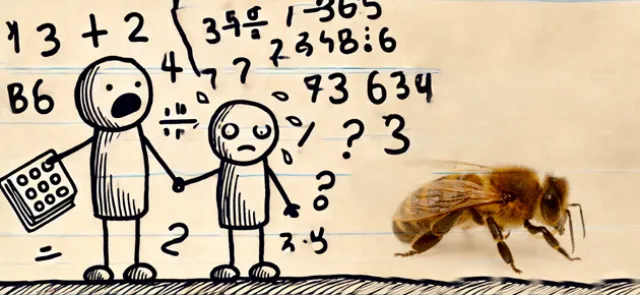
From bees to dyscalculia | Tangente
Catherine Thevenot studies the link between number and space, notably through bees' innate abilities. Her work sheds light on how mathematical skills develop in children, whether or not they are affected by dyscalculia.
 Podcast
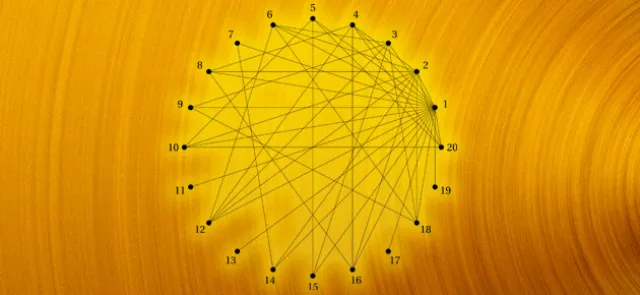
Walks in the divisor graph — Erdős and Saias | Tangente
Among Paul Erdős's interests, two fields stand out more often than others: number theory and graph theory. It is therefore no surprise that he eventually became interested in the divisor graph, a mathematical object that lies precisely at the crossroads of these two subjects.
 Podcast
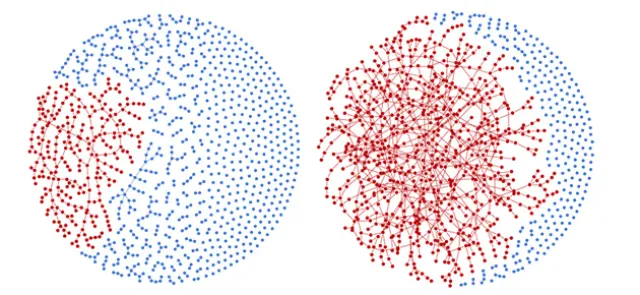
The Erdős-Rényi random graph
The Erdős and Rényi random graph model is so famous in mathematics that it has become a common noun: in probability theory, people routinely speak of "an Erdős-Rényi" the way one would speak of a Brillat-Savarin in gastronomy or a Stradivarius in music.
 Podcast
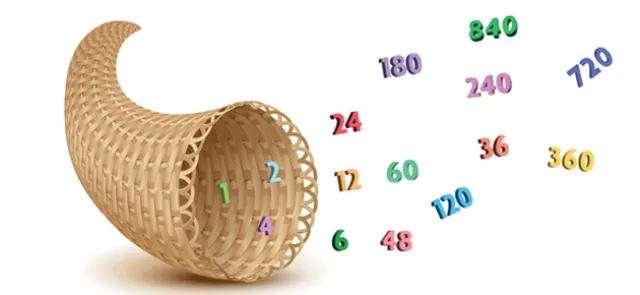
A cornucopia
Paul Erdős and Leonidas Alaoglu studied highly abundant and superabundant numbers, rediscovering along the way notions already studied, but not published, by the celebrated Indian mathematician Ramanujan.
 Podcast
Some of Erdős's work in number theory
Analytic and probabilistic number theory was one of Paul Erdős's favorite subjects. Here is a small selection of his contributions in this field, picked here and there from topics that can still be presented accessibly.
 Podcast
Trinity College and the dissection of the square | Tangente
In the 1930s, the problem of dissecting a square into smaller squares of different sizes gave rise to two conjectures by Erdős. They would be disproved by four Trinity College students who threw themselves into the research.