



Curiosity
Patterns, crafts, magic squares and fun mathematical content not part of the school curriculum

A centenarian devoted to magic squares | Tangente
After a busy career in public works engineering, during which he held various positions in Alsace, René Descombes (born in 1924!) has pursued his interest in magic squares since retiring.

The joy of mathematical discovery: amateur mathematicians | Tangente
Christian Boyer, Vincent Thill, Jean Moreau de Saint-Martin and Philippe Fondanaiche—all passionate amateur mathematicians—agreed to answer our questions about how their interest in mathematics began and the activities they have developed in their favorite areas.
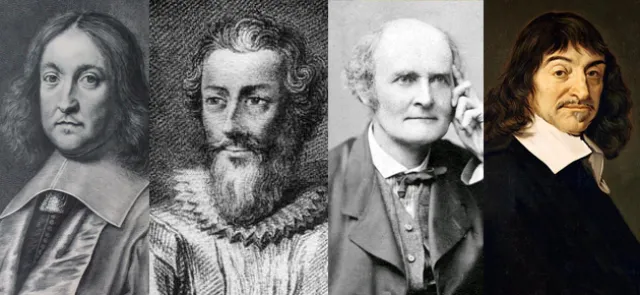
Recognized amateurs
What is an amateur mathematician? Defining one is no easy task, especially since the concept has undoubtedly evolved over time. Nevertheless, we will look at a few examples, both past and present.

2025: a very square number!
What better way to celebrate the new year than with some delightful mathematical properties of the number 2025? Tangente wishes all its readers a wonderful 2025.

Curious stories of mathematics on video | Tangente
For almost a year, Noëlle Krajcman has been running a TikTok and Instagram channel devoted to mathematical anecdotes.

Polygonizing a number: histonumbers and Theodorus' spiral | Tangente
Several methods can be used to associate a polygon with a given number.

The one-cut theorem: any polygon in a single cut | Tangente
Can a polygon be cut from a sheet of paper with a single straight cut? Surprisingly, the answer is yes! More surprisingly still, this also applies to other objects.
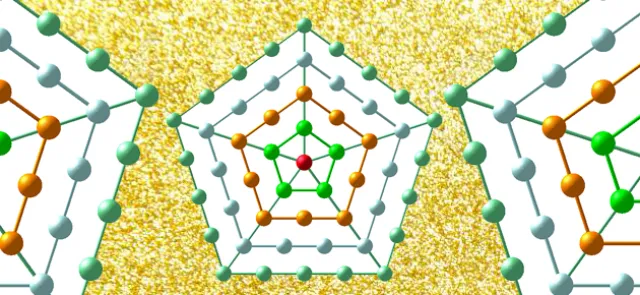
When polygons form numbers
All is number! The Pythagorean school established many properties of numbers from their geometric representations. First developed for triangles and squares, this way of arranging numbers was later extended to all kinds of polygons.
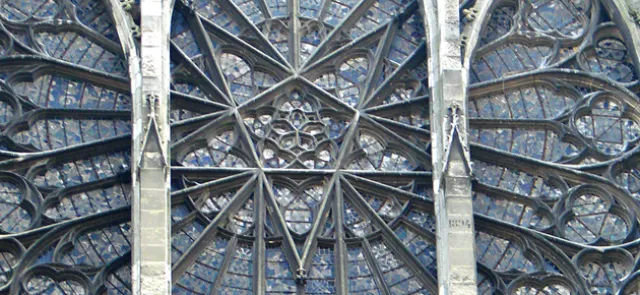
Pentacles and pentagrams: symbols and mathematics | Tangente
The pentagram, also known as the star pentagon, is a non-convex pentagon formed by joining every other vertex of a regular pentagon. It has journeyed through the ages and across civilizations, always shrouded in mystery.

Heptadecagon: fact and fiction
Theory tells us that a regular seventeen-sided polygon—a heptadecagon—can be constructed using only a straightedge and compass. But it gives no details of the construction, which is far from straightforward.
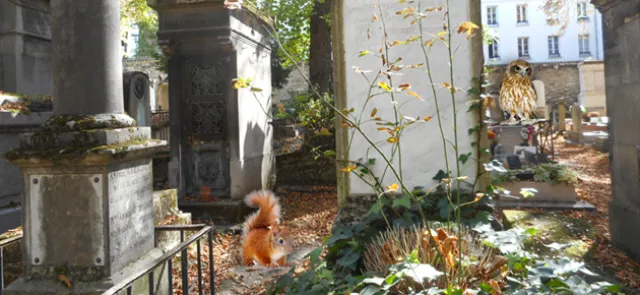
The mathematicians of Père-Lachaise | Tangente
At this time of year, around All Saints’ Day, tradition calls for visits to cemeteries. So let's take the opportunity to visit the graves of mathematicians in the most iconic cemetery of all: Père-Lachaise.

Italo Calvino's mathematical writing | Tangente
Widely read in Italian schools and universities, Italo Calvino is a major author, renowned for the literary quality of his work. He was also an avid lover of mathematics and readily drew on it in his writing, particularly to structure his texts, as one would expect of a committed Oulipian.
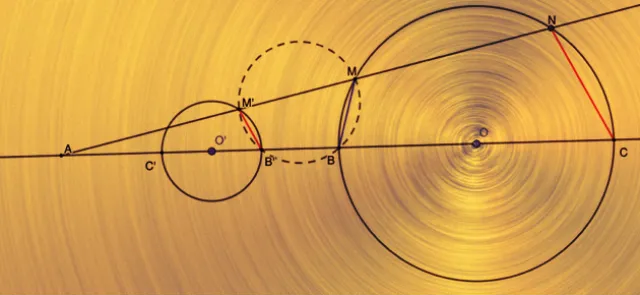
The curiosities of antiparallelism
In elementary geometry, proportionality often involves parallel lines, through the intercept theorem. But there are also antiparallel lines. Might there likewise be such a thing as "antiproportionality"?
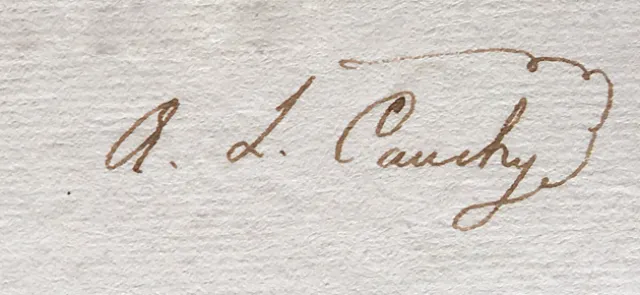
Origins of group theory: Cauchy and Galois | Tangente
Cauchy the analyst is well known; Cauchy the algebraist, much less so. Cauchy's contribution to group theory long went unrecognized, even though his research on algebraic structures was highly influential.

A mathematical password: sin x in 1830 | Tangente
In their 1894 book on the slang of the École polytechnique, Albert Lévy and Gaston Pinet recount an anecdote illustrating the atmosphere that could prevail in Paris during the revolutions of 1830 and 1848.

Counting by substitution
At barely 25, Cauchy puts the finishing touches to a paper on symmetric functions that is eventually published as two articles. In it, he introduces new concepts, notation and methods, and creates the calculus of substitutions, which will play a central role in the development of group theory.

Secrets from mathematical archives | Tangente
For its YouTube channel, the Académie des sciences produced a series entitled "Treasures from the archives." Each episode, lasting around five minutes, features a member of the Academy presenting a document from its archives.

The origins of pifometry | Tangente
The ancients used units based on human abilities or physical characteristics: the length of a thumb or foot, the handspan, the cubit, the fathom...

Approximating the paths of celestial bodies | Tangente
The word planet comes from a Greek word meaning "wandering star." This etymology suggests that the motion of the planets—which for the Greeks included the Moon and the Sun—is difficult to define and seems to defy all logic.
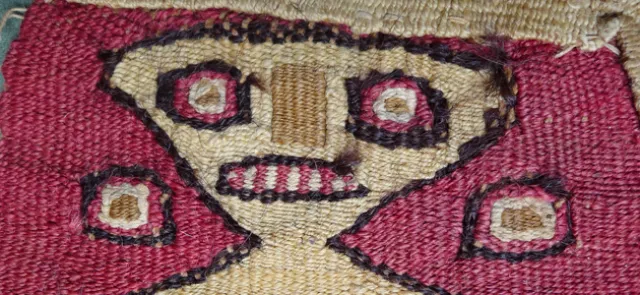
Geometry of Andean textiles | Tangente
In the Andes, weavers from periods sometimes lost in the distant past produced an immense variety of patterns that nevertheless bear a clear family resemblance. Mathematics can help us understand part of the visual language these textiles share.