



Knowledge
In-depth articles on mathematical knowledge and theories

My first differential equation | Tangente
Do differential equations frighten you? Admittedly, there is good reason to be wary. Yet they become very approachable once a few constraints are imposed; linearity is one of them. And when the factors involved are constants, they are within everyone's reach—especially when the right-hand side is zero.

Differential equations / Understanding the solution space without calculating the solutions
Combining tools, methods and techniques from geometry, algebra and analysis can yield particularly fruitful and spectacular results. Sometimes, for instance, we can learn about the solution space of a differential equation without having to calculate the solutions themselves!

Beyond convexity | Tangente
The intuitive idea behind convexity seems entirely natural. Yet one cannot help wondering whether slightly altering the formal definition might lead to other interesting ideas… Here too, convexity is just as fruitful!

Useful functions in analysis
With a graph that "looks skyward," convex functions give us reason for optimism. More seriously, first introduced to prove elegant inequalities, they have shown their importance far beyond mathematics. But what, exactly, are the properties of convex functions?

Surprising shapes in space
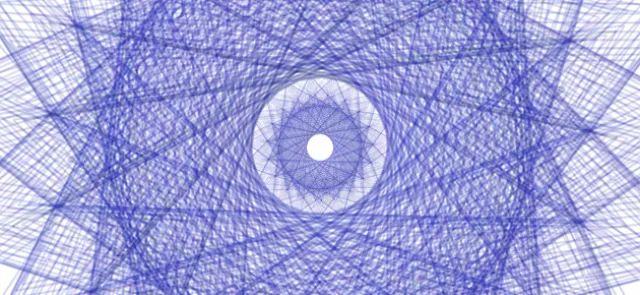
As in the plane, many balls associated with different norms can be defined in space. They include polyhedra, some regular and others more surprising. You can thus make a delightful festive collection of baubles to match your next Christmas tree!
Balls in the plane
A spherical ball is the set of points whose distance from a center is less than a constant. Mathematicians, always seeking to generalize, accept this definition of a ball… in any space equipped with any kind of "distance."

Convex geometry
Convex geometry lies at the crossroads of optimization, analysis, topology, combinatorics and, of course, geometry. The graphical and visual interpretations it affords are powerful aids to intuition. Yet fundamental questions remain open.
Surprising distances: Manhattan and Chebyshev | Tangente
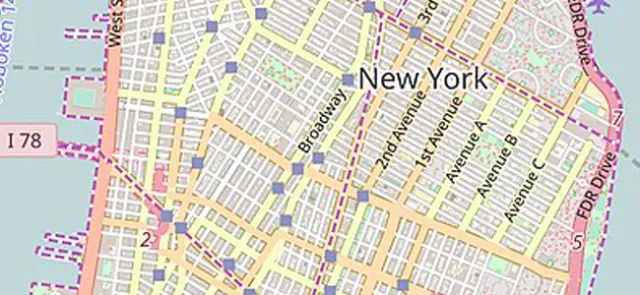
The Euclidean distance in the plane is the one everyone knows: it tells us that the shortest path between two points is a straight line. But there are many others, often rather unusual. Some are downright surprising…

So far, so near…
What is the distance between Paris and Rome? Faced with this question, one may legitimately wonder whether this means "as the crow flies," "by train," "by car," or "in the Euclidean sense." Ultrametric distances even reveal a world in which every triangle is isosceles.

Points on the sphere: the hostile dictators problem | Tangente
How can points be distributed "as well as possible" on a sphere? The idea is to place them "as far apart as possible." With two, three or four points, one might think that the vertices of a regular polyhedron inscribed in the sphere would do the trick. And yet…

Berlekamp problem: a strategy game | Tangente
The idea of distance has applications in some unexpected fields. A playful example is the Berlekamp problem, in which Hamming distance makes an appearance—and proves particularly effective!

The evolution problem in general relativity
Einstein's equations of general relativity have returned to the spotlight in recent years. Progress has been made on the stability of Minkowski space and on the still-elusive cosmic censorship conjecture, formulated by 2020 Nobel laureate in physics Roger Penrose...

An architect's dream?
The golden ratio, as everyone knows, crops up everywhere in art... provided, that is, you are determined to find it and willing to overlook (!) a few approximations or anachronistic units of measurement. Let's trace the writings that linked it to architecture and brought it to public attention.
Remarkable mathematical properties
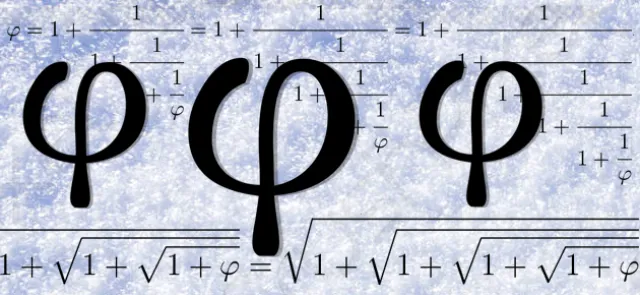
At first glance, the golden ratio, despite its mythical name, is nothing exceptional mathematically: it is simply the positive solution of a quadratic equation. Much ado about nothing? Let's see, then, what surprises it has in store.
The Cayley diagram
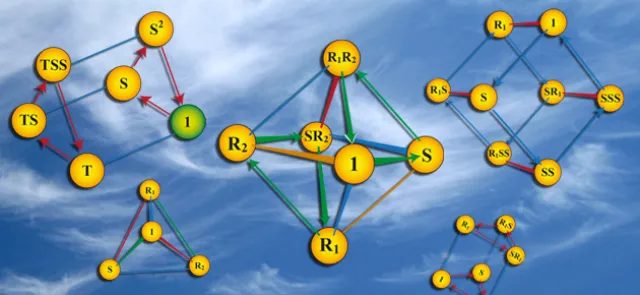
How can we grasp the structure of a finite group at a glance? The Cayley diagram provides the answer!

The Erlangen program
On his appointment as a professor at the University of Erlangen in 1872, Felix Klein, then only 23, presented a research program in geometry that has since become known as the "Erlangen Program." The concept of a group lies at its heart.

The Klein group and its many guises
When we first start working with groups, we patiently draw up the tables for those with only a few elements. A one-element group consists solely of the identity element and is therefore unique. Similarly, groups with two or three elements are unambiguously determined. The surprises begin with four elements...

Groups: a matter of relationships
The concept of a group emerged in the early 19th century to solve polynomial equations and very quickly spread to other fields, including those outside mathematics: it allows us to focus on relationships between objects rather than on the objects themselves.

Groups of geometric transformations
The notion of a group—abstract and purely algebraic? Not at all! In geometry, it keeps us from being overwhelmed by the apparent profusion and diversity of transformations, and helps us understand the different kinds of symmetry we may encounter.
Early formalizations
Évariste Galois's tragic death lent an epic quality to the introduction of the group concept in mathematics. What followed is less familiar but fascinating, culminating in brilliant theorems that are still taught today. Sixty years later, the notion of a group was finally established.