



Knowledge
In-depth articles on mathematical knowledge and theories

The projective geometry behind the Dobble game | Tangente
You would never guess it while playing Dobble: combinatorics, projective geometry and modular arithmetic can offer a new approach to constructing the game's various variants.

Grundy's game: graphs and winning strategy | Tangente
Graphs are crucial to strategies in games of complete information, provided the positions are not too numerous and can be represented. Patrick Grundy devised a game to formalize these strategies.
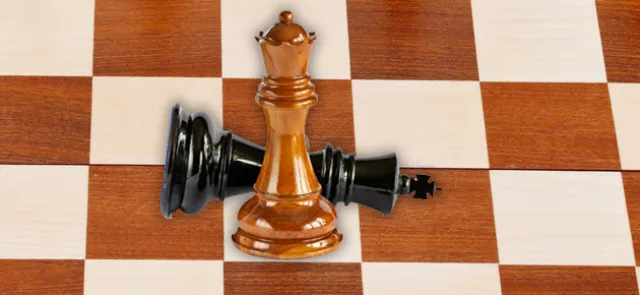
A strategy for moving the queen
Two players take turns moving a queen across a chessboard. This seemingly innocuous game offers a way to discover and illustrate a major result in game theory: the Sprague–Grundy theorem. It also has another mathematical surprise in store…

Welcome to regulous geometry
Algebra and geometry are intimately linked. Building a kind of dictionary between the two makes it possible to solve questions elegantly that would remain extremely difficult without these complementary perspectives. We can even have fun constructing new geometries…
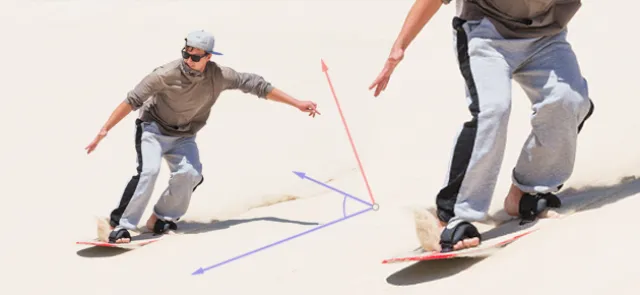
Polar vectors and axial vectors
In physics, forces and velocities are usually represented by vectors, mathematical objects with both magnitude and direction. Yet their behavior under a change of frame reveals two types of vectors, depending on the orientation of space: polar and axial.
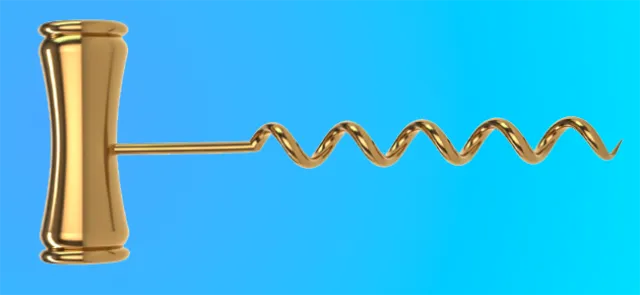
Mathematics points the way
We encounter broken symmetries every day, allowing us to distinguish up from down and right from left. Likewise, when objects in our mathematical spaces can be oriented, their orientation inevitably rests on an arbitrary definition.

A delightful conjecture by Paul Erdős…
The convergence of certain series is a classic topic in analysis (see Suites et Séries, Bibliothèque Tangente 41, 2011). For example, it is fairly easy to prove that the harmonic series—the sum of the reciprocals of the positive integers—diverges.

A genius off the beaten track
In the scientific world, Bertrand Russell is known first and foremost as a logician and philosopher. His contribution cannot be understood without grasping the major shift then taking place in the development of mathematics: this was the era of the "foundational crisis."
From intuition to rigor
In Euclid’s geometry, a line already divided the plane into two distinct regions, but negative lengths were not accepted. How can the algebraic notions of direction and measurement be brought into geometry?
Beyond Lagrange's memoir
As a teenager, Galois read Legendre and Lagrange, followed by Gauss and Cauchy. He often cites the latter two, but rarely Lagrange. Galois was clearly influenced by Lagrange's ideas; he would, however, go much further, benefiting from all the advances made since 1771.
Two geniuses, two approaches
Two methods are known for proving that the general quintic equation cannot be solved: Abel's method, presented in 1824 and refined in 1826, and Galois's method from 1829–1830. Galois theory is fairly well known, whereas Abel's ideas are less often discussed.

The entrance examination for the École préparatoire…
As a young student, Galois is known to have failed the École polytechnique entrance examination twice. Yet this was not the only entrance examination he sat: he was even admitted to the École préparatoire. Let's see how he tackled the first problem on the mathematics paper.
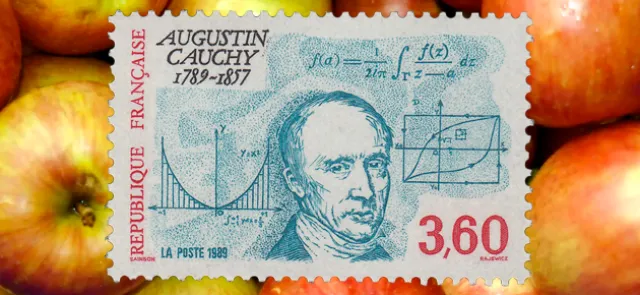
Cauchy, a forgotten pioneer
Because Augustin-Louis Cauchy did not take a direct interest in solving algebraic equations, he is an overlooked figure in the history of group theory. Yet his research on permutations provided valuable tools for those who worked on Galois theory.

Finite-difference schemes
Physics, biology, chemistry, mechanics and many other fields abound in phenomena that can be modelled mathematically using differential equations or partial differential equations. In general, these equations cannot be solved explicitly. We must therefore seek approximate solutions…

Proving without saying a word
No drawing or diagram can ever replace a "proper" proof, but both can help make a proof self-evident. In this respect, proofs without words, so beloved of mathematicians, are a fine exercise in style. Some have become classics of the genre.
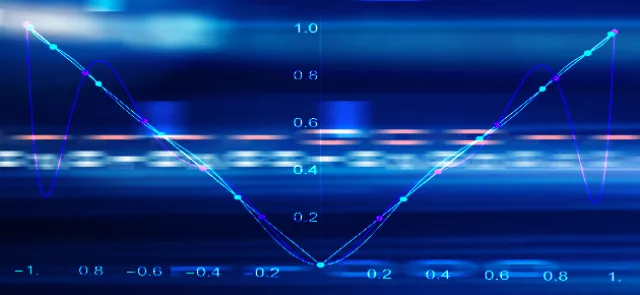
When numerical methods provide the solution
Except when a differential equation is linear or of a very special type, there is generally no exact method for solving it—that is, for finding a solution. We therefore often have to resort to approximation methods and numerical schemes.

A relationship between functions and derivatives
Historically, differential equations emerged early in the development of analysis, through problems in geometry and mechanics.
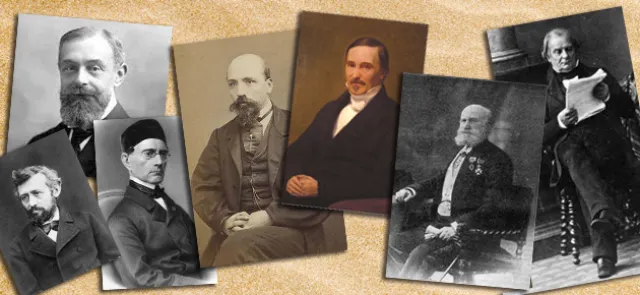
Graphical statics
Have you heard of "graphical statics"? Rooted in mathematics, particularly geometry, it is the art of balancing the forces acting on a body… without any calculations. Surprisingly, the discipline originated long before vectors were introduced!
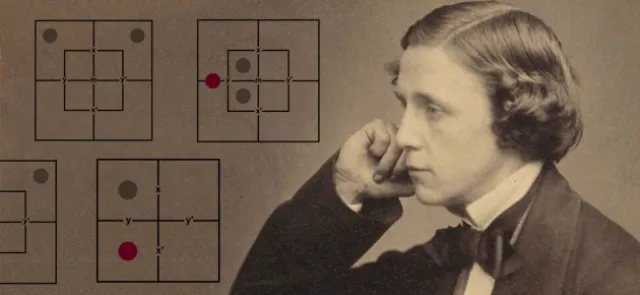
Lewis Carroll's diagrams
Lewis Carroll is known worldwide as the author of Alice's Adventures in Wonderland. Behind the pseudonym was Charles Lutwidge Dodgson (1832–1898), an Oxford mathematics lecturer with a passion for logic.

High-school reform: maths go off on a tangent | Tangente
Last January, the Société mathématique de France, together with several learned societies and professional associations, warned the Ministry about the disastrous effects of the new high-school reform on mathematics education. Here is an analysis, backed by figures.