



Knowledge
In-depth articles on mathematical knowledge and theories

Cross product and scalar triple product
Defined on three-dimensional Euclidean space, these two products grew out of Hamilton's quaternions. They have become useful tools in geometry and mechanics.
The slow emergence of Euclidean spaces
The axiomatic definition of the dot product provided a rigorous and fruitful framework for studying metric properties—those involving distance, angle, and orthogonality. This concept did not emerge clearly until the 1920s.

First examples of vector spaces (2)
Every good vector space E needs a base field K. But what exactly is a field?

The seven types of frieze | Tangente
A tiling covers the plane, extending infinitely in two dimensions; a frieze extends in just one direction. The quintessential decorative motif, it is the decorative border you can put above your wallpaper. There can be only seven different types.

The mosaics of the Alhambra in Granada
The decorative patterns of the Alhambra in Granada, a fortress built in the 14th century, encompass all the symmetry groups of plane tilings that can be repeated using two nonparallel translations. But this finding is recent, incomplete and somewhat controversial...
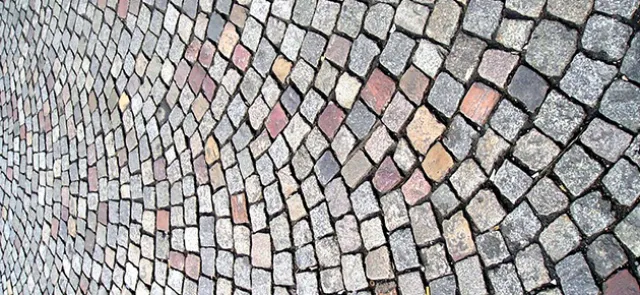
Seventeen groups that tile the plane
The plane tiling theorem states that the weight of a motif must equal 2. This small value makes it possible to consider every possible wallpaper symmetry: there are only seventeen wallpaper groups.
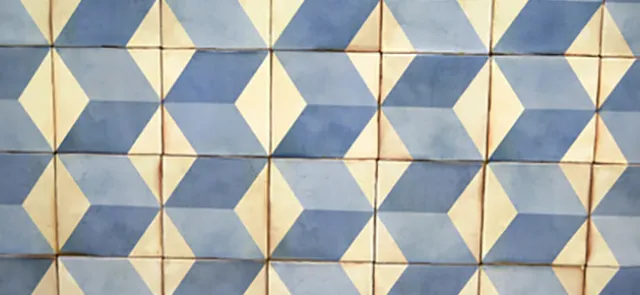
Signature and the tiling theorem | Tangente
Have you ever noticed? In friezes, tilings and other periodic patterns that repeat or exhibit symmetries, the artist's range of possibilities is actually quite limited. A fundamental theorem provides a complete enumeration of these patterns.
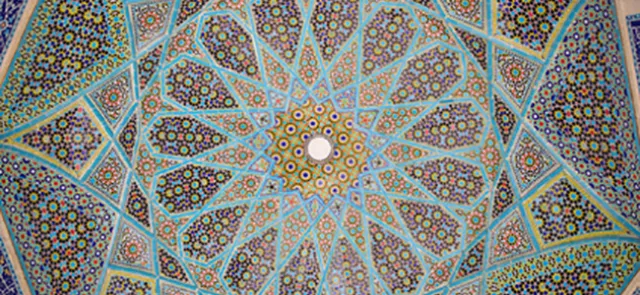
The secret of patterns in the Islamic world
The tilings and interlaced designs of medieval Islamic art command our admiration. But could a few simple geometric shapes lie behind this apparent complexity of line segments, interlacing, nested curves and polygons?
A first overview
Tiling began as a practical idea. Roads and houses were paved long before anyone saw mathematics in them! Since then, the concept has been extended, and today even non-Euclidean and four-dimensional spaces are tiled…
Dissecting the square, from Abu al-Wafa to Dudeney
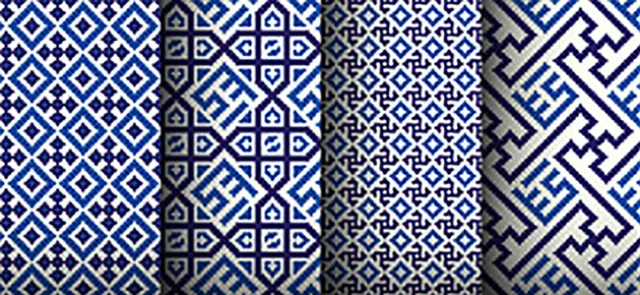
Cutting a given square into identical squares seems easy at first glance—and produces beautiful mosaics. But is it really that simple? What if, instead of identical squares, we require them all to be different, creating ingenious puzzles? A rich geometric world opens up…
Four authors for one theorem | Tangente
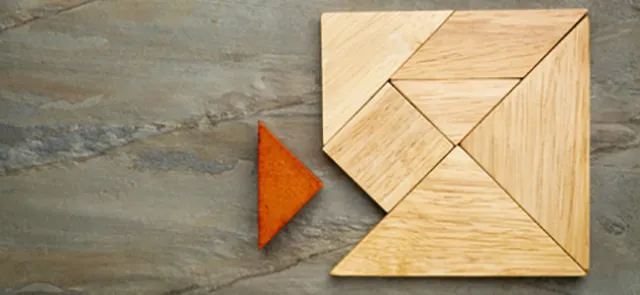
A tangram consists of seven polygonal pieces that can be assembled to form a given shape. But what about the inverse problem? When can two figures be solutions to the same puzzle? When do they admit the same dissection into elementary shapes? A famous theorem answers that question completely.
The geometry of scissors
Dissections are an inexhaustible source of research, discoveries and feats for amateur geometers and seasoned mathematicians alike. Born of practical concerns, they have become a treasure trove of mathematical recreations and brainteasers.

Stomachion: the world's oldest puzzle | Tangente
The Stomachion is certainly the world's oldest puzzle. It owes its fame not only to Archimedes' interest in it, but also to the extraordinary circumstances in which the Syracusan's writings, lost for two thousand years, were recovered…

Chinese remainder theorem: history and applications | Tangente
The Chinese remainder theorem owes its name to ancient Chinese mathematicians’ interest in the arrangement problems it describes. Originally a source of puzzles, it has since found more practical applications, particularly in cryptography.

A lovely transformation
An operation on complex numbers turns lines into circles and vice versa. A transformation worth keeping in mind when tackling problems involving lines and circles…

A detour through complex numbers
Taking a detour, part way through a proof, by way of complex numbers can lead to one of those redeeming "mathematical surprises".

? as in comic
The classics of mathematical humor often borrow some of their gems from the vocabulary of complex numbers…

Teaching complex numbers in France
Complex numbers, though they may seem self-evident in the wording of today's school curricula, have not always been part of the high-school teaching corpus.

Complex numbers according to Adrien Douady | Tangente
The film Dimensions offers a look at a number of spectacular representations of complex numbers. Don't wait to rediscover it!
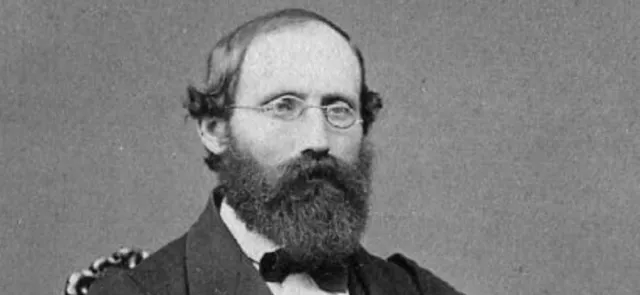
The zeta function and the Riemann hypothesis
The most important problem in contemporary mathematics can be stated in entirely elementary terms, requiring only a rudimentary knowledge of complex analysis. Despite mathematicians' titanic efforts, the Riemann hypothesis remains stubbornly out of reach.