



Knowledge
In-depth articles on mathematical knowledge and theories

The complex exponential
How can the classical exponential function be extended to complex numbers? Will its usual properties be preserved? Although the resulting extension is easy to study, the associated notion of a complex logarithm is more elusive. It was the subject of controversy in the 18th century.

Marden's theorem
Complex numbers, born of impossible calculations, found an unlikely geometric interpretation. This meeting of algebra and geometry is beautifully illustrated by theorems about the roots of a complex polynomial.

The geometry of complex numbers
René Descartes dreamed of turning a problem in pure geometry into an algebraic one. It took more than a century to realize that dream! Complex numbers opened up a new way to explore geometric figures and constructions.
Another transformation: inversion
Isometries (and more generally similarities) are not the only plane transformations that can be easily described using complex numbers. The same is true of inversion.

Some interesting similarities...
Isometries can be studied very neatly using complex numbers. But they are not the only transformations that can be described by simple formulas! Once we dispense with preserving lengths, the vast family of similarity transformations opens up before us.

Isometries of the plane
Studying isometries of the plane—reflections, translations, rotations, and so on—can sometimes be dizzying. What happens to a point or figure when several transformations are applied in succession? Complex numbers provide a representation that is as elegant as it is illuminating.

Complex numbers aren't so complicated
What do complex numbers really represent? How can we "picture" i² being equal to −1? A striking visual answer comes from interpreting multiplication geometrically. The icing on the cake is that the same model explains why "a negative times a negative makes a positive."

Conjugates, moduli and arguments
Once we accept the existence of a number i such that i² = −1, do we risk losing touch with physical reality? Quite the opposite: a profound and fruitful correspondence emerges, allowing questions of pure geometry to be solved through simple algebraic manipulations.

Complex numbers of modulus 1
Initially mere formal symbols used in algebraic calculations, complex numbers came into widespread use from the 19th century onward thanks to their geometric interpretation... in almost every branch of mathematics! They therefore arise naturally in number theory.

? is an algebraically closed field
The field ? of complex numbers was constructed to provide solutions to every quadratic equation. Surprisingly, it also contains the solutions to all algebraic equations with coefficients in ?. In technical terms, it is algebraically closed.

What is a complex number?
The set of complex numbers gained acceptance—with difficulty—when it became necessary to look beyond the real numbers for all the solutions of a quadratic equation. What no one had anticipated was its richness and the links it would forge with mathematics as a whole. Early discoveries.

Correspondence analysis
How can social data be examined without falling prey to preconceived ideas or stereotypes? Correspondence analysis, though now losing ground to other techniques, is a method that makes it possible to replace common sense and preconceptions with neutral, objective factors.

Preference modelling: voting and social choice | Tangente
We are all constantly called upon to make choices based on our preferences. Modelling them is a crucial step in decision support and is therefore of interest to the social sciences, particularly sociology.
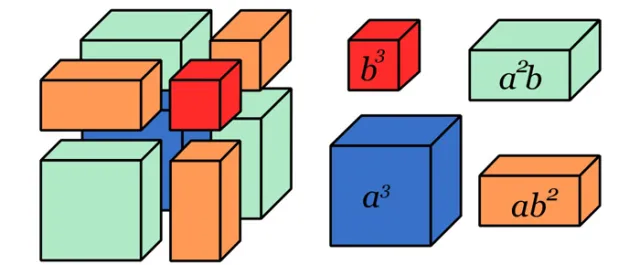
From algebraic identities to useful applications
The standard identities studied in middle school (and now at the start of high school…) can prove very useful in finding the solutions to certain equations, including quadratics. The trick is knowing where these mysterious identities are hiding!

Algebraic topology applied to the internet | Tangente
A different approach to mathematics, using algebraic topology, is available online.

The economist's toolbox: probability | Tangente
Collecting data only makes sense if the information is sorted, classified, and studied for useful purposes. Some data collections involve numerical data and can be processed statistically without manipulation. But this is not always the case.

Inventory management in a stochastic setting
From small bakeries to hypermarkets, retailers face dilemmas with every product they sell. How much should they make available to customers? Too little, at the risk of losing sales, or too much, at the risk of being left with unsold goods? And, of course, at what price? A probabilistic model can help them decide.

An introduction to econometrics
Economic models are only simplified representations of reality. Econometrics provides a set of tools for estimating the parameters of these models and testing their validity. The trouble is, the closer we want to get to reality, the more complex the model becomes…
Formulas for public procurement
Fair competition, which follows from the Declaration of the Rights of Man, is, fortunately, the fundamental principle governing all public procurement. Yet the freedom to choose scoring formulas inevitably introduces an element of subjectivity.

What consumers prefer
How can we model the behavior of a particular consumer? Their tastes, needs and available budget all help shape their choice. The mathematical concepts of preference, indifference and utility should help us...