



Math for everyone
Mathematical content accessible to everyone
 Podcast
A happy ending
Behind this phrase lies a famous mathematical challenge that brought together two brilliant minds on a quest to uncover the hidden order within chaos. It was the birth of a beautiful love story — and of a new branch of mathematics!
 Podcast
Probabilities where you wouldn't expect them! | Tangente
The probabilistic method, which Paul Erdős introduced and used, makes it possible to prove the existence of a mathematical object. Despite the use of probability, what is remarkable — and all the more surprising — is that the result obtained is certain!
 Podcast
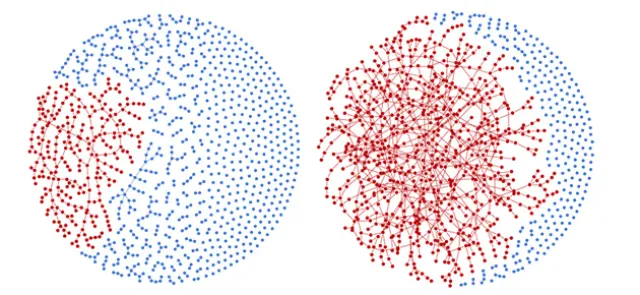
The Erdős-Rényi random graph
The Erdős and Rényi random graph model is so famous in mathematics that it has become a common noun: in probability theory, people routinely speak of "an Erdős-Rényi" the way one would speak of a Brillat-Savarin in gastronomy or a Stradivarius in music.
 Podcast
A cornucopia
Paul Erdős and Leonidas Alaoglu studied highly abundant and superabundant numbers, rediscovering along the way notions already studied, but not published, by the celebrated Indian mathematician Ramanujan.
 Podcast
Some of Erdős's work in number theory
Analytic and probabilistic number theory was one of Paul Erdős's favorite subjects. Here is a small selection of his contributions in this field, picked here and there from topics that can still be presented accessibly.
 Podcast
Trinity College and the dissection of the square | Tangente
In the 1930s, the problem of dissecting a square into smaller squares of different sizes gave rise to two conjectures by Erdős. They would be disproved by four Trinity College students who threw themselves into the research.

Two geometric jewels
Long after the 19th century, the golden age of geometry, Erdős took an interest in problems whose statements could appear in an elementary textbook. Among these are two jewels of elegance: the Erdős–Mordell theorem, which involves nothing more than a triangle, and the Erdős–de Bruijn theorem, which features only points defining lines.

Some conjectures in algebra
Here are a few conjectures proposed by Erdős that, despite some progress, remain unsolved...

So many distances!
Here are two problems about distances that interested Paul Erdős. The first studies the distances defined by n points. The second looks for sets of points that define only integer distances.
 Podcast
The great book of problems
The "Book" was a project of Erdős's to bring together the most beautiful known mathematical proofs, several of which had been found by Erdős himself. Although he died shortly before the project was completed, the work was nonetheless published, authored by Aigner and Ziegler. Its successive new editions keep the flame alive.
 Podcast
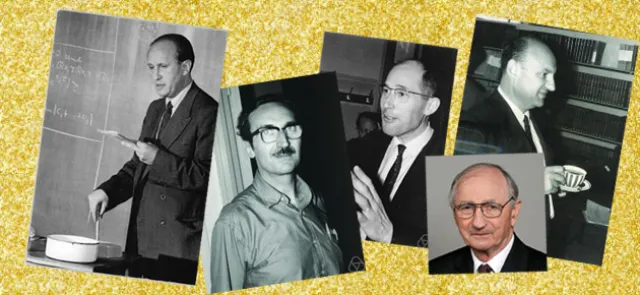
Collaborating with Paul Erdős — Tenenbaum's Account | Tangente
Much of Paul Erdős's work was carried out jointly with others. Gérald Tenenbaum, one of the French mathematicians who collaborated with him, agreed to discuss the methods of this unconventional mathematician.
 Podcast
The weaver mathematician — the Erdős number | Tangente
Fostering mathematical collaboration like no one else at a time when doing so was not as easy as it is today, Paul Erdős prompted a new way of looking at publications: first as a marker of ties to him, then as a subject of study in its own right.

Paul Erdős: Biographies and a film | Tangente
Two books in particular, both published in 1998, offer a glimpse into Erdős's life through anecdotes and accounts by other mathematicians.
 Podcast
To exist is to do mathematics — Erdős | Tangente
Pál Erdős (1913-1996) is renowned for his eccentric behavior, but above all for the brilliance of his ideas. His ingenious methods, off the beaten track, his countless publications, and his constant wandering built the image of a legendary scholar.
 Podcast
More than 600 problems still open
Throughout his life, in papers written either alone or with collaborators, Erdős posed a great many problems. He solved some of them—but far from all.

An iconic photograph
The famous photograph of Paul Erdős and Terence Tao deep in thought has become an iconic image in the recent history of mathematics. But what were these two extraordinary minds thinking about at that moment?
 Podcast
Mathemagical interview with Yves Meret | Tangente
Yves Meret teaches mathematics at Lycée Blaise Pascal in Rouen, but he is also a magician. Here he tells us how he lives out these two passions, which he has turned into his profession.
 Podcast
Elizebeth Smith Friedman, cryptanalyst | Tangente
In 2008, declassified archives revealed the crucial role of a figure who had long remained in the shadows: Elizebeth Smith Friedman. A talented cryptanalyst, she helped change the course of the world wars and dismantle a powerful criminal network.
 Podcast
Maths on France Musique: a podcast | Tangente
Many mathematicians enjoy or play music, and the two disciplines have long been far more closely connected than we might imagine today.
 Podcast
Yvonne Choquet-Bruhat and relativity | Tangente
Yvonne Choquet-Bruhat, who died on 11 February 2025, is known as the first woman to become a member of the Académie des sciences. Dwelling on this fact risks overshadowing the importance of her work. Her colleague Piotr Chruściel takes us through her research, which is little known to the general public.