



Math for everyone
Mathematical content accessible to everyone
 Podcast
The challenges of tomorrow's agriculture
The AgroStat project studies the dynamic evolution of living organisms of interest to agronomy using an approach based on the overall study of agroecosystems. This leads to interdisciplinary work bringing together numerous scientists.
 Podcast
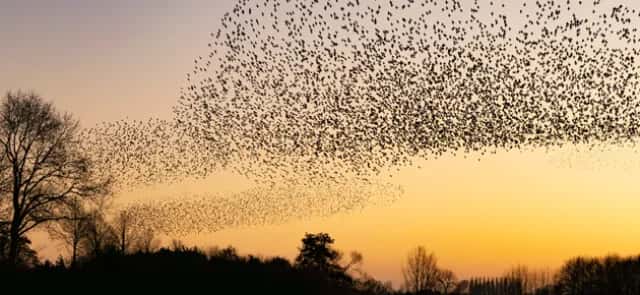
Bacteria carried by the crowd
Collective dynamics abound in the animal world, from flocks of birds to colonies of bacteria. The MAMUTCELL project aims to explore and mathematically model the movements of large bacterial assemblies in heterogeneous environments.
 Podcast
Calculated distances, lived distances
Did you know that in Manhattan, the ways of connecting two places a few hundred metres apart number in the millions? Whereas in Cabourg, there is generally only one shortest path connecting two points? These are the very properties of mathematical distance that can help geographers and urban planners better design the spaces we live in.
 Podcast
Financing the environmental transition | Tangente
The MIRTE project studies incentives and regulations in key sectors such as finance, energy and transport, with the aim of steering behavior toward a low-carbon economy.
 Podcast
Mathematics in Interaction | Tangente
The Mathematics in Interaction program, launched in 2024, aims to foster interaction between mathematics and other disciplines around the themes of life sciences, the environment and society. Backed by funding of €50 million, it brings together nineteen scientific projects led by multidisciplinary teams.
 Podcast
Flexible in three dimensions | Tangente
The flexacube and a more sophisticated form, the Yoshimoto cube, are three-dimensional versions of flexagons. Beyond their construction, these astonishing objects raise questions about the flexibility of polyhedra and formalize that question: under what condition does a solid remain rigid?
 Podcast
Tetraflexagons: squarely strange | Tangente
Unlike hexaflexagons, known for their regularity, tetraflexagons, whose faces are squares, have always escaped systematic study. They exhibit several types of cycles, and the complexity of handling them contrasts sharply with the apparent simplicity of their shape.
 Podcast
In the land of hexaflexagons | Tangente
The first hexagonal-faced flexagon studied had three stable positions. Methods were quickly found for constructing an associated hexaflexagon for a given number of stable positions — and even several different hexaflexagons…

An animal with a knack for flexing | Tangente
Les flexagones du Kangourou is a leaflet printed on thick paper, featuring a mathematical structure to cut out.

The trick wallet and flexing | Tangente
Although hexaflexagons were identified by Stone, the shape of the first tetraflexagon had been known for a very long time. This is a double-acting hinge.
 Podcast
A short history of flexagons | Tangente
Popularized by Martin Gardner, flexagons are geometric curiosities that sparked huge enthusiasm among the general public. Although their mathematical study began in the 1940s, they have not yet given up all their secrets.
 Podcast
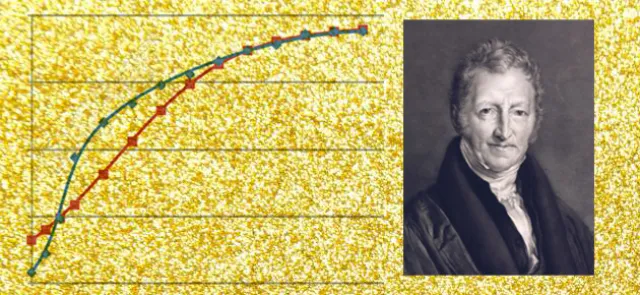
Logistic functions, from demographics to marketing
Driven by the desire for reliable demographic models, logistic functions emerged around 1840. They provide the best model for growth limited by external factors, extending Malthus's approach. Today they have unexpected applications, whether in marketing or household equipment.
 Podcast
Hilbert spaces, a framework for quantum mechanics
The mathematical modeling of quantum physics rests on probability theory, but also on Hilbert spaces and linear maps (generally not continuous) on these spaces. The power of this mathematical structure has made it possible, for example, to calculate the energy levels of the hydrogen electron.

New developments in polynomial equations
Did you think the subject of polynomial equations had been more or less settled since Galois's work? Think again.
 Podcast
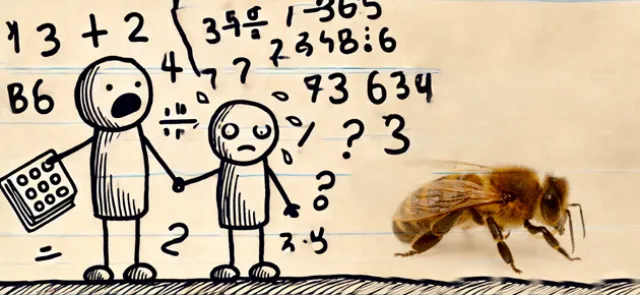
From bees to dyscalculia | Tangente
Catherine Thevenot studies the link between number and space, notably through bees' innate abilities. Her work sheds light on how mathematical skills develop in children, whether or not they are affected by dyscalculia.
 Podcast
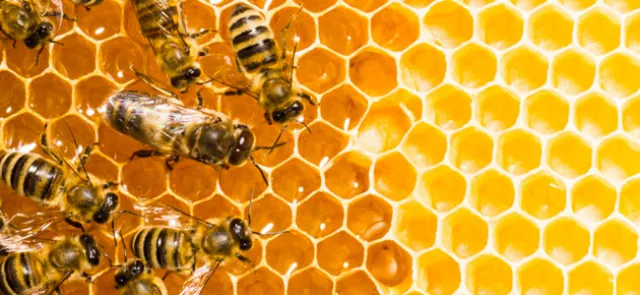
The geometry of honeycomb cells
Bees do not shape their honeycomb cells into hexagons deliberately, but because of the viscoelasticity of wax: the cells, initially circular, compress against one another, the wax melts and angles begin to form; the circular shape becomes hexagonal.
 Podcast
Bees and the abstract sense of number | Tangente
Research into bees' cognitive abilities shows that they can count up to five, order numbers along a mental number line that includes zero, perform simple operations, and even associate a number with a symbol. This suggests the near-universal nature of mathematics.
 Podcast
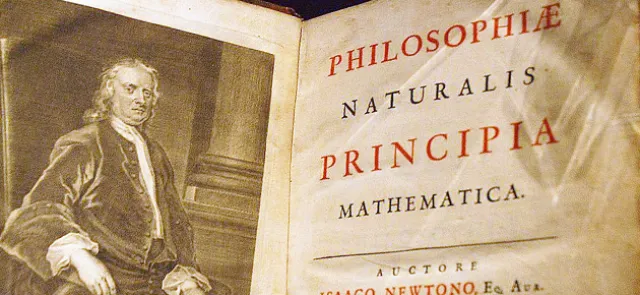
More than a translation of Newton | Tangente
Émilie du Châtelet is famous for having translated Isaac Newton's scientific work into French. Yet she did not simply reproduce the Latin text identically in French; she undertook an original rewriting of the proofs and concepts of Newtonian physics.
 Podcast
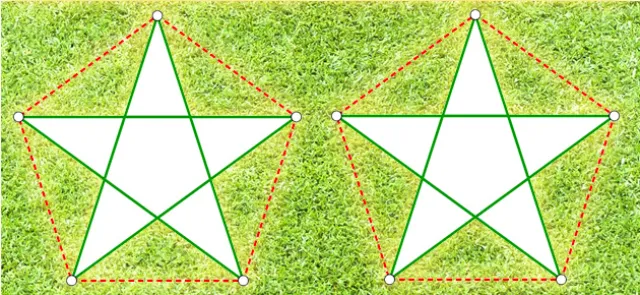
Order according to Ramsey
Ramsey theory is another field in which Erdős played a crucial role without being its originator. His use of the probabilistic method was essential to this theory, whose aim is to find the size of a set that guarantees the existence of a substructure possessing a given property.
 Podcast
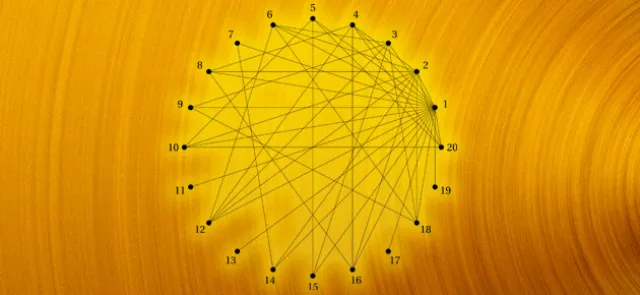
Walks in the divisor graph — Erdős and Saias | Tangente
Among Paul Erdős's interests, two fields stand out more often than others: number theory and graph theory. It is therefore no surprise that he eventually became interested in the divisor graph, a mathematical object that lies precisely at the crossroads of these two subjects.